
Who Controls Community Property During a California Marriage?
California is a community property state, which means most income and property acquired during marriage belongs equally to both spouses. But equal ownership raises an obvious practical question: who gets to actually manage, sell, or spend it day to day? The answer isn’t “both spouses must agree on everything” — that would make ordinary life impossible. It’s also not “whoever’s name is on the account” — that would gut the whole point of community property.
California splits the difference with a statutory scheme in Family Code §§ 1100–1101 that gives each spouse broad, equal management power for everyday matters, layered with specific consent or notice requirements for the transactions that matter most.
The General Rule: Equal Management Power
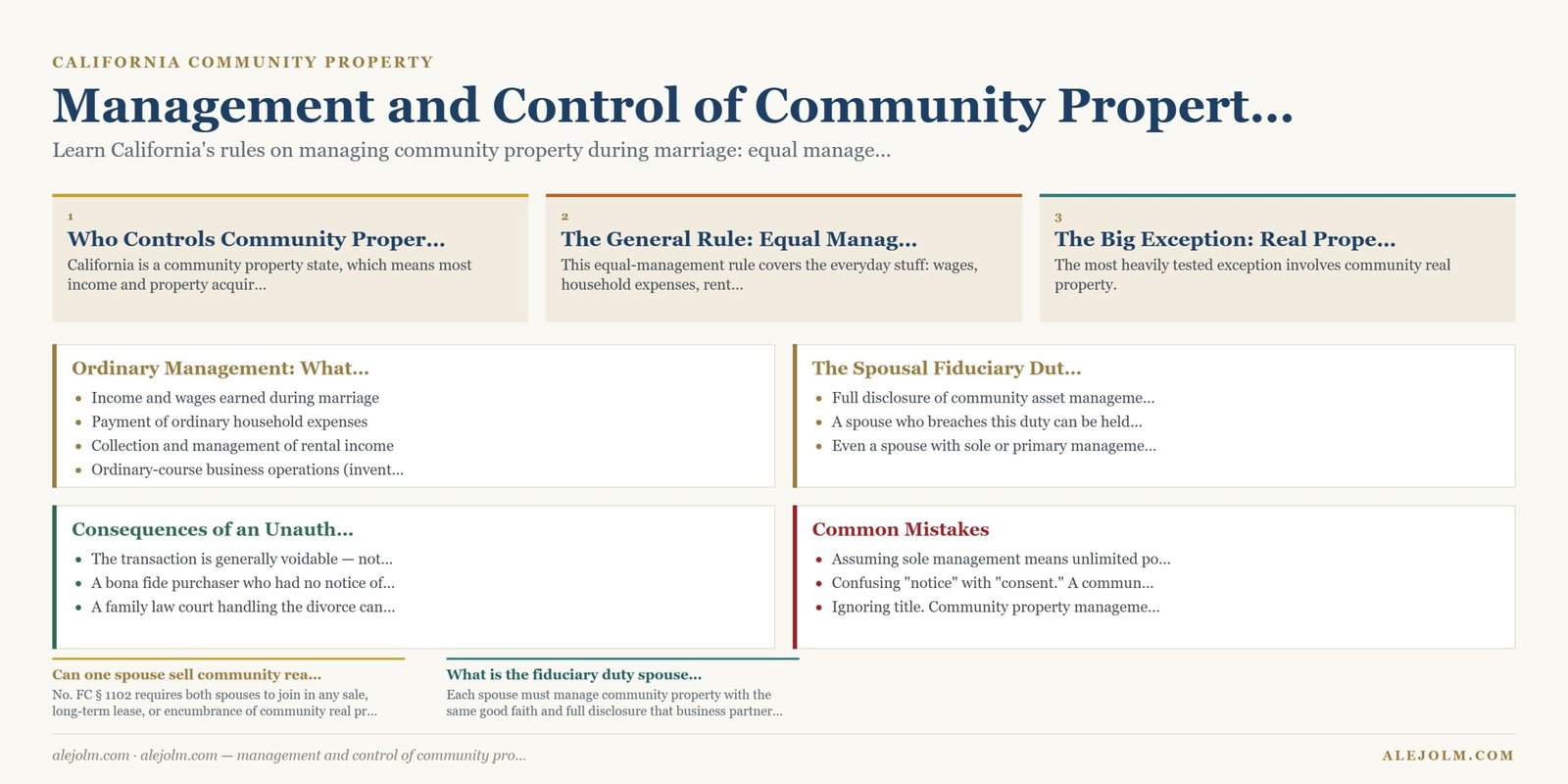
Under California Family Code §§ 1100–1101, each spouse has equal power to manage and control community property, and either spouse may act alone for ordinary management decisions — subject to specific statutory exceptions requiring the other spouse’s consent or notice for major transactions.
This equal-management rule covers the everyday stuff: wages, household expenses, rental income collection, and ordinary business operations. A spouse doesn’t need permission to deposit a paycheck or pay the electric bill.
The Big Exception: Real Property Requires Both Spouses
The most heavily tested exception involves community real property. Under FC § 1102, the sale, lease of more than one year, or encumbrance of community real property requires both spouses to join in the transaction — regardless of whose name is on title.
This joinder requirement exists precisely because real estate is often a family’s largest asset, and California doesn’t want one spouse unilaterally selling the house out from under the other.
Statutory Exceptions to Equal Management
| Transaction | Requirement | Statute |
|---|---|---|
| Sale, lease (>1 year), or encumbrance of community real property | Joinder of BOTH spouses | FC § 1102 |
| Gift of community personal property to a third party | Other spouse’s WRITTEN consent | FC § 1100(b) |
| Sale/encumbrance of household furnishings or the other spouse’s/minor children’s clothing | WRITTEN consent; can be set aside anytime | FC § 1100(c) |
| Sale/lease/encumbrance of all or substantially all of a community business’s personal property | Prior WRITTEN notice (not consent) to the other spouse | FC § 1100(d) |
Notice the pattern: real property needs joinder, gifts and household items need written consent, and a community business needs only notice — because efficient business management requires letting the operating spouse act quickly.
Ordinary Management: What a Single Spouse Can Handle Alone
Most day-to-day community property management doesn’t require the other spouse’s involvement at all:
- Income and wages earned during marriage
- Payment of ordinary household expenses
- Collection and management of rental income
- Ordinary-course business operations (inventory purchases, routine sales, hiring staff)
This baseline matters on the bar exam because students sometimes over-apply the consent rules to routine transactions that don’t need them.
The Spousal Fiduciary Duty Under FC § 1101
California layers a distinctly strong protection on top of the management rules: FC § 1101 imposes a fiduciary duty on each spouse toward the other in managing community property — similar to the duty business partners owe each other. This means:
- Full disclosure of community asset management is required.
- A spouse who breaches this duty can be held to an accounting.
- Even a spouse with sole or primary management authority over an asset (like an operating business) cannot abuse that power.
Worked Example: The Restaurant
Husband and Wife jointly own a restaurant as community property. Husband handles daily operations — ordering supplies, paying staff, managing the schedule. This is ordinary business management, so Husband can act alone without Wife’s consent.
Now suppose Husband decides to sell the restaurant’s entire kitchen equipment inventory to a friend at well below market value, using the proceeds for himself. This is no longer ordinary management — it implicates both the FC § 1100(d) notice requirement (if the sale covers substantially all business personalty) and the FC § 1101 fiduciary duty, since Husband appears to be self-dealing at the community’s expense. Wife may have a claim for breach of fiduciary duty or seek to set aside the transaction.
Worked Example: The Unauthorized Real Property Sale
Husband and Wife own a rental house as community property, worth $400,000 on the market. Without Wife’s knowledge or consent, Husband sells it to Buyer for $300,000 and pockets the proceeds.
Analysis: Community real property sales require both spouses’ consent under FC § 1102. Husband’s unilateral sale is unauthorized. Wife may sue to set the sale aside if she acts promptly — unless Buyer qualifies as a bona fide purchaser without notice of Wife’s community interest, in which case Buyer may be protected and Wife’s remedy shifts to Husband personally.
Consequences of an Unauthorized Disposition
- The transaction is generally voidable — not automatically void — meaning the non-consenting spouse must act to set it aside.
- A bona fide purchaser who had no notice of the spousal interest may still take good title.
- A family law court handling the divorce can set aside unauthorized transactions and order reimbursement or an accounting.
Common Mistakes
- Assuming sole management means unlimited power. Even a spouse with primary or sole management authority over an asset owes a fiduciary duty and cannot self-deal.
- Confusing “notice” with “consent.” A community business only requires written notice for major dispositions (FC § 1100(d)); it does not require the other spouse’s consent, unlike real property or gifts.
- Ignoring title. Community property management rights exist regardless of whose name appears on the account or deed.
FAQ
Can one spouse sell community real property without the other’s consent in California?
No. FC § 1102 requires both spouses to join in any sale, long-term lease, or encumbrance of community real property, regardless of how title is held.
What is the fiduciary duty spouses owe each other under FC § 1101?
Each spouse must manage community property with the same good faith and full disclosure that business partners owe one another, and can be held to an accounting for breaches.
Does a spouse need the other’s permission to manage their own paycheck?
No. Ordinary management of income, household expenses, and routine business operations can be handled by a single spouse without the other’s consent.
Key Takeaways
- Each spouse has equal power to manage community property, with a single spouse able to act alone for ordinary matters.
- Community real property sales, long-term leases, and encumbrances require both spouses to join under FC § 1102.
- A community business’s operating spouse has primary management but must give written notice before disposing of substantially all business personalty.
- FC § 1101 imposes a fiduciary duty on each spouse in managing community assets, enforceable through an accounting or set-aside remedy.
- Unauthorized transactions are generally voidable, subject to bona fide purchaser protections.
This article is educational and is not legal advice. Consult a licensed California attorney about your situation.
Related guides
- spousal consent for community property disposition
- household furnishings exception
- community property presumptions
- trustee duties