
Why Do Family Furnishings Get Special Protection in California?
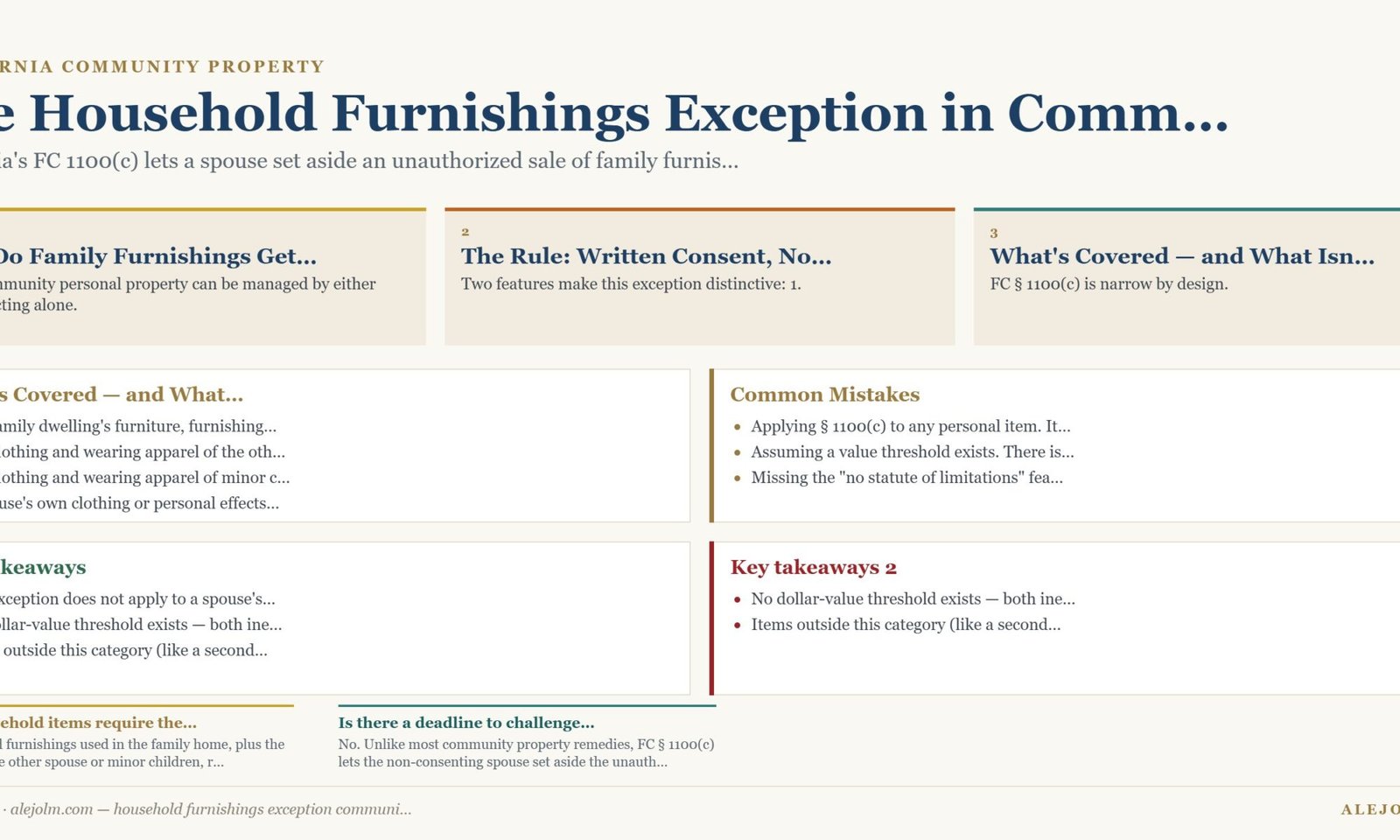
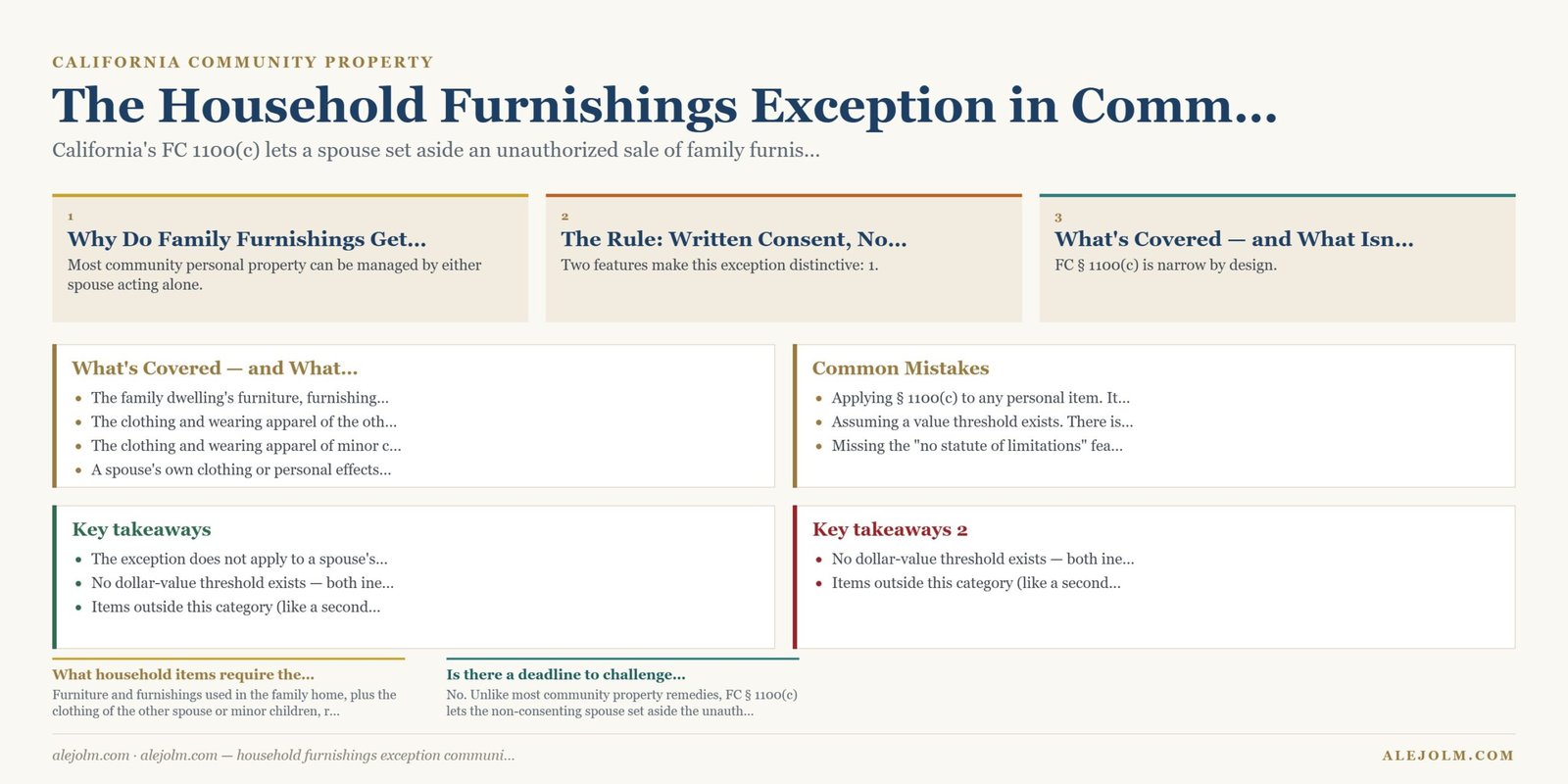
Most community personal property can be managed by either spouse acting alone. But California carves out one narrow, heavily protected category: the furniture and furnishings used in the family home, and the clothing of the other spouse or minor children. This exception is small in scope but big on remedy, which is exactly why it shows up on the bar exam more often than its size would suggest.
The Rule: Written Consent, No Deadline to Object
Under Family Code § 1100(c), neither spouse may sell, convey, or encumber community personal property used in the family home — furniture, furnishings, or the clothing of the other spouse or minor children — without the other spouse’s written consent, and an unauthorized transaction may be set aside by the non-consenting spouse at any time.
Two features make this exception distinctive:
- Written consent is mandatory before disposing of or encumbering these specific items.
- There is no statute of limitations on the remedy — the non-consenting spouse can set the transaction aside years later, unlike most other community property remedies.
What’s Covered — and What Isn’t
FC § 1100(c) is narrow by design. It covers:
- The family dwelling’s furniture, furnishings, and fittings.
- The clothing and wearing apparel of the other spouse.
- The clothing and wearing apparel of minor children.
It does not cover:
- A spouse’s own clothing or personal effects (a spouse can dispose of their own items freely).
- General community personal property outside the home, like a second car — that falls under the ordinary equal-management default of FC § 1100(a).
| Item | Covered by § 1100(c)? | Governing Rule |
|---|---|---|
| Living room sofa | Yes | Written consent required; set aside anytime |
| Minor child’s bedroom furniture | Yes | Written consent required; set aside anytime |
| Other spouse’s winter coat | Yes | Written consent required; set aside anytime |
| Selling spouse’s own jacket | No | Ordinary equal management (FC § 1100(a)) |
| Family’s second car | No | Ordinary equal management (FC § 1100(a)) |
No Dollar-Value Carve-Out
A common misconception is that this exception only applies to expensive items. It doesn’t. The statute isn’t limited by value: a costly heirloom dining set qualifies as “furniture” of the home just as much as an inexpensive lamp does. Conversely, an inexpensive item of the other spouse’s clothing is still covered — value has nothing to do with the analysis. What matters is the category (family-home furnishings, or the other spouse’s/children’s clothing), not the price tag.
Worked Example: The Gambling Debt Sale
Without Wife’s written consent, Husband sells the family’s living room furniture and their minor daughter’s bedroom set to a secondhand dealer to cover a gambling debt.
Analysis: These are community personal property items used in the family home and a minor child’s belongings — squarely within FC § 1100(c). Wife’s written consent was required and was never given. Wife may set the sale aside at any time, even years later, because no statute of limitations applies to this specific exception. Contrast this with the one-year period that can limit challenges to unauthorized real property conveyances under FC § 1102 — the absence of a deadline here is what makes § 1100(c) unusual.
Worked Example: The Second Car
Husband sells the family’s second car without asking Wife first.
Analysis: A car is not “household furnishings” in the FC § 1100(c) sense. This transaction falls under the general equal-management rule of FC § 1100(a) instead. Wife’s remedies, if any, are governed by ordinary community property principles — not the special “set aside at any time” rule reserved for family furnishings and the other spouse’s/children’s clothing.
Why the Bar Exam Loves This Fact Pattern
Examiners like this exception because it rewards precise issue-spotting: recognizing (1) that the item falls specifically within the family-furnishings/clothing category, and (2) that the remedy has no time limit — the feature most students forget. A fact pattern involving a sold couch, a pawned wedding-family heirloom, or discarded children’s clothing is a strong signal to reach for § 1100(c) specifically, rather than the general consent or joinder rules.
Common Mistakes
- Applying § 1100(c) to any personal item. It’s limited to family-home furnishings and the other spouse’s/children’s clothing — a spouse’s own belongings and unrelated personal property fall outside it.
- Assuming a value threshold exists. There is none; both expensive and inexpensive covered items require written consent.
- Missing the “no statute of limitations” feature. This is the detail examiners test most — don’t assume ordinary time limits apply.
FAQ
What household items require the other spouse’s written consent to sell in California?
Furniture and furnishings used in the family home, plus the clothing of the other spouse or minor children, require written consent before sale, transfer, or encumbrance under FC § 1100(c).
Is there a deadline to challenge an unauthorized sale of family furniture?
No. Unlike most community property remedies, FC § 1100(c) lets the non-consenting spouse set aside the unauthorized transaction at any time, with no statute of limitations.
Does FC § 1100(c) apply to a spouse’s own clothing?
No. The written-consent requirement runs only to the other spouse’s clothing and minor children’s clothing, not to a spouse’s own personal items.
Key Takeaways
- FC § 1100(c) requires written consent before selling or encumbering family-home furnishings or the other spouse’s/minor children’s clothing.
- Unlike most community property remedies, there is no statute of limitations on setting aside a violation.
- The exception does not apply to a spouse’s own clothing or to general community personal property outside this narrow category.
- No dollar-value threshold exists — both inexpensive and valuable covered items require consent.
- Items outside this category (like a second car) fall under the ordinary equal-management default of FC § 1100(a).
This article is educational and is not legal advice. Consult a licensed California attorney about your situation.
Related guides
- management and control of community property
- spousal consent for community property disposition
- managing a community property business under FC 1100(d)