
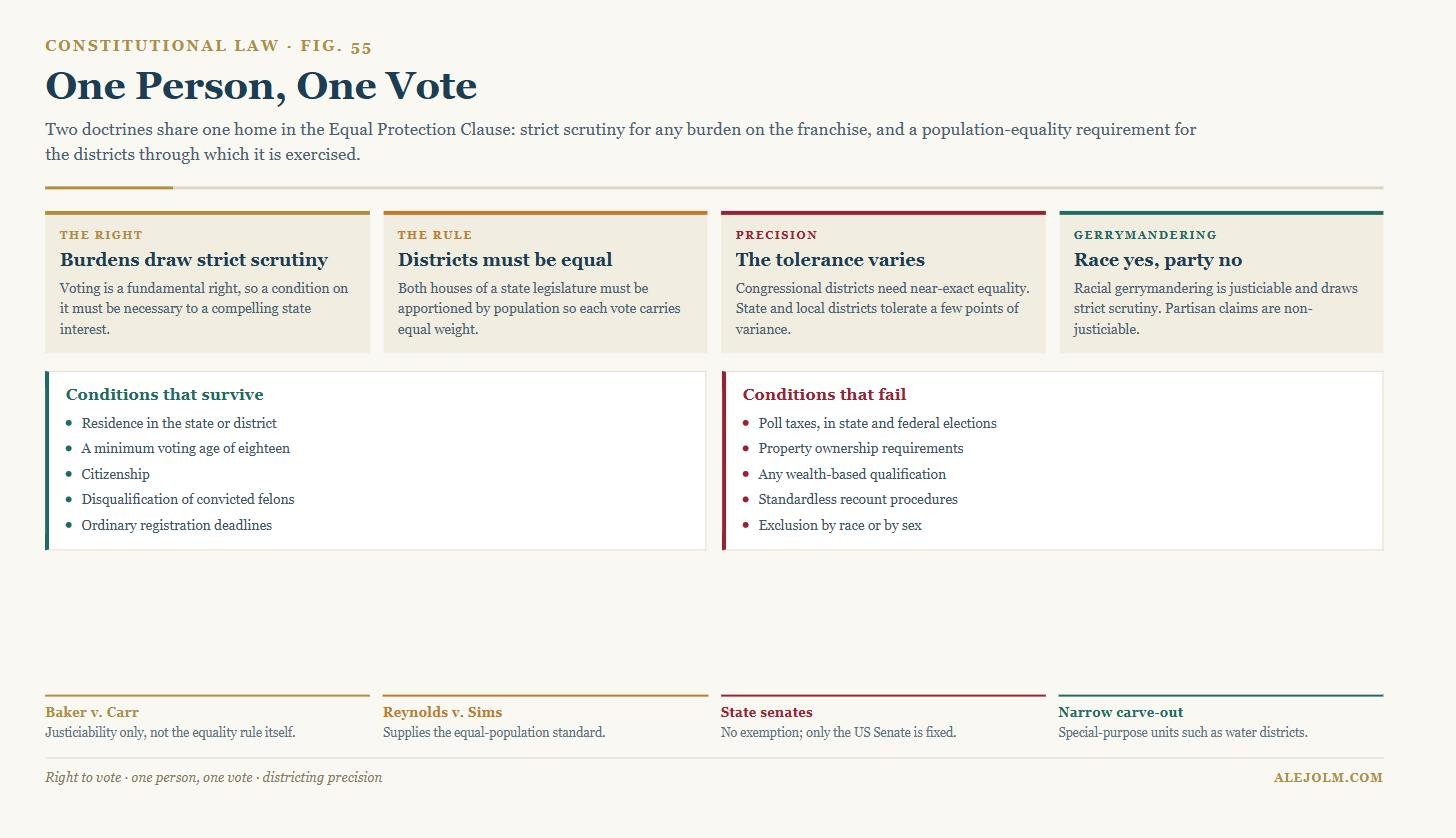
Two related doctrines sit together in the Equal Protection Clause. The first treats voting as a fundamental right, so that any condition placed on the franchise is reviewed under strict scrutiny. The second, one person one vote, governs the districts through which the franchise is exercised, requiring that populations be drawn close enough to equal that no one’s ballot is worth more than anyone else’s.
They are usually tested together, and the traps are specific: the wrong case cited for the equality rule, the wrong tolerance applied to the wrong kind of district, and the assumption that a state upper chamber enjoys the same exemption as the United States Senate.
Voting as a fundamental right
The franchise is not enumerated as such, but it is treated as fundamental through the equal-protection fundamental-rights branch. The practical effect is that a state defending a restriction must show the condition is necessary to a compelling interest, which is a burden most restrictions cannot carry.
Wealth-based conditions fail first. A poll tax is unconstitutional in state elections under equal protection and in federal elections by express constitutional amendment, and a substitute burden designed to achieve the same effect fares no better. Property-ownership qualifications fall for the same reason: the state cannot explain why owning land is necessary to responsible participation, and the requirement looks like a device for suppressing turnout rather than a means to any legitimate end.
Some conditions do survive, and they are worth listing precisely because the doctrine sounds more absolute than it is. A state may require residence, may set eighteen as the minimum age, may require citizenship, and may disqualify people convicted of serious crimes, in many states permanently. Ordinary registration machinery is likewise unobjectionable. These are conditions on who belongs to the electorate rather than devices for filtering it by wealth or race.
Baker and Reynolds are not the same case
This is the most commonly mishandled point in the area. The 1962 decision holding malapportionment claims justiciable did exactly that and no more: it removed the political-question barrier and opened the courthouse door. It announced no standard for how equal districts must be.
The substantive rule arrived two years later, holding that seats in both houses of a state legislature must be apportioned on a population basis so that each citizen’s vote carries substantially equal weight. Cite the first case for justiciability and the second for the equality requirement, and keep the two functions separate in your answer.
Exam tip: Baker opened the door; Reynolds furnished the rule. An answer that cites only the 1962 case for the equal-population standard has made the single most recognisable error in this topic.
How precise must the districts be?
There is no single tolerance. The required precision depends on what is being apportioned, and the differences are large enough that applying one standard across the board will produce wrong answers.
| What is being drawn | Required precision |
|---|---|
| Congressional districts within a state | Almost exact mathematical equality |
| House seats apportioned among the states | Substantial equality, with deference |
| State legislative districts | Substantial equality |
| Local government districts | Substantial equality |
| Special-purpose units such as water districts | Exempt in narrow circumstances |
Two carve-outs deserve mention. Special-purpose government units that deliver a narrow service to a defined subset of the population may restrict voting to those specially affected; the recognised example is water-storage districting, and the exception should not be stretched to general-purpose local government. At-large elections are also permissible on their face, and are vulnerable only where they were adopted for a discriminatory purpose — which returns the analysis to the intent inquiry rather than to the numbers.
One trap is worth stating flatly. State senates must comply with the equality requirement. The two-senators-per-state composition of the United States Senate is fixed by the constitutional text itself and is therefore immune, but no equivalent provision protects a state upper chamber, and analogising from the federal design is a mistake.
Gerrymandering: the justiciability divide
Where race predominates in the drawing of a district, the map is a racial classification and receives strict scrutiny, which it will rarely survive. Where partisan advantage is the motive, the claim is non-justiciable: the Court concluded there is no manageable standard for deciding how much partisanship is too much, so federal courts will not adjudicate the question at all.
The consequence for an answer is procedural rather than substantive. On facts suggesting partisan motive, do not reach the merits; identify the claim as a political question and stop. On facts suggesting race was the predominant factor, proceed to strict scrutiny. Statutory voting-rights protections operate alongside these constitutional rules and can reach conduct the Constitution does not, but they are a separate track.
Worked example
After a census, State L redraws two legislative districts. District A ends up with 200,000 voters and District B with 160,000, each electing one representative. A voter in District A sues.
Begin with the standard. These are state legislative districts, so substantial equality governs rather than the near-exact requirement applied to congressional maps. Then quantify: the gap between 200,000 and 160,000 is 40,000, a deviation of twenty-five per cent measured against the smaller district. Tolerances in this context run to a few percentage points, conventionally under ten, so a twenty-five per cent disparity is far outside the permissible range. The effect is that a ballot cast in District B carries materially more weight, since fewer voters elect the same single representative. Absent some legitimate districting justification of a kind that has never been held to excuse a deviation of this size, the map fails and must be redrawn.
Change one fact. Suppose the same twenty-five per cent disparity existed between two water-storage districts whose only function is allocating irrigation supply to landowners within them. The special-purpose exception is now in play, the body does not exercise general governmental power, and the equality requirement may not apply at all.
Common mistakes that cost points
- Citing Baker v. Carr for the equal-population rule when it decided only justiciability.
- Applying the near-exact congressional standard to state or local districts, or the looser standard to congressional maps.
- Assuming a state senate is exempt by analogy to the United States Senate.
- Treating partisan gerrymandering as reviewable; it is a non-justiciable political question.
- Treating racial gerrymandering as unreviewable; it is justiciable and draws strict scrutiny.
- Stretching the special-purpose district exception beyond narrow single-function bodies.
- Forgetting the textual amendments on race, sex and age, which operate as floors no statute can undercut.
- Assuming every burden on voting is fatal; residence, age, citizenship and felony disqualification all survive.
Frequently asked questions
Are felon disenfranchisement laws constitutional?
Generally yes. Many states may deny the vote to people convicted of serious offences, in some cases permanently, and such laws have been sustained despite the fundamental status of the franchise. They remain vulnerable if enacted with racially discriminatory purpose, which returns the analysis to the intent inquiry.
What variance in district population is acceptable?
It depends on the body. Congressional districts within a state require almost exact equality, so even minor deviations need justification. State and local districts are held to substantial equality, with a few percentage points generally tolerated and larger deviations requiring a legitimate districting rationale.
Why can courts review racial but not partisan gerrymandering?
Because race is a suspect classification with an established framework for review, whereas the Court found no judicially manageable standard for measuring permissible partisanship. The distinction is about the availability of a workable test rather than about the seriousness of the conduct.
One person, one vote and the Los Angeles County Board, 2026
No jurisdiction illustrates the stakes of this principle better than Los Angeles County. A county of roughly ten million residents has been governed by a five-member Board of Supervisors, which means each supervisor represents about two million people, larger than the population of many states and by a wide margin the biggest local legislative constituencies in the country.
That structure has been litigated. In Garza v. County of Los Angeles the Ninth Circuit upheld findings that the county had drawn supervisorial boundaries in a way that diluted Latino voting strength, and the districts were redrawn as a result. The case remains a standard reference on intentional dilution and on the use of total population as the apportionment base, an approach the Supreme Court later confirmed as permissible in Evenwel v. Abbott (2016). County voters have since approved charter reform expanding the Board and restructuring county governance on a phased timetable, so the institutional picture in 2026 is one of transition; confirm the current implementation schedule with the County of Los Angeles directly.
The doctrine as applied here:
- Congressional districts demand near equality. Even small deviations require justification, and California’s maps are drawn by an independent commission.
- State and local districts get a ten per cent band. Deviations below that are presumptively acceptable, above it the burden shifts to the jurisdiction.
- Equal population does not cure dilution. A perfectly apportioned map can still violate the Fourteenth Amendment or voting rights legislation.
- Total population is the standard base. California apportions on total population, not eligible voters.
- Special purpose districts may deviate. Water and similar districts with limited functions have been allowed landowner-weighted voting.
- The state statute is the sharper tool. California’s own voting rights legislation has ended at-large elections in numerous county cities without requiring federal-style proof.
In 2026, ask first whether the claim is about population equality or about dilution, since they use different tests. Read with the franchise amendments, Section 5 enforcement power and the political question doctrine.
Next steps
The fundamental-rights branch used here is part of a larger structure, so read equal protection for the three-step method and the levels of scrutiny for how strict scrutiny actually operates. Because the partisan-gerrymandering holding is a justiciability ruling rather than a merits ruling, the political question doctrine is essential background, and substantive due process covers the overlapping route to protecting unenumerated rights.
The leading opinions are collected at Justia, the Fourteenth Amendment is annotated by the Cornell Legal Information Institute, and current examination scope is published by the State Bar of California.
Related guides
 Freedom of the Press: Publication Liability and Limits
 Miranda Rights: Custody, Interrogation and Invocation
 Second Amendment: The Bruen Text-and-History Standard
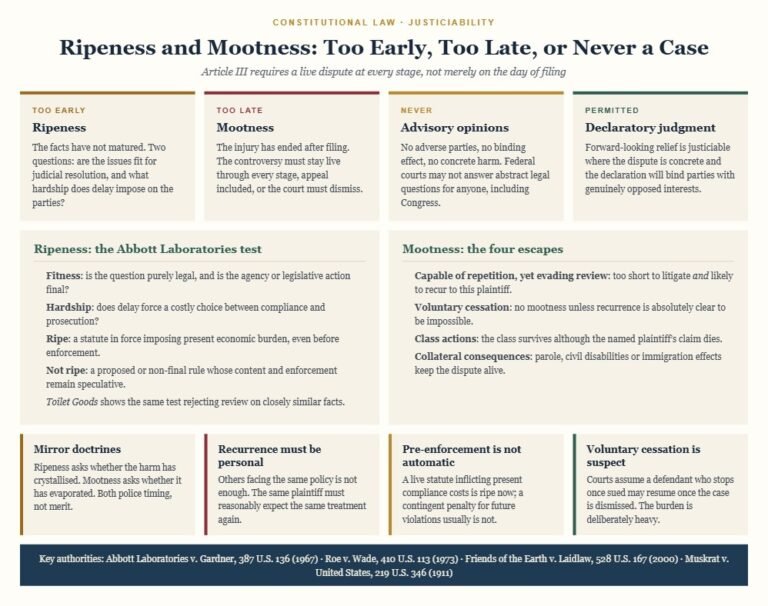 Ripeness and Mootness: Timing Rules in Federal Court
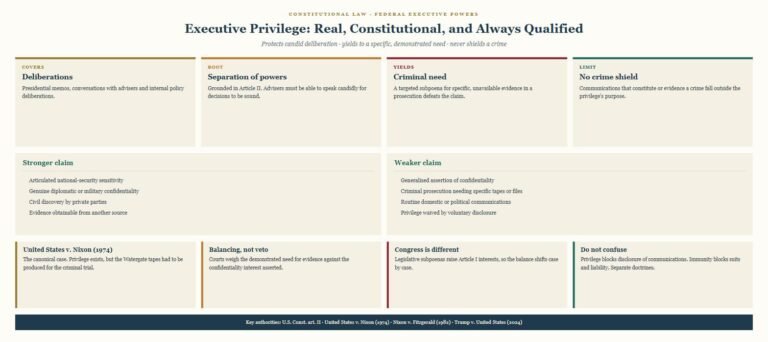 Executive Privilege: A Qualified Right That Must Yield
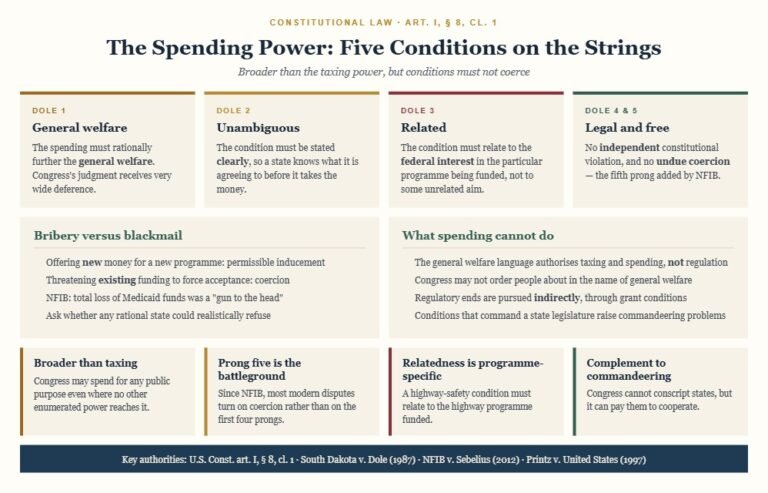 The Spending Power and the Five Dole Test Conditions
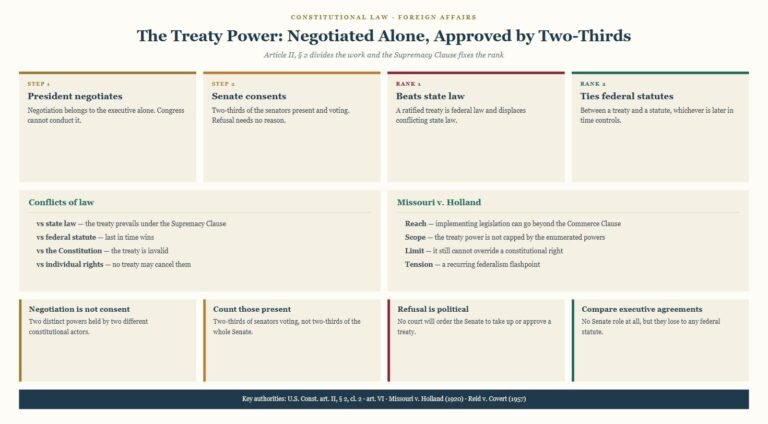 The Treaty Power: Senate Advice and Consent Explained
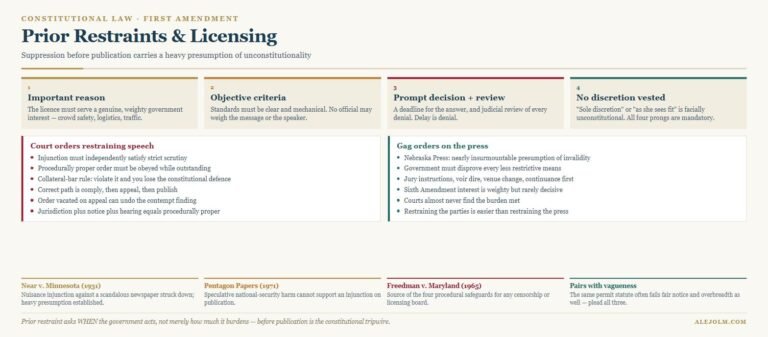 Prior Restraint and Licensing: The Freedman Safeguards
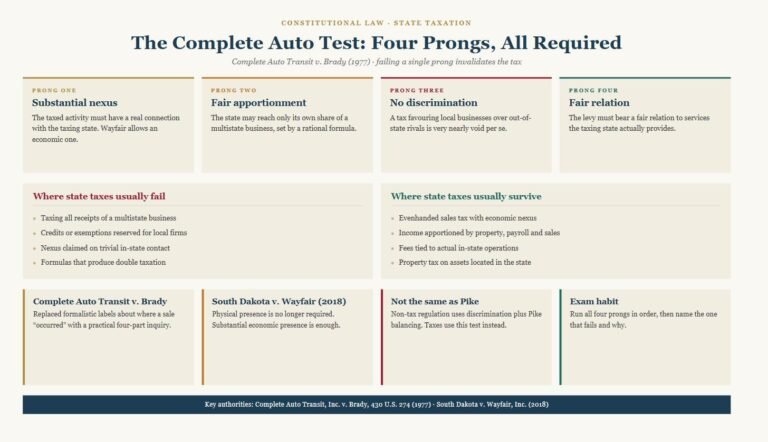 The Complete Auto Test: Taxing Interstate Commerce
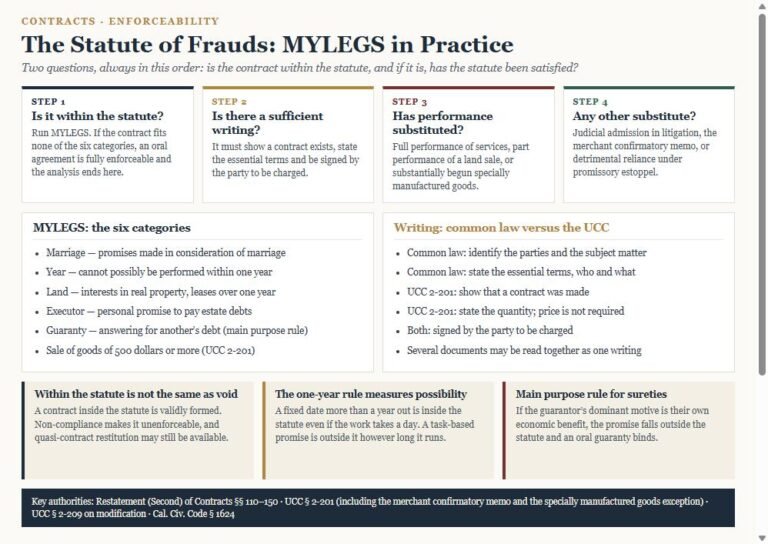 The Statute of Frauds: MYLEGS and How to Satisfy It
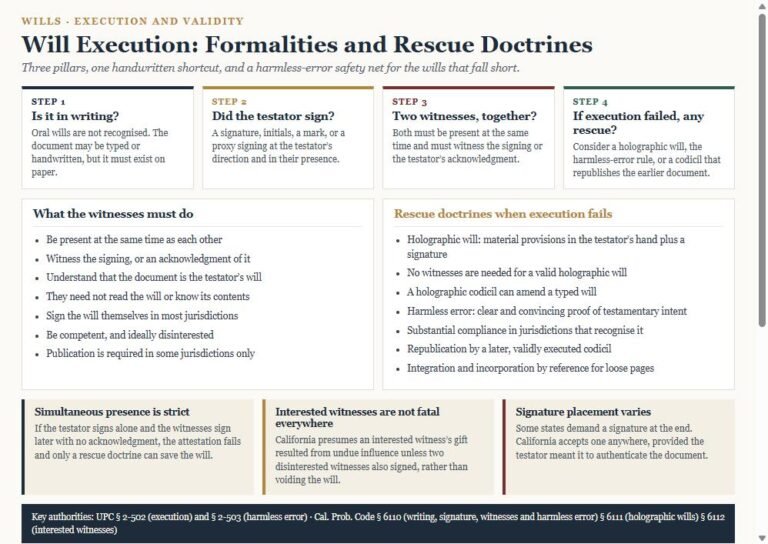 Will Execution Requirements: Formalities and Rescue
 The Supremacy Clause: Floors, Ceilings and Preemption