
The abstention doctrine is the rule that lets a federal court which unquestionably has jurisdiction decline to exercise it, temporarily or permanently, out of respect for state courts and state interests. It is one of the few doctrines where the correct answer is that the court can hear the case but should not.
This guide explains the four branches of abstention, the fact pattern that triggers each one, the relief that follows, and the exceptions that pull a case back into federal court. It also shows why abstention is a question of sequencing rather than power, which is exactly where most candidates go wrong.
What abstention actually decides
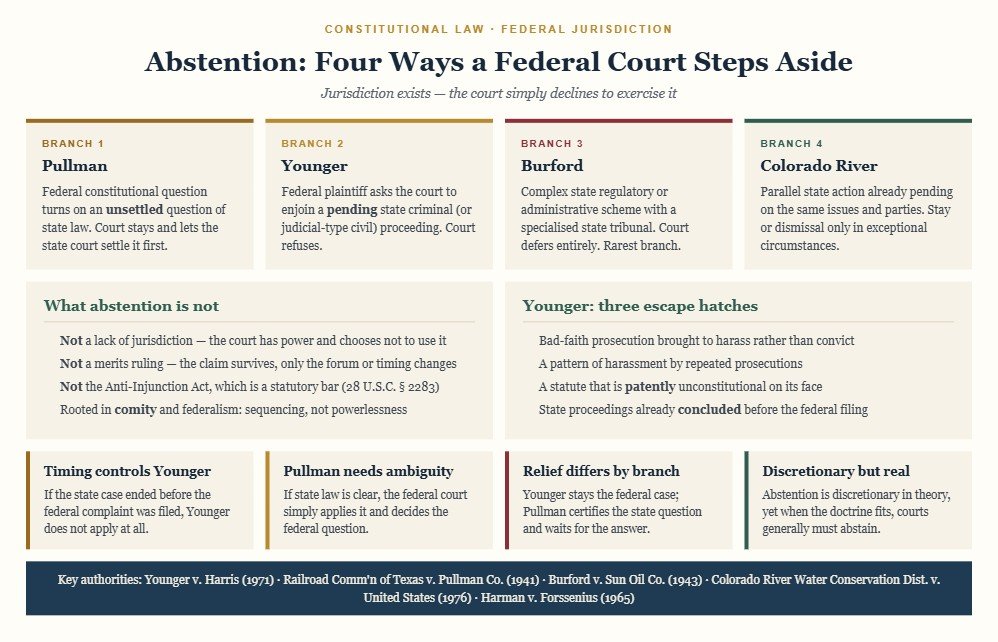
Abstention answers a narrow question: given that this federal court has subject-matter jurisdiction, should it use it now? Because jurisdiction is present, a dismissal for want of jurisdiction is not abstention, and abstention is never a ruling on the merits. The doctrine rests on comity, the mutual respect between two court systems operating in the same territory.
That framing matters for scoring. An answer that says the federal court “lacks jurisdiction” over a pending state prosecution has already lost the point. The federal court has jurisdiction; it withholds its exercise so the state process can run first.
Exam tip: if the facts describe a plaintiff asking a federal judge to stop an ongoing state criminal case, Younger abstention is almost certainly the issue, however strong the constitutional claim looks.
Pullman abstention: unsettled state law first
Pullman applies when the federal constitutional question depends on an unsettled question of state law. The state-law issue must be logically prior to the federal one, so that a narrowing state construction could make the constitutional ruling unnecessary. The federal court stays its hand, certifies the question to the state’s highest court or waits for state application, and then decides only what remains.
The ambiguity requirement
If state law is settled, Pullman is unavailable even though the federal question still depends on it. The court simply applies the settled state rule and resolves the constitutional issue. Harman v. Forssenius illustrates the limit: the statute was unambiguous and a fundamental voting right demanded a prompt answer, so abstention was refused.
Younger abstention: hands off pending state proceedings
Younger v. Harris bars federal courts from enjoining pending state criminal prosecutions. The rule has been extended to pending state civil and administrative proceedings that are judicial in nature where an important state interest is at stake. A proceeding is pending if it began before the federal court reached the merits.
Why Younger is not a dead end
The federal claim is not lost. The defendant raises the constitutional argument as a defence in the state court. If the state court rejects it, review can follow by appeal or, in custody cases, by petition for the writ of habeas corpus. Younger controls the order of decision, not the availability of federal review.
The three extraordinary circumstances
- Bad-faith prosecution, brought to harass rather than to obtain a conviction.
- A pattern of harassment through repeated or duplicative charges.
- A statute that is patently and flagrantly unconstitutional in every clause.
- A fourth, structural point: if the state case had already concluded when the federal suit was filed, Younger simply does not apply.
Burford and Colorado River: the narrow branches
Burford abstention protects complex state regulatory or administrative schemes committed to a specialised state tribunal, typically oil and gas or utility regulation. It is the rarest branch and asks the federal court to defer entirely rather than merely to wait.
Colorado River addresses parallel litigation: an existing state action between the same parties on the same issues. The default rule is that parallel proceedings may run side by side, so a stay or dismissal requires genuinely exceptional circumstances such as a res that only one court can control.
| Branch | Trigger | What the federal court does |
|---|---|---|
| Pullman | Unsettled state-law question underlies a federal constitutional claim | Stays the case and sends the state question to state court |
| Younger | Pending state criminal or judicial-type civil proceeding | Refuses the injunction and stays or dismisses the federal case |
| Burford | Complex state administrative scheme with a specialised tribunal | Defers entirely to the state system |
| Colorado River | Parallel state action, same parties and issues | Stays or dismisses only in exceptional circumstances |
Worked example: one statute, two answers
A state bans “unreasonable” emissions without defining the term. Before applying for a permit, a plant owner sues in federal court claiming the statute is unconstitutionally vague. The federal due process question depends on how the state will construe “unreasonable”, and that construction is unsettled. Pullman abstention fits: the court stays the case, the state clarifies the standard, and the vagueness claim may evaporate.
Change one fact. The state now prosecutes the same owner under the same statute, and he asks the federal court to enjoin the prosecution. The proceeding is pending and no bad faith is alleged, so Younger applies. The vagueness defence belongs in the state criminal case, with federal review to follow if he loses.
Change the timing instead. The state prosecution ended before the federal complaint was filed. The comity concern has expired, and the federal court hears the case on the merits. Nothing about the constitutional claim changed; only the sequence did.
Common mistakes that cost points
- Calling abstention a jurisdictional defect. The court has jurisdiction and declines to exercise it, which is a different holding with different consequences.
- Applying Younger to a threatened rather than a pending prosecution. Pre-enforcement challenges are exactly what federal courts are for.
- Using Pullman when state law is clear. Without genuine ambiguity there is nothing for the state court to settle.
- Confusing abstention with the Anti-Injunction Act. One is judge-made comity, the other a statutory bar on enjoining state proceedings.
- Treating Colorado River as routine. Parallel litigation is normally permitted; exceptional circumstances are required.
- Forgetting that Younger extends to some civil and administrative proceedings where an important state interest is involved.
- Assuming abstention destroys the federal claim. It relocates or postpones the claim rather than extinguishing it.
- Ignoring the remedy question. Marks come from saying what the court does next, not merely that it abstains.
Frequently asked questions
Does abstention mean the plaintiff loses?
No. Abstention decides forum and timing. The plaintiff litigates the constitutional issue in state court, and federal review may follow once the state proceedings conclude.
Which branch is tested most often?
Younger, because the fact pattern is easy to build: an ongoing state prosecution and a federal plaintiff seeking an injunction. Pullman appears second, usually flagged by an ambiguous state statute.
Can a federal court abstain on its own motion?
Yes. Abstention rests on comity and federalism rather than party rights, so a court may raise it even when no party asks.
Younger came from Los Angeles: abstention in 2026
The leading abstention case is a Los Angeles County prosecution. John Harris was charged under California’s criminal syndicalism statute and sought federal relief against Evelle Younger, then the District Attorney of Los Angeles County. In Younger v. Harris (1971) the Supreme Court held that a federal court should not enjoin a pending state criminal prosecution absent bad faith, harassment or extraordinary circumstances, grounding the rule in comity and respect for state processes.
The doctrine has since been confined. Sprint Communications v. Jacobs (2013) limited Younger to three categories: pending state criminal prosecutions, civil enforcement proceedings akin to criminal actions, and proceedings involving orders uniquely in aid of a state court’s judicial function. Outside those categories, a federal court must ordinarily hear the case even if parallel state litigation exists.
How abstention arises in Los Angeles County litigation:
- Criminal defendants cannot bypass state court. A person prosecuted by the Los Angeles County District Attorney must raise constitutional defences there rather than by federal injunction.
- Civil enforcement actions qualify. Nuisance abatement, licensing discipline and code enforcement brought by the county can trigger abstention.
- Ordinary civil suits do not. A parallel private action in the Los Angeles Superior Court does not justify declining federal jurisdiction under Younger.
- Pullman abstention needs genuine ambiguity. Where an unclear state provision might avoid the federal question, certification to the California Supreme Court is often quicker than abstention.
- Colorado River is exceptional. Deferring to parallel state proceedings requires more than mere duplication.
- Bad faith is the escape hatch. Repeated prosecutions brought without expectation of conviction can justify federal intervention, but the showing is demanding.
In 2026, classify the state proceeding before deciding whether the federal court may act. Read with Supreme Court jurisdiction, ripeness and mootness and the Eleventh Amendment.
Next steps
Abstention sits alongside the other limits on federal judicial power, so revise it with them. Compare it with the ripeness and mootness timing rules in Ripeness and Mootness: Timing Rules in Federal Court, with the injury requirement in Standing in Federal Court: The 3-Part Article III Test, and with the immunity bar explained in The Eleventh Amendment and State Sovereign Immunity.
For primary sources, read Younger v. Harris and Railroad Commission of Texas v. Pullman Co. at Justia, the overview of abstention and of comity at Cornell LII, and the subject scope published by the State Bar of California.
Related guides
 Ripeness and Mootness: Timing Rules in Federal Court
 The Statute of Frauds: MYLEGS and How to Satisfy It
 The Eleventh Amendment and State Sovereign Immunity
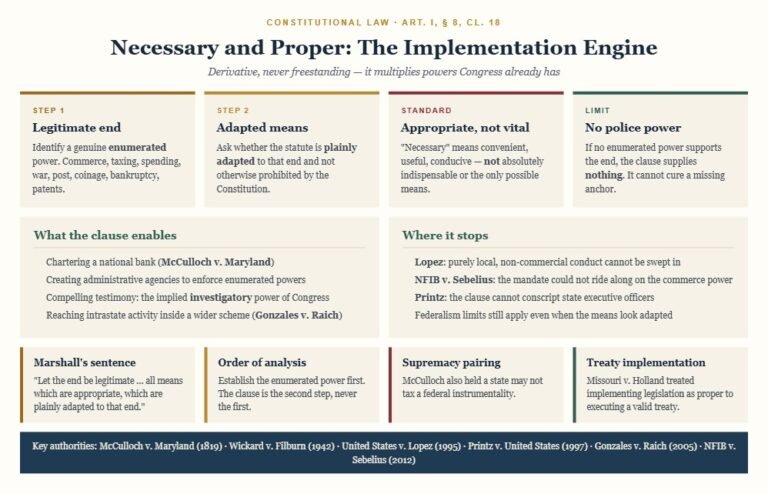 The Necessary and Proper Clause: Congress’s Multiplier
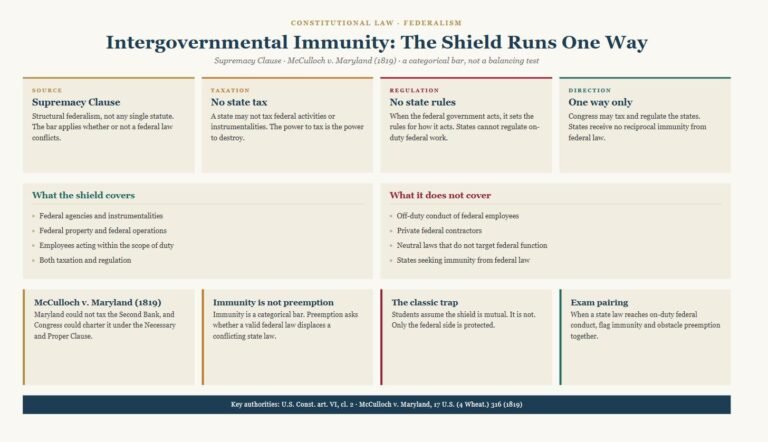 Intergovernmental Immunity: The Shield Runs One Way
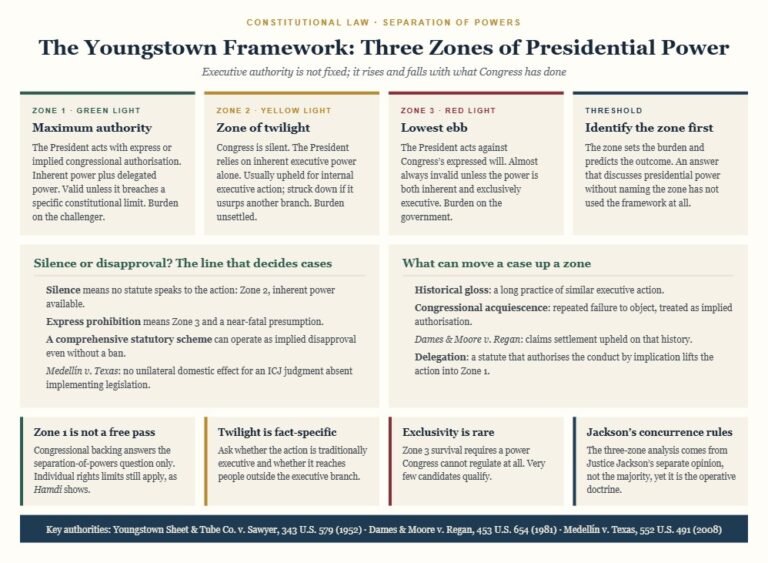 The Youngstown Framework: Presidential Power in 3 Zones
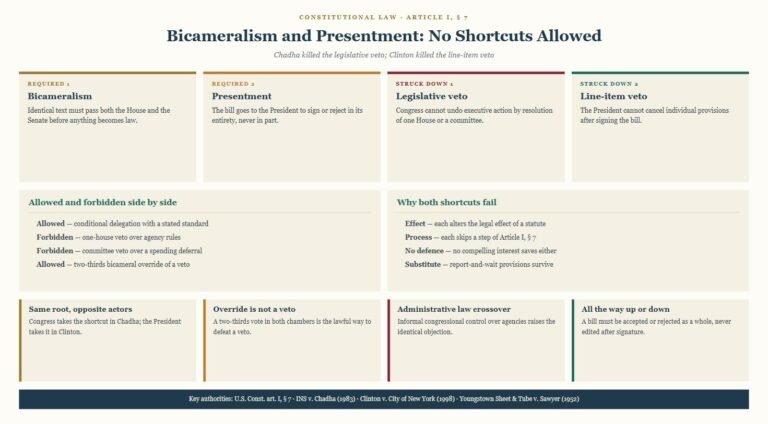 Bicameralism and Presentment: Two Vetoes Struck Down
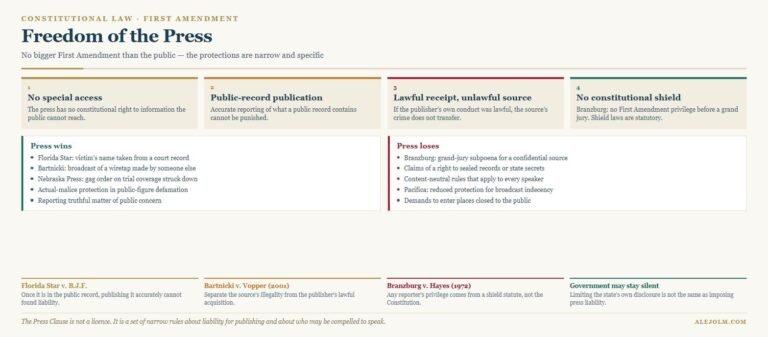 Freedom of the Press: Publication Liability and Limits
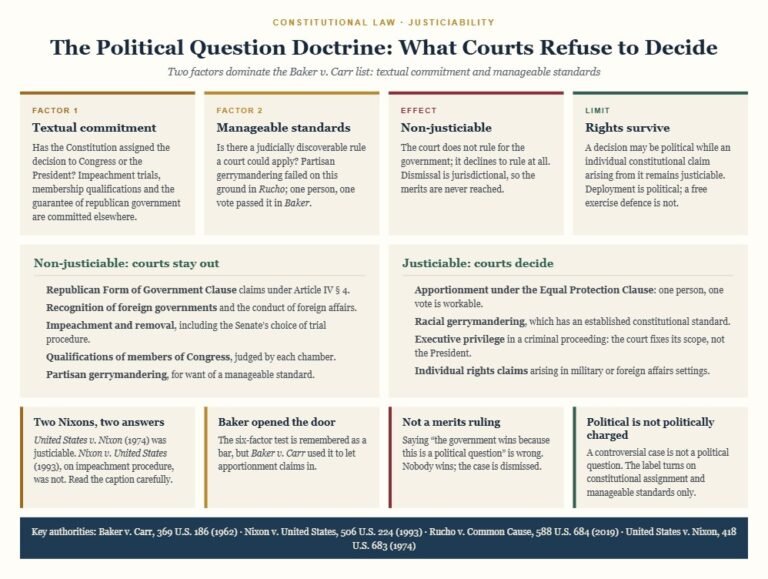 Political Question Doctrine: What Courts Will Not Decide
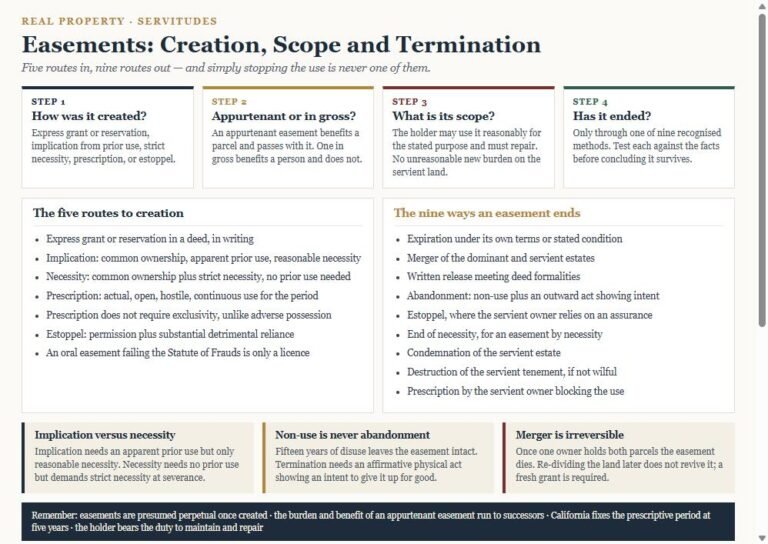 Easements Explained: Creation, Scope and Termination
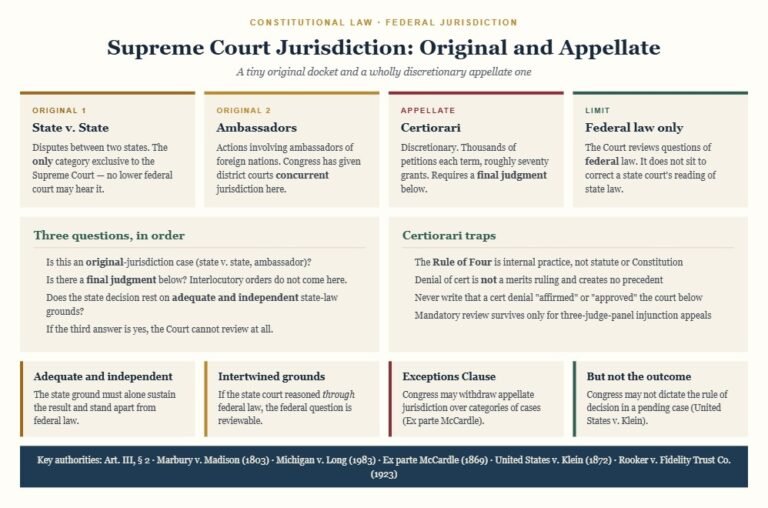 Supreme Court Jurisdiction: Original vs Appellate Power
 3 Levels of Scrutiny in Constitutional Law Explained