
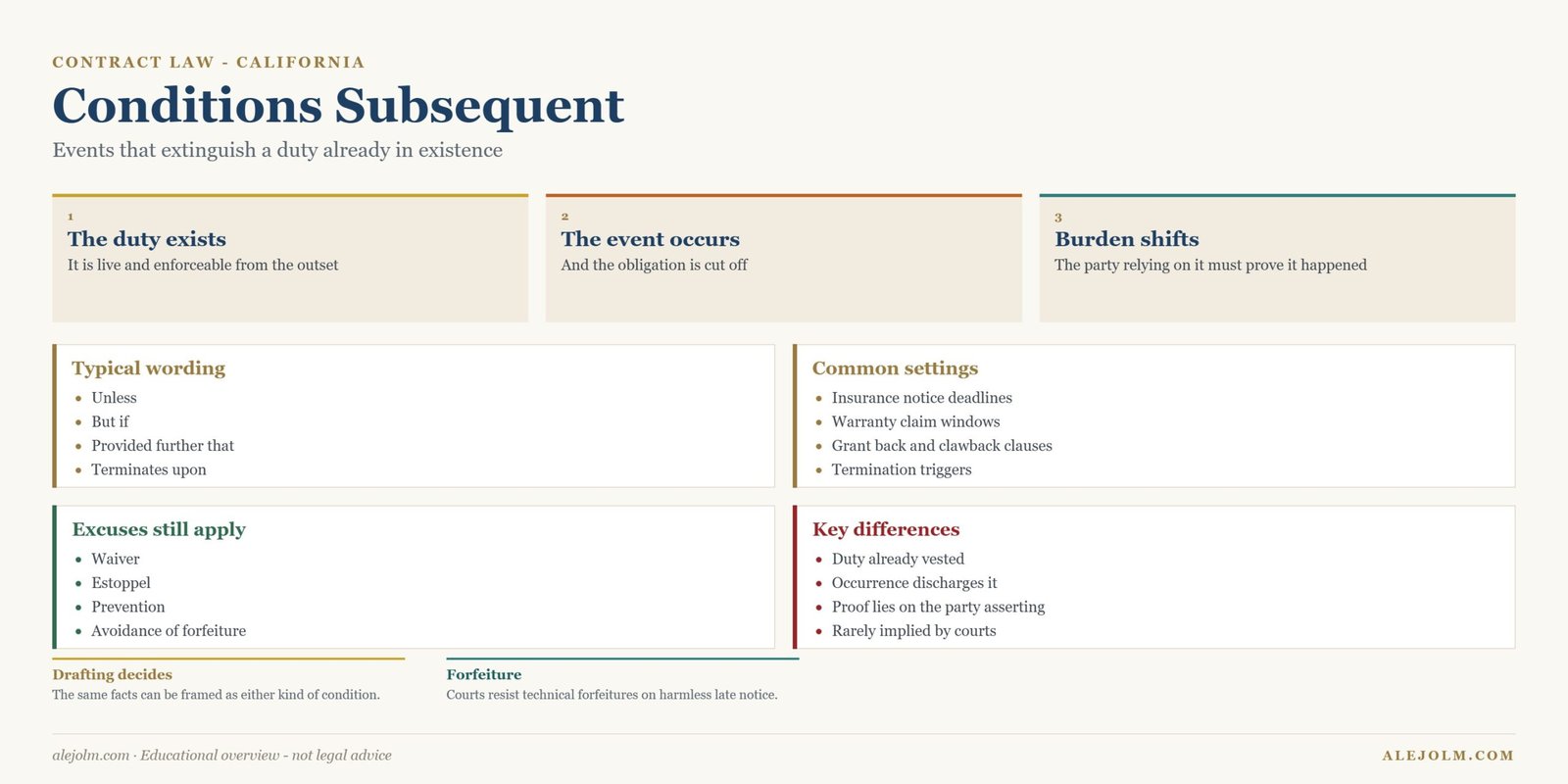
A condition subsequent is an event that, if it occurs, extinguishes an obligation that has already come into existence. California describes it in the Civil Code as a condition referring to a future event, on the happening of which the obligation becomes no longer binding upon the other party if that party chooses to avail itself of the condition.
The contrast with a condition precedent is precise. A condition precedent prevents a duty from ever arising. A condition subsequent kills a duty that was alive. The practical consequence is that the burden of proof moves: the party claiming to be released must show that the terminating event happened. This guide explains the wording, the settings in which it appears, and why courts resist harsh technical forfeitures.
How it works
Under a condition subsequent the obligation is enforceable from the outset. An insurer is liable for a covered loss the moment the loss occurs. A warranty obligation exists as soon as the goods are delivered. What the condition does is provide a mechanism by which that live obligation can be terminated, usually by the failure of the other party to do something within a stated period.
The burden of proof
Because the party asserting the condition is claiming a release from a duty it admits once existed, that party must prove the terminating event. This reverses the ordinary allocation, under which a claimant must establish the elements of its claim, and it is a meaningful practical advantage for the party seeking to enforce the original obligation.
Where conditions subsequent appear
- Insurance notice provisions. Cover ends unless a proof of loss is submitted within a stated period.
- Warranty claim windows. The obligation to repair lapses unless the defect is reported in time.
- Construction claim clauses. Entitlement to an extension terminates unless notice is served promptly.
- Employment benefit provisions. An entitlement ends upon a defined event such as departure before a vesting date.
- Grant back and clawback terms. A payment must be returned if a stated event occurs.
- Termination triggers. A licence or lease that ends automatically on a defined breach.
| Question | Condition precedent | Condition subsequent |
|---|---|---|
| Does the duty exist before the event | No | Yes |
| Effect of the event | Duty arises | Duty ends |
| Who proves it | The claimant | The party released |
| Typical wording | If, subject to | Unless, terminates upon |
| Frequency | Very common | Less common |
A worked example
A commercial property policy covering a warehouse in Commerce provides that the insurer obligation to pay a covered claim terminates unless proof of loss is submitted within ninety days. A fire occurs, and the insured submits proof on day ninety six after being hospitalised with injuries from the same fire. The insurer must prove the condition occurred, which it can, but the short and reasonably explained delay creates a strong argument that strict enforcement would work a disproportionate forfeiture.
Change the delay. Suppose the proof arrives eighteen months late with no explanation and after the insurer has lost the opportunity to investigate the scene. Now the condition operates as drafted, the prejudice to the insurer is real, and the obligation to pay is discharged.
Conditions subsequent in California and Los Angeles County in 2026
California insurance practice is where the doctrine matters most locally. Courts in Los Angeles County examine late notice provisions closely and frequently require the insurer to show that it was actually prejudiced by the delay before allowing a technical failure to defeat a claim. That approach reflects a broader reluctance to permit forfeiture where the breach caused no harm.
Construction claim notice provisions raise the same tension. Public and private contracts commonly require notice of a claim within days, and a contractor that misses the window may lose an otherwise good entitlement. The countervailing arguments are waiver, where the owner has continued to process the claim, and prevention, where the owner conduct caused the delay.
- Diary every notice deadline. The consequences of missing one are severe.
- Give notice early and in writing. A short protective notice preserves the position.
- Record any prejudice or lack of it. It is central to the forfeiture argument.
- Look for waiver. Continued processing of a claim can waive a notice condition.
- Draft clearly. Decide whether you want a precedent or a subsequent condition and say so.
- Include a cure period. It reduces the risk of a court refusing to enforce the clause.
For 2026, confirm the current California authority on notice conditions, prejudice and forfeiture directly with current authority, since these continue to develop.
Common mistakes to avoid
- Mislabelling the condition. The classification decides who bears the burden of proof.
- Assuming a technical breach ends the duty. Courts resist forfeiture where no harm was caused.
- Ignoring waiver. Continuing to deal with a claim can waive the condition.
- Overlooking prevention. A party that caused the delay cannot rely on it.
- Drafting ambiguously. Unless and provided that can be read either way in context.
- Forgetting that excuses apply. The same doctrines that excuse conditions precedent apply here.
Frequently asked questions
What is a condition subsequent?
An event which, if it occurs, discharges an obligation that already exists. The Civil Code describes it as making the obligation no longer binding if the other party chooses to rely on the condition.
Who has to prove that the event occurred?
The party relying on the condition to escape its duty. That is the reverse of the usual position and is one of the main practical consequences of the classification.
Does missing a notice deadline always end the claim?
Not necessarily. California courts frequently require the party relying on the clause to show that the delay caused actual prejudice before permitting a forfeiture.
Can a condition subsequent be waived?
Yes. Waiver, estoppel, prevention and avoidance of forfeiture all apply in the same way as they do to conditions precedent.
How do I tell the two kinds apart?
Ask whether the duty existed before the event. If it did, the condition is subsequent. If the duty only comes into being when the event happens, it is precedent.
Related guides
- Conditions precedent
- Material breach
- Substantial performance
- Good faith and fair dealing
- Limitation periods for sales of goods
- Remedies for breach of contract
- Rescission of a contract
- Contract formation in California
Next steps
If your contract terminates a right unless something is done in time, treat that deadline as the most important date in the file. Our guides to conditions precedent and material breach explain the neighbouring doctrines.
For primary sources, read California Civil Code section 1438 and the civil jury instructions published by the Judicial Council of California.