
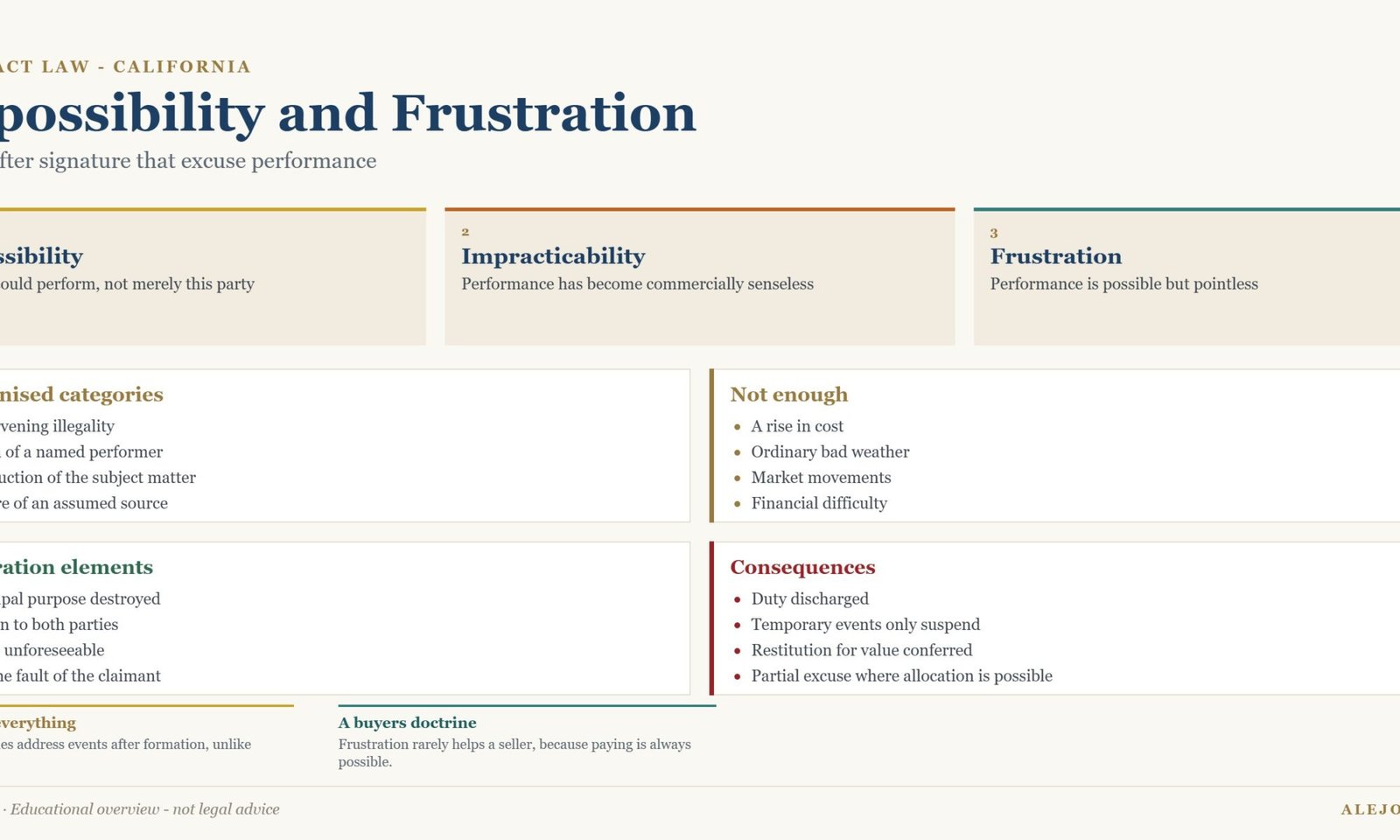
Impossibility and frustration excuse performance when an unforeseen event after the contract was made destroys either the ability to perform or the point of performing. California addresses the principle in the Civil Code, which excuses a party whose performance is prevented or delayed by the operation of law or by an irresistible superhuman cause.
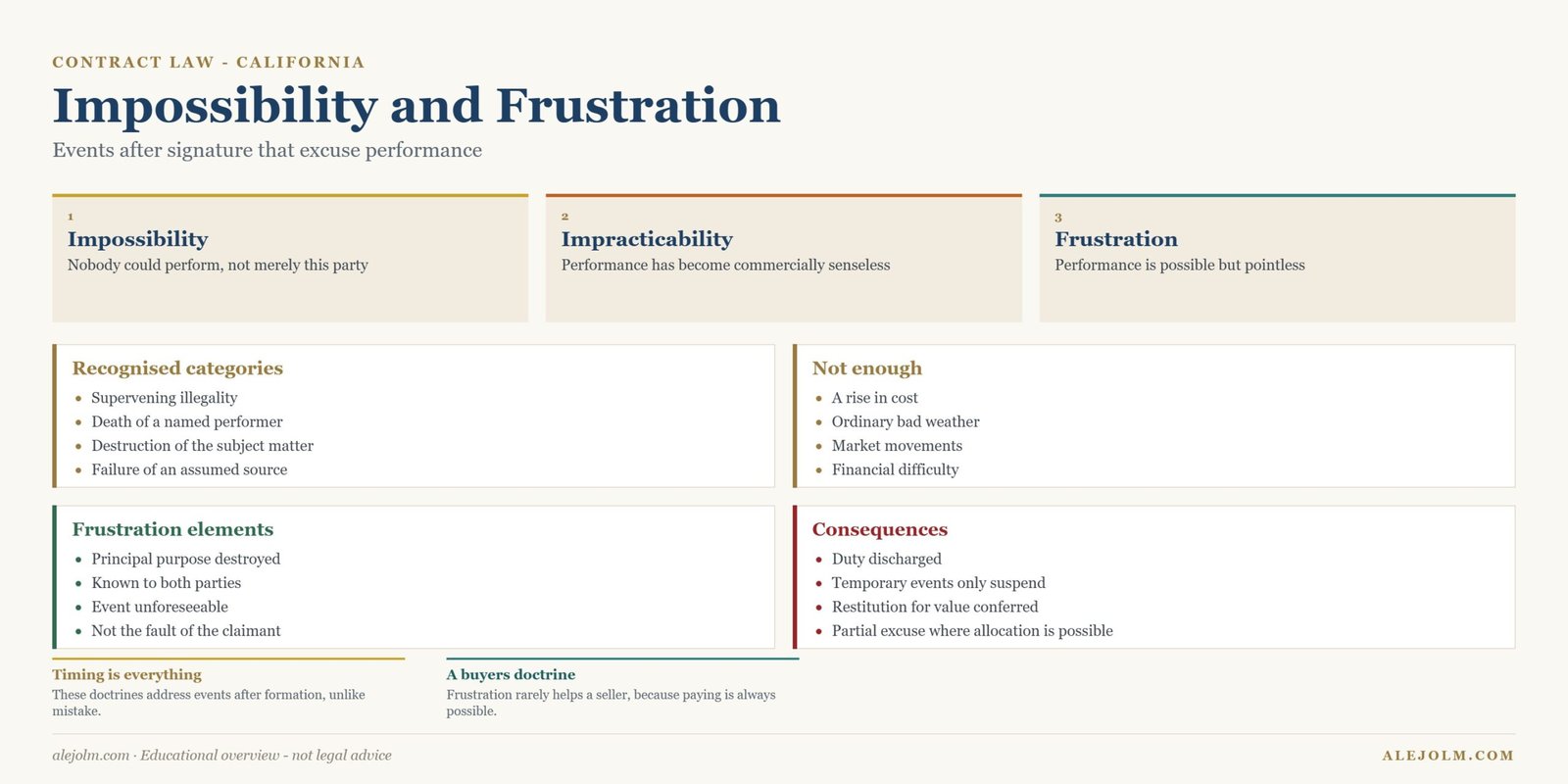
The doctrines sit on a spectrum. Impossibility is the strictest and asks whether anyone could perform. Impracticability asks whether performance has become commercially unreasonable because of an extreme and unforeseeable event. Frustration accepts that performance remains perfectly possible but holds that the reason for it has evaporated. This guide works through each and explains why cost increases almost never qualify.
Impossibility
Objective impossibility means that the performance cannot be rendered by anyone, not merely that this party can no longer manage it. Three categories recur: performance has become illegal, a person specifically identified as essential to the performance has died or become incapacitated, and the specific subject matter has been destroyed without the fault of either party.
Subjective difficulty is not impossibility
A party that has run out of money, lost a key employee who was not identified in the contract or found a supplier unwilling to deal has not established impossibility. The question is whether performance is objectively unavailable, not whether it has become inconvenient or unaffordable for this particular obligor.
Impracticability
For sales of goods, the Commercial Code excuses delay or non delivery where performance has been made impracticable by the occurrence of a contingency whose non occurrence was a basic assumption of the contract, or by compliance in good faith with an applicable governmental regulation. The bar is high.
- Qualifying events. War, embargo, epidemic, destruction of a specified source, closure of essential routes.
- Not qualifying. Increases in raw material or labour cost, however steep.
- Not qualifying. Ordinary adverse weather, which is always foreseeable.
- Not qualifying. A general market downturn or an unprofitable bargain.
- Allocation. Where supply is only partly affected, the seller must allocate fairly among customers.
- Notice. The seller must notify buyers seasonably of delay or the quota available.
Frustration of purpose
Frustration applies where performance remains entirely possible but the event has destroyed the principal purpose for which the contract was made, that purpose was known to both parties, and the event was not foreseeable and not the fault of the party seeking relief. Because the obligation of the paying party is simply to pay, and paying is always possible, the doctrine in practice is available to buyers rather than sellers.
| Doctrine | Can performance be rendered | Typical trigger |
|---|---|---|
| Impossibility | No, by anyone | Destruction or illegality |
| Impracticability | Yes, but unreasonably | Extreme supervening event |
| Frustration | Yes, easily | Loss of the purpose |
| Mistake | Yes | A fact false at signature |
| Breach | Yes | A choice not to perform |
A worked example
A company hires a rooftop venue in downtown Los Angeles for a single evening to view a scheduled public event, a purpose recorded in the agreement. The event is cancelled. The venue is still available and the hirer can still pay, so this is not impossibility. It is frustration: the shared and recorded purpose has been destroyed by an event neither party foresaw, and the duty to pay the balance is excused.
Change the reason for the difficulty. Suppose instead the hirer simply found the fee burdensome because its own trading had deteriorated. Nothing has happened to the purpose of the contract, only to the hirer finances, and no excuse doctrine assists. The venue may enforce the agreement.
Impossibility and frustration in California and Los Angeles County in 2026
Commercial leases, event contracts and supply agreements in Los Angeles County continue to generate excuse claims arising from regulatory restrictions, supply chain disruption and closures. California courts have consistently held that economic hardship alone is not enough, and that a party seeking relief must point to a specific supervening event that was not allocated to it by the contract.
Force majeure drafting has become correspondingly important. Where a clause defines the qualifying events, the notice required and the consequences, it will normally displace the common law doctrines. Where it is silent or vague, the statutory and common law tests apply with all their strictness.
- Draft the force majeure clause carefully. List events, notice and consequences.
- Record the purpose. Frustration requires a purpose known to both parties.
- Give prompt notice. Delay undermines both the clause and the doctrine.
- Allocate fairly. A partially affected supplier must share the available supply.
- Document the event. Regulatory orders and closure notices are the best evidence.
- Consider restitution. Deposits and advance payments are usually recoverable subject to reliance costs.
For 2026, confirm the current California authority on impossibility, impracticability, frustration and force majeure directly with current authority, since these continue to develop.
Common mistakes to avoid
- Confusing it with mistake. These doctrines address events after formation.
- Claiming relief for cost increases. They almost never suffice.
- Treating a temporary event as a discharge. It merely suspends performance.
- Invoking frustration as a seller. Accepting payment is always possible.
- Ignoring the contract allocation. A clause placing the risk on you defeats the claim.
- Forgetting notice. Most force majeure clauses make notice a condition.
Frequently asked questions
Does a price increase excuse performance?
Almost never. Cost increases are treated as an ordinary commercial risk, and only an extreme supervening event outside the basic assumptions of the contract will suffice.
What is the difference between impossibility and frustration?
Impossibility means performance cannot be rendered at all. Frustration means it can be rendered but the reason for doing so has been destroyed.
Can a seller rely on frustration of purpose?
Rarely. The seller performance is usually to accept payment, which remains possible, so the doctrine is in practice available to the paying party.
What happens to money already paid?
Restitution principles apply, so advance payments are generally recoverable, subject to an allowance for reliance expenditure the other party has already incurred.
Does a force majeure clause replace these doctrines?
Usually yes, where it is comprehensive. A well drafted clause defines the qualifying events and the consequences and will normally govern in preference to the general law.
Related guides
- Mistake of fact
- Material breach
- Substantial performance
- Anticipatory repudiation
- Quasi-contract and restitution
- Remedies for breach of contract
- Conditions precedent
- Good faith and fair dealing
Next steps
If an outside event has made your contract unworkable, start with the contract own risk allocation before reaching for the general law. Our guides to material breach and quasi-contract explain the consequences either way.
For primary sources, read California Civil Code section 1511 and the civil jury instructions published by the Judicial Council of California.