
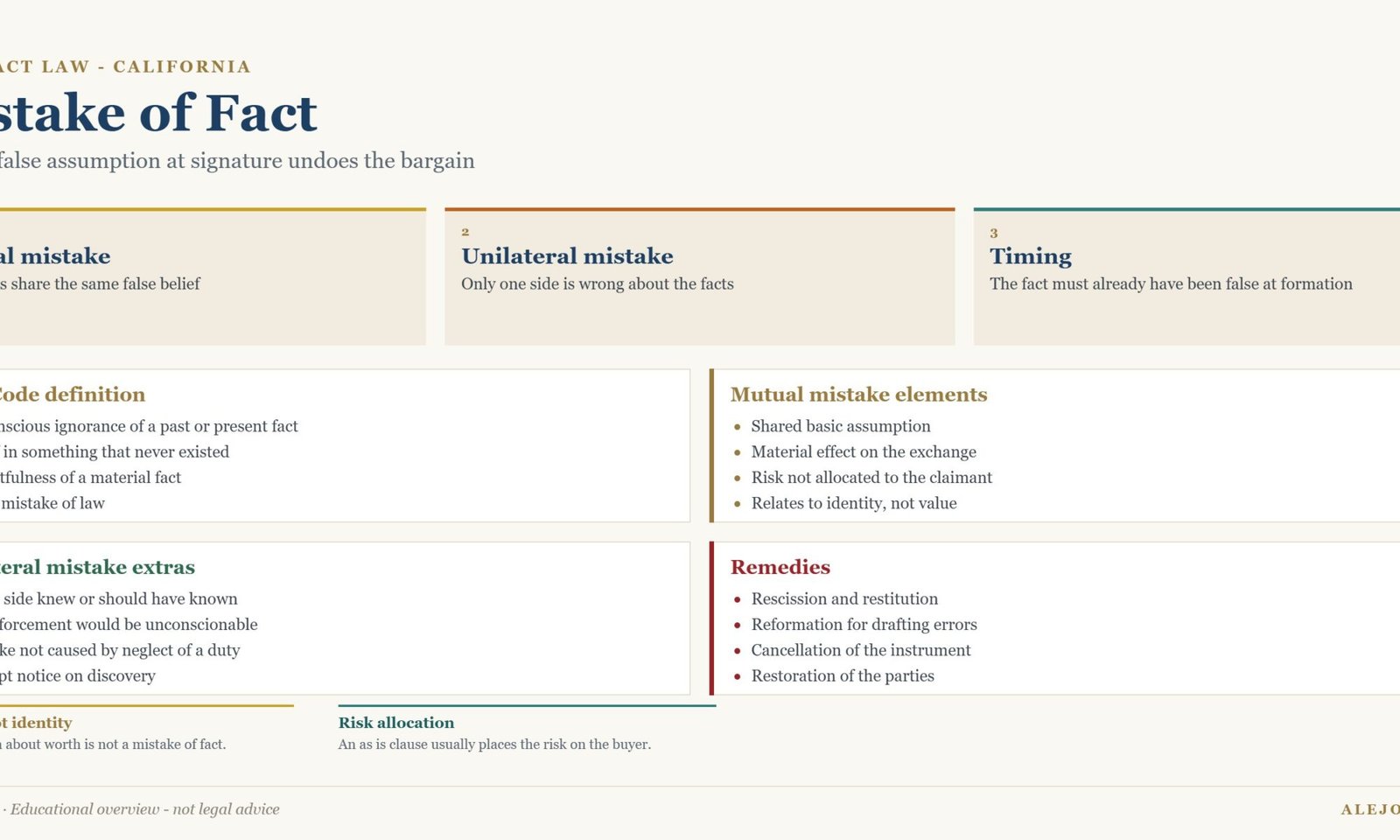
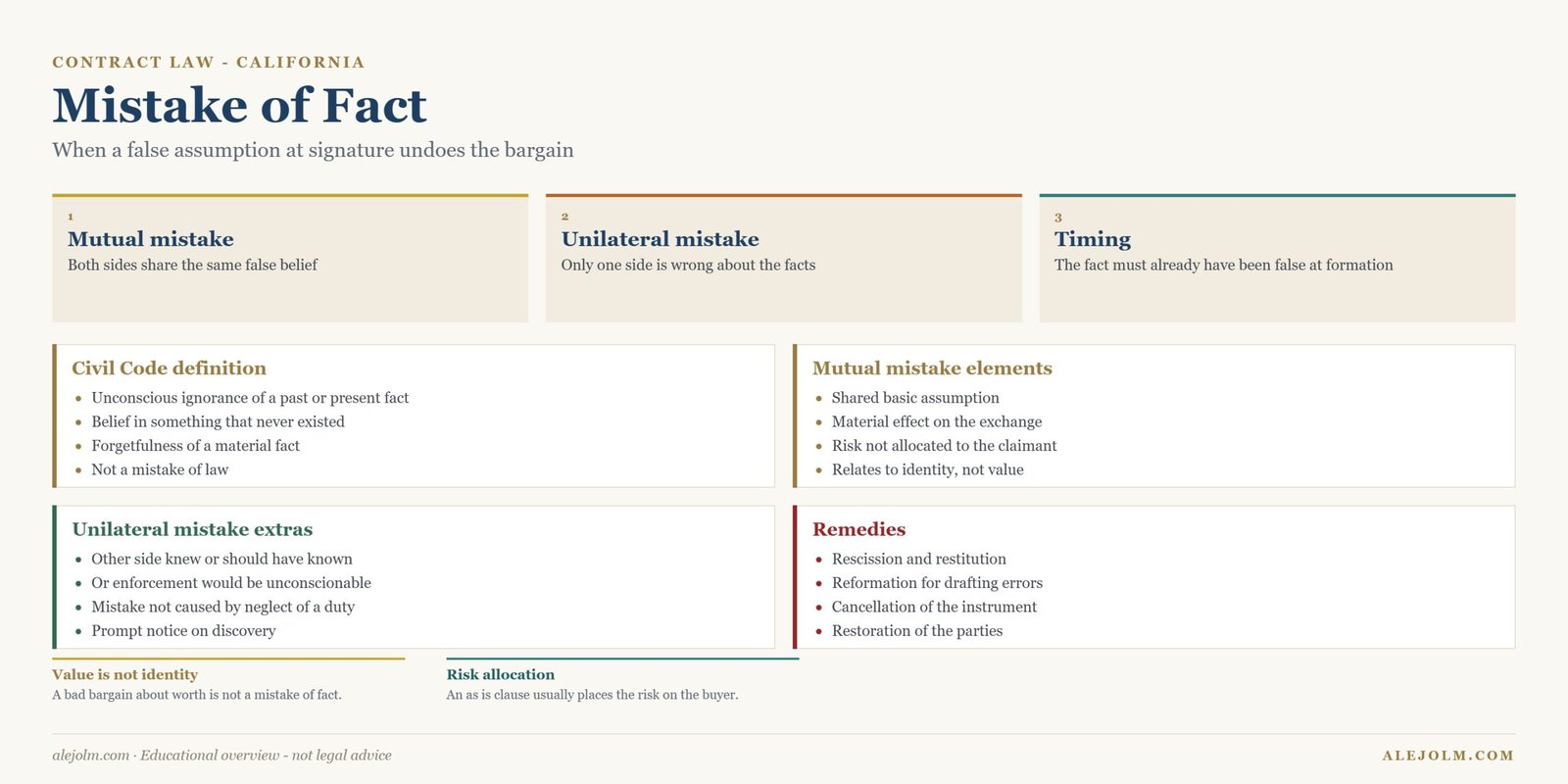
A mistake of fact is a false belief about the world as it stood when the contract was made. California defines it in the Civil Code as a mistake not caused by neglect of a legal duty, consisting in an unconscious ignorance or forgetfulness of a material past or present fact, or a belief in the present existence of something that does not exist.
The timing element is what separates this doctrine from the excuse doctrines. Mistake looks backwards to facts that were already false at signature. Impossibility and frustration look forwards to events that happen afterwards. This guide explains the difference between mutual and unilateral mistake, why a mistake about value rarely helps, how risk allocation defeats the defence, and when reformation rather than rescission is the answer.
Mutual mistake
Where both parties share the same erroneous assumption about a basic fact, the contract is voidable by the party the error disadvantages. Three conditions apply. The assumption must be one on which the contract was made. The error must have a material effect on the exchange. And the party seeking relief must not have borne the risk of being wrong.
Identity, not value
The critical line runs between the nature of the thing and its worth. A shared belief that a stone was ordinary glass, when it was in fact a diamond, goes to what the object is. A shared belief that a property would rise in value, when the market fell, goes only to worth. Courts rescue the first and leave the second alone, because contracting parties are expected to bear market risk.
Unilateral mistake
Where only one party was mistaken, California requires something more. Either the other party knew or had reason to know of the error and took advantage of it, or enforcing the contract as made would be so unfair as to be unconscionable. The mistaken party must also not have caused the problem by neglecting an ordinary duty of care, and must act promptly once the error is discovered.
- Bid errors. A clerical slip in a tender that the recipient must have noticed is the classic case.
- Knowledge by the other side. Silence in the face of an obvious error will not be rewarded.
- Unconscionable enforcement. Relief may follow even without knowledge where the result would be grossly unfair.
- No serious fault. Carelessness amounting to neglect of a legal duty defeats the claim.
- Prompt notice. Delay after discovery suggests affirmation.
- Restoration. The mistaken party must return what it received.
| Doctrine | Timing of the fact | Effect |
|---|---|---|
| Mutual mistake | False at formation | Voidable |
| Unilateral mistake | False at formation | Voidable if extra element met |
| Latent ambiguity | No shared meaning | No contract at all |
| Impossibility | Event after formation | Duty discharged |
| Frustration | Event after formation | Duty discharged |
A worked example
A dealer in Culver City and a collector both believe a ring is costume jewellery and price it accordingly. It turns out to be a genuine antique diamond piece worth many times the price. The mistake goes to the identity of the object rather than to a forecast about value, both parties shared it, and neither assumed the risk of misidentification. The seller may rescind.
Change the knowledge. Suppose the buyer privately suspected the stone was genuine and hurried the sale through before any appraisal. Now the analysis shifts to unilateral mistake, and the buyer knowledge of the seller error supplies the additional element. Rescission remains available, and the buyer conduct may attract further scrutiny.
Mistake of fact in California and Los Angeles County in 2026
Public and private construction bidding in Los Angeles County generates the largest number of unilateral mistake claims. California has long allowed a contractor to withdraw a bid containing a genuine clerical error where the mistake was material, notice was given promptly and the awarding authority had not changed position. The rules are strict about timing, and a contractor that waits loses the right.
Real estate is the other frequent setting, usually in the form of a boundary, acreage or zoning assumption shared by both sides. Where the error appears only in the drafting of the document rather than in the underlying agreement, the remedy is reformation, and the court corrects the writing rather than cancelling the deal.
- Give notice immediately. Bid relief depends on speed.
- Keep the working papers. They prove a clerical error rather than a change of mind.
- Read the risk clauses. An as is provision usually allocates the risk to the buyer.
- Distinguish drafting errors. Reformation preserves the bargain the parties actually made.
- Verify assumptions. Independent survey and title work defeats most later claims.
- Do not rely on value. A disappointing market is not a mistake of fact.
For 2026, confirm the current California authority on mutual mistake, unilateral bid mistake and reformation directly with current authority, since these continue to develop.
Common mistakes to avoid
- Treating a bad forecast as a mistake. The doctrine reaches existing facts only.
- Claiming relief for a mistake about value. Courts do not rescue ordinary bad bargains.
- Ignoring risk allocation. A party that accepted the uncertainty cannot complain about it.
- Confusing mistake with latent ambiguity. One makes a contract voidable, the other means no contract formed.
- Seeking rescission for a typing error. Reformation is the correct remedy there.
- Delaying after discovery. Continuing to perform can affirm the agreement.
Frequently asked questions
What counts as a mistake of fact in California?
An unconscious ignorance or forgetfulness of a material past or present fact, or a belief in the present existence of something that does not exist, provided it was not caused by neglect of a legal duty.
Can I cancel a contract because I paid too much?
Generally no. A mistake about value or market conditions is not a mistake of fact, and courts leave ordinary bad bargains where they fall.
Can a contractor withdraw a bid containing an error?
California permits it in defined circumstances where the error was material and clerical, notice was prompt and the recipient has not relied to its detriment.
What is the difference between rescission and reformation?
Rescission undoes the contract and restores the parties. Reformation keeps the contract and corrects the document so that it records what was actually agreed.
Does an as is clause defeat a mistake claim?
Frequently. Such a clause usually shows that the buyer accepted the risk of being wrong about the condition of what it bought.
Related guides
 Misrepresentation and fraud
 Contract formation in California
- Misunderstanding and latent ambiguity
- Unconscionability
- Impossibility and frustration
- Rescission of a contract
- Remedies for breach of contract
- The parol evidence rule
Next steps
If you signed on the strength of an assumption that turned out to be untrue, work out first whether the assumption was shared and whether anyone had taken the risk of it. Our guides to rescission and latent ambiguity explain the two most likely routes.
For primary sources, read California Civil Code section 1577 and the civil jury instructions published by the Judicial Council of California.