
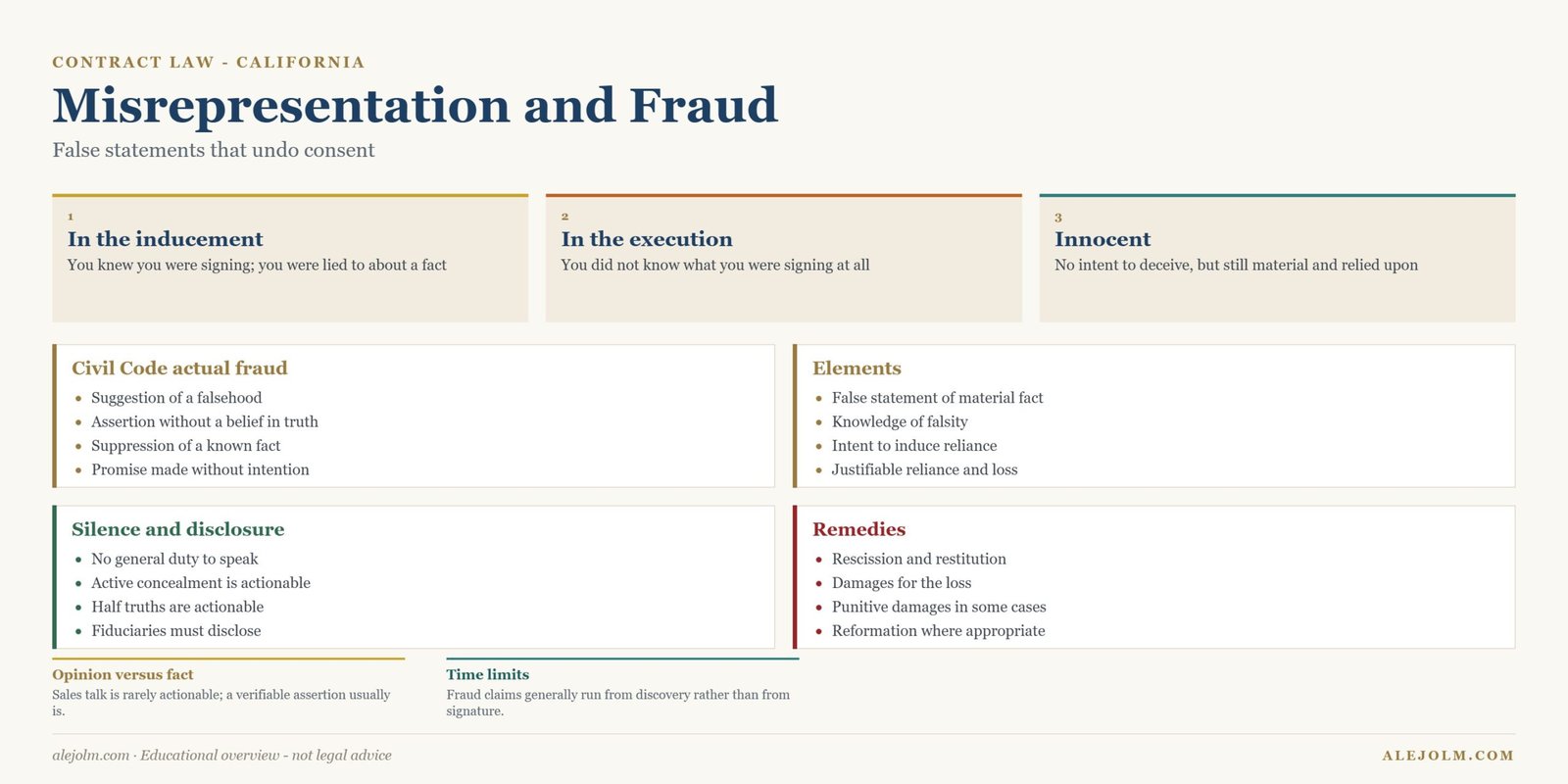
Misrepresentation and fraud attack the genuineness of consent. California defines actual fraud in the Civil Code to include suggesting as a fact something that is not true, asserting something without any belief in its truth, suppressing a fact that a party is bound to disclose, and making a promise with no intention of performing it.
The doctrine divides in two directions that matter enormously in practice. Fraud in the inducement means the party knew it was signing a contract but was deceived about a fact that persuaded it to sign, and the contract is voidable. Fraud in the execution means the party did not understand the nature of the document at all, and there was never any consent to void. This guide works through both, together with innocent misrepresentation, the rules about silence, and the remedies available.
The elements of fraudulent misrepresentation
- A false representation of material fact. Past or present fact, not a prediction and not mere opinion.
- Knowledge of falsity. Actual knowledge, or an assertion made recklessly without any belief in its truth.
- Intent to induce reliance. The statement was made to get the other party to act.
- Justifiable reliance. The claimant actually relied, and doing so was reasonable in the circumstances.
- Resulting damage. The reliance caused loss.
- Materiality. Especially important where the statement was innocent rather than deliberate.
Innocent and negligent misrepresentation
Where the speaker believed the statement but had no reasonable ground for that belief, California treats the conduct as negligent misrepresentation. Where there was neither knowledge nor negligence, an innocent misrepresentation may still make the contract voidable provided the fact was material and the reliance justified. What falls away is the availability of punitive relief.
Silence, half truths and concealment
There is no general duty to volunteer information to the other side of an arms length bargain. Three qualifications matter. Active concealment, such as painting over damage or arranging a viewing to hide a defect, is treated as an assertion that the defect does not exist. A half truth that creates a false impression is actionable. And where a relationship of trust or a statute imposes a duty to disclose, silence itself becomes a misrepresentation. California residential sellers, for instance, are subject to statutory disclosure obligations.
| Type | State of mind | Effect on the contract |
|---|---|---|
| Fraud in the inducement | Knowing or reckless | Voidable |
| Fraud in the execution | Knowing | Void, no consent at all |
| Negligent misrepresentation | Careless | Voidable, damages available |
| Innocent misrepresentation | Honest belief | Voidable if material |
| Opinion or puffery | Any | Usually no remedy |
A worked example
A dealer in Los Angeles sells a used vehicle stating that it has never been in a collision, knowing that it was rebuilt after a serious crash and repainted to hide the repair. The buyer relies and pays full value. That is fraud in the inducement: the buyer knew it was buying a car but was deceived about a material fact. The buyer may rescind and recover the price, or keep the vehicle and sue for the difference in value.
Change the deception. Suppose an elderly non English speaker is handed a stack of papers and told to sign a delivery receipt, when the document is in fact a deed transferring her home. She never consented to any conveyance, so this is fraud in the execution and the instrument is a nullity rather than merely voidable.
Misrepresentation and fraud in California and Los Angeles County in 2026
Residential real estate is the principal battleground in Los Angeles County. California requires sellers to complete statutory disclosure forms covering the condition of the property, and failures to disclose known material defects generate a steady stream of litigation. Concealment claims are also common in the sale of businesses and in franchise disputes.
The limitation period is a further practical point. Claims founded on fraud generally run from the discovery of the facts constituting the fraud rather than from the date of the contract, which can keep old transactions alive for far longer than parties expect.
- Complete disclosure forms carefully. An incomplete form is itself evidence.
- Do not conceal. Painting over a defect converts silence into a positive assertion.
- Beware half truths. A partly accurate answer that misleads is actionable.
- Record what was said. Oral representations are provable but harder to establish.
- Investigate where you can. Reliance must be justifiable.
- Act quickly on discovery. Continuing to take the benefit can affirm the contract.
For 2026, confirm the current California authority on fraud, concealment and statutory disclosure duties directly with current authority, since these continue to develop.
Common mistakes to avoid
- Confusing the two types of fraud. One makes the contract voidable, the other means it never existed.
- Assuming silence is always safe. Concealment, half truths and statutory duties change the position.
- Treating sales talk as fraud. Opinion and general praise are rarely actionable.
- Overlooking justifiable reliance. A claimant who knew the truth cannot say it relied.
- Affirming the contract. Continuing to take the benefit after discovery undermines rescission.
- Assuming the clock runs from signature. Fraud claims usually run from discovery.
Frequently asked questions
Is a seller obliged to disclose defects in California?
For residential property, yes. Statutory disclosure forms require sellers to reveal known material defects, and concealing them exposes the seller to liability.
What is the difference between fraud and negligent misrepresentation?
Fraud requires knowledge of falsity or recklessness. Negligent misrepresentation requires only that the speaker lacked reasonable grounds for believing the statement true.
Can I sue if the statement was just an opinion?
Usually not, although an opinion that implies undisclosed facts, or one given by someone with special expertise, may be treated as a statement of fact.
Do I have to give the property back to sue?
Not necessarily. You may rescind and seek restitution, or affirm the contract and claim damages for the loss caused by the deception.
How long do I have to bring a claim?
Fraud claims generally run from the point at which the claimant discovered, or reasonably should have discovered, the facts constituting the fraud.
Related guides
- Rescission of a contract
- Mistake of fact
- Duress and undue influence
- Fraud as a tort
- Negligent misrepresentation
- Unconscionability
- Capacity and legality
- The parol evidence rule
Next steps
If you discovered after signing that you were told something untrue, decide early whether you want the contract undone or the loss compensated. Our guides to rescission and negligent misrepresentation set out the two routes.
For primary sources, read California Civil Code section 1572 and the civil jury instructions published by the Judicial Council of California.