
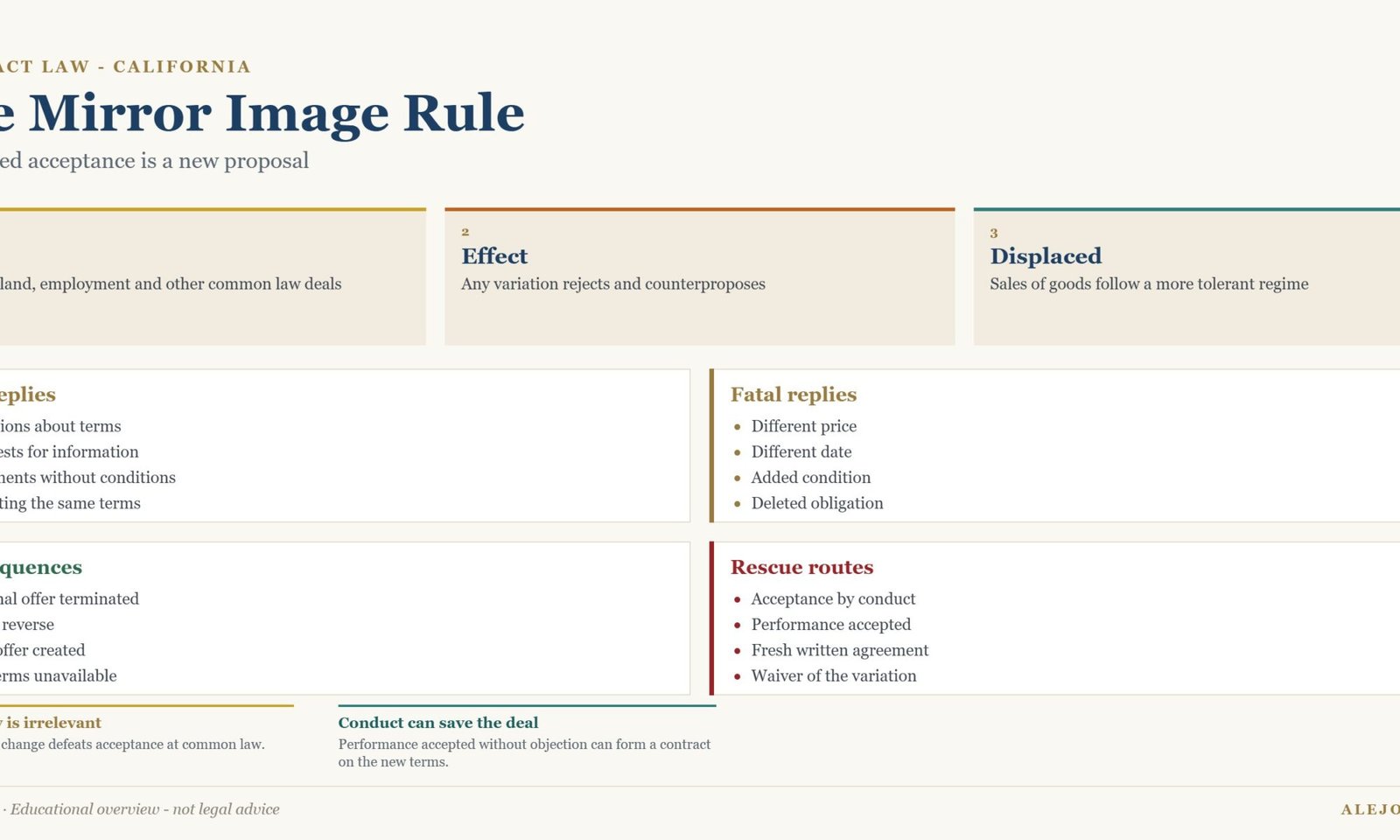
The mirror image rule requires an acceptance to correspond exactly to the offer. California expresses the principle in a single line of the Civil Code: a qualified acceptance is a new proposal. Change the price, move the completion date or add a condition, and the reply is not an acceptance at all but a counteroffer that kills what came before.
The rule governs services, employment, real property and every other agreement outside the law of sales, where a far more tolerant regime applies. This guide explains what counts as a variation, why materiality makes no difference, how a counteroffer reverses the roles of the parties, and how performance can rescue a deal that the paperwork never closed.
What the rule requires
An acceptance must agree to the terms proposed and to nothing else. The test is not whether the change is important but whether there is a change at all. Substituting a date one day later, adjusting a figure by a single dollar or inserting an ordinary clause about interest all have the same effect: the original offer terminates and a new proposal takes its place.
Why the rule is strict
The strictness protects the offeror. A party who has carefully specified what it will do should not find itself bound to different obligations because the other side edited the document. The cost of that protection is a certain formalism, which is precisely why the law of sales abandoned it.
Telling a question from a counteroffer
Not every reply that mentions a different term is a counteroffer. The distinction turns on whether the offeree is asking or insisting. A question preserves the offer; a condition destroys it.
- Does this include the appliances. An inquiry, and the offer survives.
- Would you consider an earlier completion date. A request, and the offer survives.
- I accept provided the appliances are included. A condition, and the offer is gone.
- I accept at the lower figure. A counteroffer, and the offer is gone.
- I accept, and separately I would like to discuss the schedule. Usually an acceptance with a collateral request.
- I accept subject to contract. Ambiguous, and often read as reserving assent.
| Stage | Who holds the power | What is on the table |
|---|---|---|
| Offer made | Offeree | The original terms |
| Inquiry sent | Offeree | The original terms |
| Counteroffer sent | Original offeror | The new terms only |
| Counteroffer rejected | Nobody | Nothing |
| Performance accepted | Both | The last terms proposed |
A worked example
A homeowner in Whittier offers a landscaping company a fixed sum for a garden renovation to be finished by the first of May. The company replies that it accepts but can only guarantee completion by the fifteenth. That reply is a counteroffer. No contract exists on the original terms, and the homeowner is free to walk away without liability.
Change what happens next. Suppose the homeowner says nothing, lets the crew onto the property, watches the work proceed and accepts the finished garden on the twelfth. That conduct accepts the counteroffer, and a contract now exists on the later completion date. The paperwork never matched, but the behaviour did.
The mirror image rule in California and Los Angeles County in 2026
Residential real estate in Los Angeles County is where the rule is most visible. Purchase agreements are exchanged with numbered counteroffer forms precisely because each variation extinguishes what preceded it, and agents are trained to keep the sequence clean. A buyer who signs an earlier version after a counter has issued is signing something that no longer exists.
Employment and professional services agreements raise the same issue in a less formal setting. Terms negotiated over email frequently drift, and a party who believes it accepted in March may discover that the last matching pair of documents dates from January. Where the parties have nonetheless performed, courts look to conduct to identify which terms govern.
- Number every counter. A clear sequence prevents signatures on superseded terms.
- Separate acceptance from negotiation. Accept first, then raise the extra point.
- Watch for subject to clauses. Language reserving approval usually prevents acceptance.
- Record conduct. Site access, payments and deliveries evidence acceptance by performance.
- Confirm which version governs. Attach the final document to any signature page.
- Remember the sales exception. Goods contracts follow the more forgiving regime.
For 2026, confirm the current California authority on qualified acceptance and acceptance by conduct directly with current authority, since these continue to develop.
Common mistakes to avoid
- Importing the sales tolerance. The flexibility for goods does not extend to services or land.
- Treating small changes as harmless. Materiality is irrelevant under the rule.
- Reading every question as a refusal. Inquiries keep the offer alive.
- Assuming the original offer survives a counter. It does not, and it cannot be revived unilaterally.
- Overlooking acceptance by conduct. Performance often supplies what the documents lack.
- Signing the wrong version. A superseded form has no legal effect.
Frequently asked questions
Does a minor typo in the acceptance create a counteroffer?
A genuine clerical slip that does not change any term is unlikely to matter. A change to substance, however small in value, will.
Can the original offer be revived after a counteroffer?
Only if the original offeror chooses to repeat it. The offeree cannot resurrect terms it has already refused.
Does the rule apply to sales of goods?
No. Sales of goods follow a statutory regime that allows a definite acceptance to form a contract even where it states additional or different terms.
What if both parties perform under mismatched documents?
Courts look to the conduct. Performance accepted without objection usually forms a contract on the last set of terms proposed.
Is a reply accepting subject to board approval an acceptance?
Usually not. Language reserving approval indicates that assent has not yet been given, which makes the reply a counterproposal.
Related guides
 What counts as an offer
 Contract formation in California
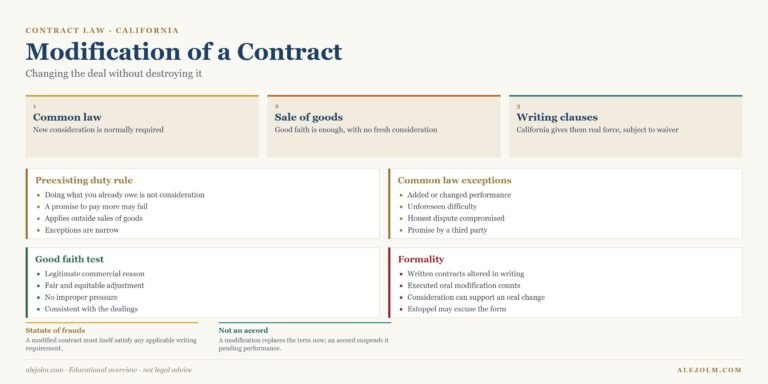 Modification of a contract
- Acceptance in contract law
- The battle of the forms
- Revocation and rejection
- The parol evidence rule
- The mailbox rule
Next steps
If a negotiation produced several drafts, line them up in date order and identify the last pair that actually matched. Our guides to acceptance and the battle of the forms explain what happens when they never did.
For primary sources, read California Civil Code section 1586 and the civil jury instructions published by the Judicial Council of California.