
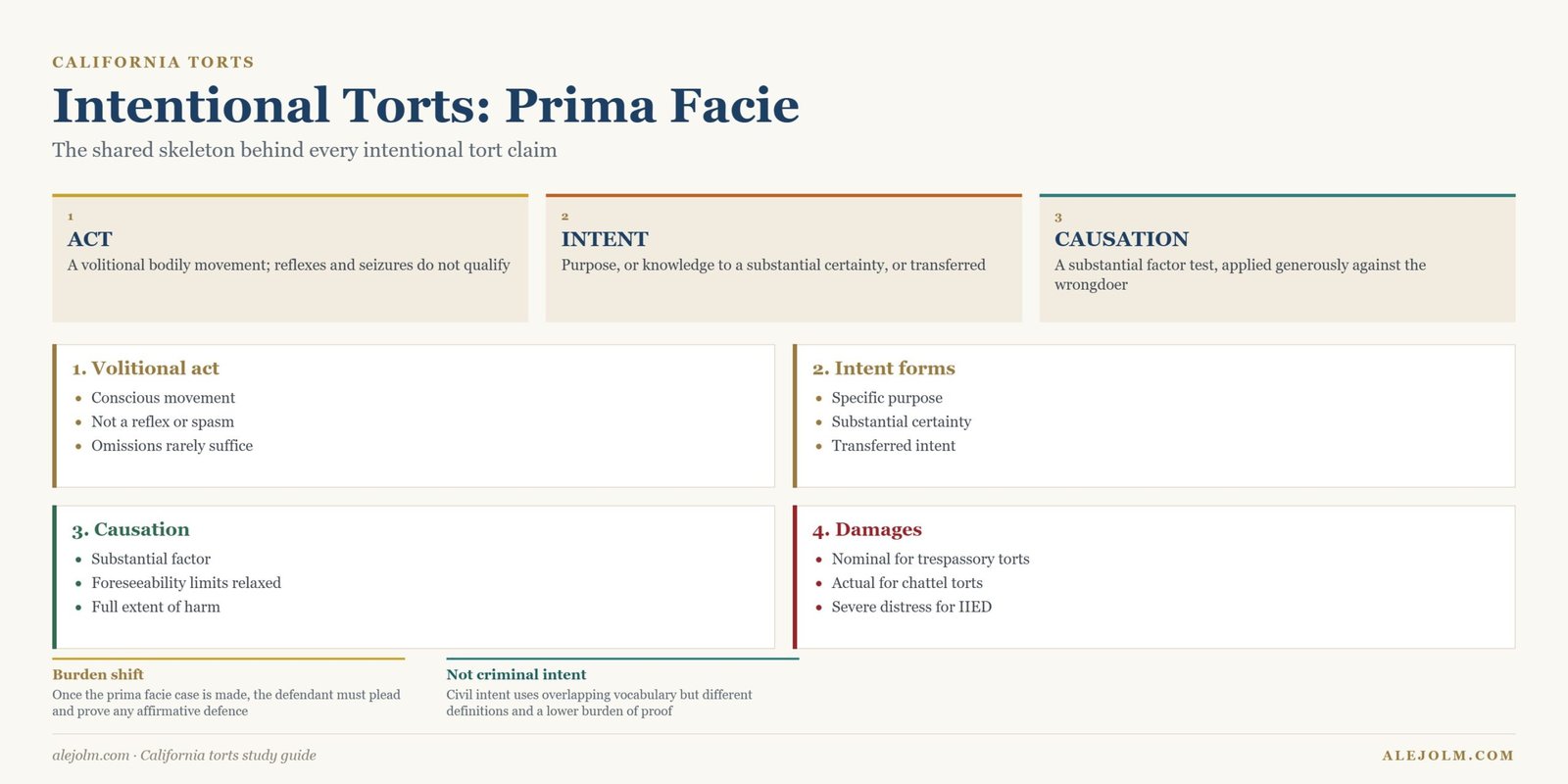
Intentional torts share a common skeleton. Whatever the label on the claim, the analysis begins with a volitional act, a culpable mental state, causation, and in some cases damage. Working through that structure before reaching for the elements of a particular tort prevents most of the errors made in this area.
The prima facie case is the minimum the claimant must establish. Once it is complete the burden shifts, and the defendant must plead and prove any affirmative defence. This guide sets out each element, explains the three forms of intent, and shows how the framework connects to the defences and to the California codification of the underlying duty.
Element one: a volitional act
The claimant must identify a volitional bodily movement by the defendant. The threshold is low but real. A pure reflex, an involuntary spasm, a seizure or movement during sleep is not a volitional act, and where the facts establish one of those the entire claim fails before any tort specific analysis begins.
Two further points follow. Intentional torts almost always require affirmative conduct, so an omission will rarely support the claim. And a protest that the defendant did not mean to cause harm goes to intent rather than to the act, since the movement itself was plainly voluntary.
Element two: intent
Three forms of intent are recognised, and any one of them will do.
Specific intent
The defendant acted with the conscious purpose of bringing about the result the tort protects against. This is the strongest form and the easiest to describe, but it is not required.
Substantial certainty
The defendant acted knowing to a substantial certainty that the consequence would follow, even where the primary goal was something else. The illustration used everywhere is the child who moves a chair knowing that the person about to sit will hit the floor. No desire to injure is needed.
Transferred intent
Intent formed as to one person or one tort can be transferred to another, within defined limits. The doctrine applies to a small group of the original trespassory torts and cannot be used to supply the distinct mental state that other torts require.
Intent is not malice
The mental state has nothing to do with hostility. Someone who touches another believing, wrongly, that the contact will be welcome or harmless can still satisfy intent if the contact itself was intended or substantially certain. Motive affects the availability of punitive damages, not the prima facie case.
| Tort | Damage requirement | Nominal damages | Typical addition |
|---|---|---|---|
| Battery and assault | None | Available | Punitive on malice |
| False imprisonment | None | Available | Punitive on malice |
| Trespass to land | None | Available | Punitive on malice |
| Trespass to chattels and conversion | Actual harm required | Not available | Value or diminution |
| Emotional distress | Severe distress required | Not available | Medical evidence often used |
Element three: causation
The causation requirement is light. The conduct of the defendant need only be a substantial factor in producing the result. The doctrines that limit liability in negligence, including foreseeability and superseding cause, do not generally constrain an intentional wrongdoer, who takes the victim as found and answers for the full extent of the harm that flows from the deliberate act.
Element four: damages where required
The damage requirement varies by tort. Battery, assault, false imprisonment and trespass to land are actionable without proof of actual harm, so nominal damages are available and punitive damages may follow where malice is shown. Trespass to chattels and conversion require actual damage. Intentional infliction of emotional distress is the outlier among the person directed torts because it requires proof of severe distress.
The burden shift
Completing the prima facie case shifts the burden. The defendant must then plead and prove an affirmative defence, and the recognised list is finite: consent, self-defence, defence of others, defence of property, recapture of chattels, necessity, the shopkeeper privilege, the privilege of arrest and the wider authority of law. Reentry onto land belongs to the historical list and is no longer available.
A worked example
At a gathering in Los Angeles a guest pulls a chair away as another begins to sit, expecting the fall to be amusing. The movement was volitional. The guest knew to a substantial certainty that contact with the floor would follow, which satisfies intent even though there was no wish to injure. The act was a substantial factor in the fall, and battery requires no proof of actual damage, so the claim is complete.
Change the mechanism. Suppose the guest had a genuine seizure and knocked the chair aside involuntarily. The volitional act element fails, and with it every intentional tort claim, regardless of how severe the resulting injury proves to be.
Intentional torts in California and Los Angeles County in 2026
California states the underlying obligation in the Civil Code, which provides that every person is bound to abstain from injuring the person or property of another or infringing upon their rights. The specific intentional torts are then developed through case law and expressed for trial purposes in the Judicial Council civil jury instructions.
California practice adds several features that shape these claims. Punitive damages require clear and convincing proof of oppression, fraud or malice, the general limitation period for injury to the person is two years, and claims against public entities carry the separate and much shorter claim presentation requirement.
- Statutory duty — the Civil Code states the obligation to abstain from injuring others.
- Jury instructions — the Judicial Council charges express each tort element by element.
- Punitive damages — available on clear and convincing proof of malice or oppression.
- Limitation period — two years for assault, battery and similar claims.
- Incapacity — infancy and mental illness bear on intent rather than providing a defence.
- Defences — the defendant carries the burden once the prima facie case is complete.
For 2026, confirm the current California authority on intentional tort elements, punitive damage standards and limitation periods directly with current authority, since these continue to develop.
Common mistakes to avoid
- Confusing volitional with intentional — the movement being voluntary is a separate question from the mental state.
- Requiring malice — hostility is irrelevant to the prima facie case.
- Skipping the shared skeleton — a failed act element defeats every intentional tort claim at once.
- Overusing transferred intent — it supplies intent only for a defined group of torts.
- Importing criminal definitions — civil intent and criminal mens rea are not the same standard.
- Forgetting the damage rules — some torts need actual harm and others do not.
Frequently asked questions
Does an intentional tort require an intention to harm?
No. It requires either the purpose of bringing about the protected result or knowledge to a substantial certainty that it will follow. A defendant who expected no harm at all can still satisfy the element.
What is a volitional act?
A conscious bodily movement. Reflexes, spasms, seizures and movement during sleep do not qualify, and where the facts establish one of those the claim fails before the tort specific elements are considered.
Are nominal damages available in California?
For the trespassory torts, yes. Battery, assault, false imprisonment and trespass to land are actionable without proof of actual harm, while trespass to chattels, conversion and emotional distress claims require damage.
Who proves the defences?
The defendant. Once the claimant has established the prima facie case, the burden shifts, and consent, self-defence and the other privileges must be pleaded and proved by the person relying on them.
Is civil intent the same as criminal intent?
No. The vocabulary overlaps but the definitions differ, and the civil burden of proof is the balance of probabilities rather than proof beyond reasonable doubt. Conduct can support a tort claim without supporting a prosecution.
Related guides
- Battery
- Assault
- False Imprisonment
- Intentional Infliction of Emotional Distress
- Transferred Intent
- Legal Incapacity
- Consent
- Trespass to Land
Next steps
Read this with battery, where the framework is worked through in its clearest form, and then transferred intent for the third and most limited form of the mental element.
For primary sources, read California Civil Code section 1708 and the civil jury instructions published by the Judicial Council of California.