
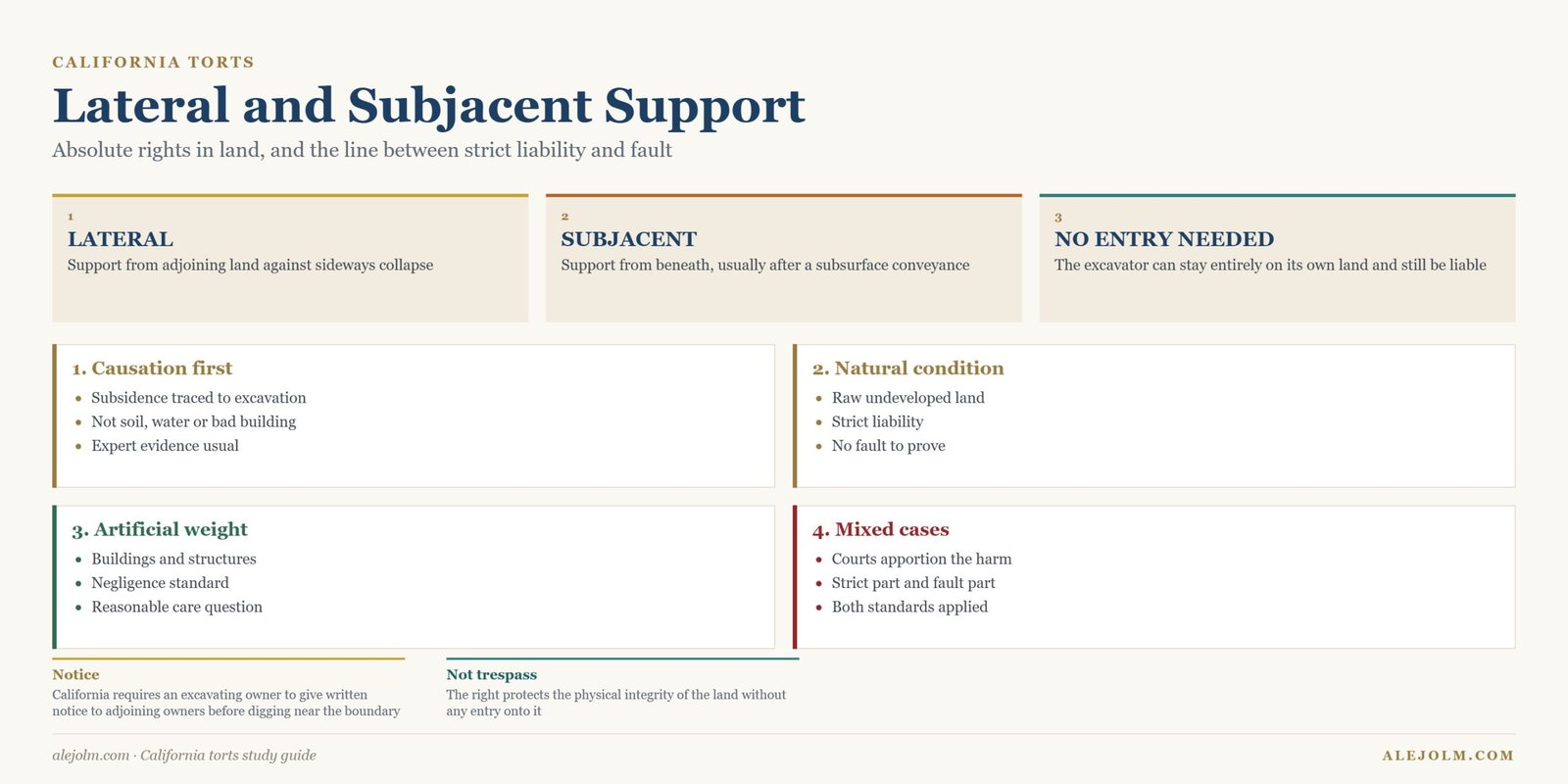
Lateral and subjacent support describes the right every landowner has to have their land held up, sideways by the adjoining land and from beneath by whatever lies below. The right is described as absolute because in its core application it does not depend on proving carelessness at all. A neighbour who digs and causes the land next door to slump is answerable whether or not the digging was done well.
That strict rule protects land in its raw condition. Once the weight of buildings enters the causal story the standard shifts to negligence, and mixed cases are apportioned between the two. California adds a statutory notice regime for excavation near a boundary, which shapes almost every real dispute. This guide explains the framework and applies it to a Los Angeles County example.
The right protected
The right is to support, not to freedom from interference. It is infringed when the removal of adjoining or underlying material causes the claimant land to subside, regardless of whether anything or anyone came onto that land. That distinguishes it from trespass, which requires an entry. An excavator who remains entirely within their own boundary can still be liable.
Causation comes first
Neither standard is reached until the claimant proves that the subsidence was actually caused by the withdrawal of support. Ground movement has many possible sources, including expansive soils, a leaking water main, poor original construction or seasonal moisture change. Establishing that the excavation was the cause, and not merely contemporaneous with the damage, is usually the central factual battle and normally requires geotechnical evidence.
Natural condition means strict liability
Where the land that subsided was in its raw, undeveloped state, the excavator is strictly liable for the collapse. The claimant need not show that the work was negligent, that the method was poor or that warnings were ignored. The right to support of land in its natural condition is treated as an incident of ownership, and the neighbour who removes that support answers for the result.
Artificial weight means negligence
Where the subsidence is attributable to the added weight of buildings or other structures, the excavator is liable only if the work was carried out without reasonable care. The reasoning is that the neighbour did not agree to support whatever the owner chose to build, and the additional burden was imposed unilaterally.
| Situation | Standard | What the claimant proves | Typical evidence |
|---|---|---|---|
| Raw land subsides | Strict liability | Causation only | Geotechnical survey |
| Building weight contributes | Negligence | Causation and want of care | Engineering practice evidence |
| Mixed land and structure | Apportioned | Both, by portion | Expert apportionment |
| Subjacent collapse after mineral grant | Same split | Causation and condition | Subsurface records |
Mixed cases and apportionment
Real properties are rarely raw land. Where a lot carries both undeveloped ground and a structure, courts apportion. Strict liability applies to the portion of the subsidence that would have occurred to the land in its natural state regardless of the building, and a negligence standard applies to the additional portion attributable to the weight of the structure. The correct answer in a mixed case is usually apportionment rather than choosing one standard for the whole loss.
Subjacent support
Subjacent support is the same rule applied vertically. It typically arises after an owner conveys mineral or subsurface rights and the operations of the grantee cause the surface above to collapse. The natural and artificial distinction governs in exactly the same way, so the two doctrines differ only in the geometry of the intrusion rather than in the standard applied.
A worked example
An owner in Los Angeles excavates for a basement extension along the boundary. The adjoining lot is an undeveloped hillside parcel, and part of it slumps into the excavation. Because the neighbouring land was in its natural state, strict liability applies. It does not matter that the contractor followed accepted shoring practice; the withdrawal of natural support is enough.
Change the neighbouring lot. Suppose it carries a heavy two storey building close to the line, and the evidence shows that the soil alone would have held but the weight of the structure caused the failure. Now the claimant must prove that the excavation was carried out without reasonable care, and compliance with proper shoring and monitoring practice becomes a genuine defence.
Support rights in California and Los Angeles County in 2026
California addresses excavation adjoining land in Civil Code section 832, which sets out reciprocal rights and duties. Each owner has a right to lateral and subjacent support, and an owner intending to excavate must give reasonable written notice to adjoining owners stating the depth and when the work will begin, so that they can protect their own structures. The section also addresses responsibility for excavation beyond specified depths.
In Los Angeles County the practical layer is the municipal permitting and grading regime. Excavation and shoring permits, geotechnical reporting requirements and inspection records frequently determine whether reasonable care was exercised where the negligence standard applies.
- Statutory scheme — Civil Code section 832 governs excavation adjoining land and the notice obligation.
- Written notice — adjoining owners must be told the depth and timing before work begins.
- Depth thresholds — additional responsibilities attach to excavation below specified depths.
- Permits and grading — local requirements often supply the practical standard of care.
- Hillside conditions — the terrain of Los Angeles County makes slope stability a recurring issue.
- Parallel claims — nuisance, trespass and negligence are frequently pleaded alongside the support claim.
For 2026, confirm the current California authority on Civil Code section 832, local grading requirements and shoring obligations directly with current authority, since these continue to develop.
Common mistakes to avoid
- Applying strict liability to improved land — the no fault rule protects land in its natural condition.
- Assuming any subsidence near a dig is actionable — causation must be proved against competing explanations.
- Treating lateral and subjacent support as different doctrines — they apply the same standard in different geometry.
- Requiring an entry — the excavator never has to set foot on the claimant land.
- Choosing one standard in a mixed case — apportionment is usually the correct approach.
- Ignoring the notice duty — a failure to give statutory notice affects both liability and remedy in California.
Frequently asked questions
Does my neighbour have to warn me before excavating in California?
Yes. Civil Code section 832 requires an owner intending to excavate to give reasonable written notice to adjoining owners, stating the depth of the intended excavation and when the work will begin, so that neighbours can take protective steps.
Is the excavator liable if the work was done carefully?
For land in its natural condition, yes. Strict liability applies to the withdrawal of natural support, so care is irrelevant. Once the weight of a building forms part of the causal story, the standard becomes negligence and careful work is a defence.
What if my house causes the collapse rather than the soil?
Then the negligence standard governs that portion of the harm. Courts commonly apportion, applying strict liability to whatever subsidence would have occurred to raw land and a fault based standard to the extra damage caused by the structure.
Is this the same as trespass to land?
No. Trespass requires a physical entry onto the land. A support claim requires none, because the wrong is the removal of the support that held the land up, carried out entirely on the excavator own property.
Does the rule apply to underground mining or drilling?
Yes, through subjacent support. Where subsurface rights have been conveyed and the operations of the grantee cause the surface to subside, the same natural and artificial distinction decides whether strict liability or negligence applies.
Related guides
- Trespass to Land
- Nuisance
- Strict Liability
- Abnormally Dangerous Activities
- Premises Liability
- Negligence Per Se
- Elements of Negligence
- Damages in Negligence
Next steps
Read this with trespass to land to see why no entry is needed here, and then nuisance for the parallel claim where interference falls short of physical collapse.
For primary sources, read California Civil Code section 832 and the civil jury instructions published by the Judicial Council of California.