
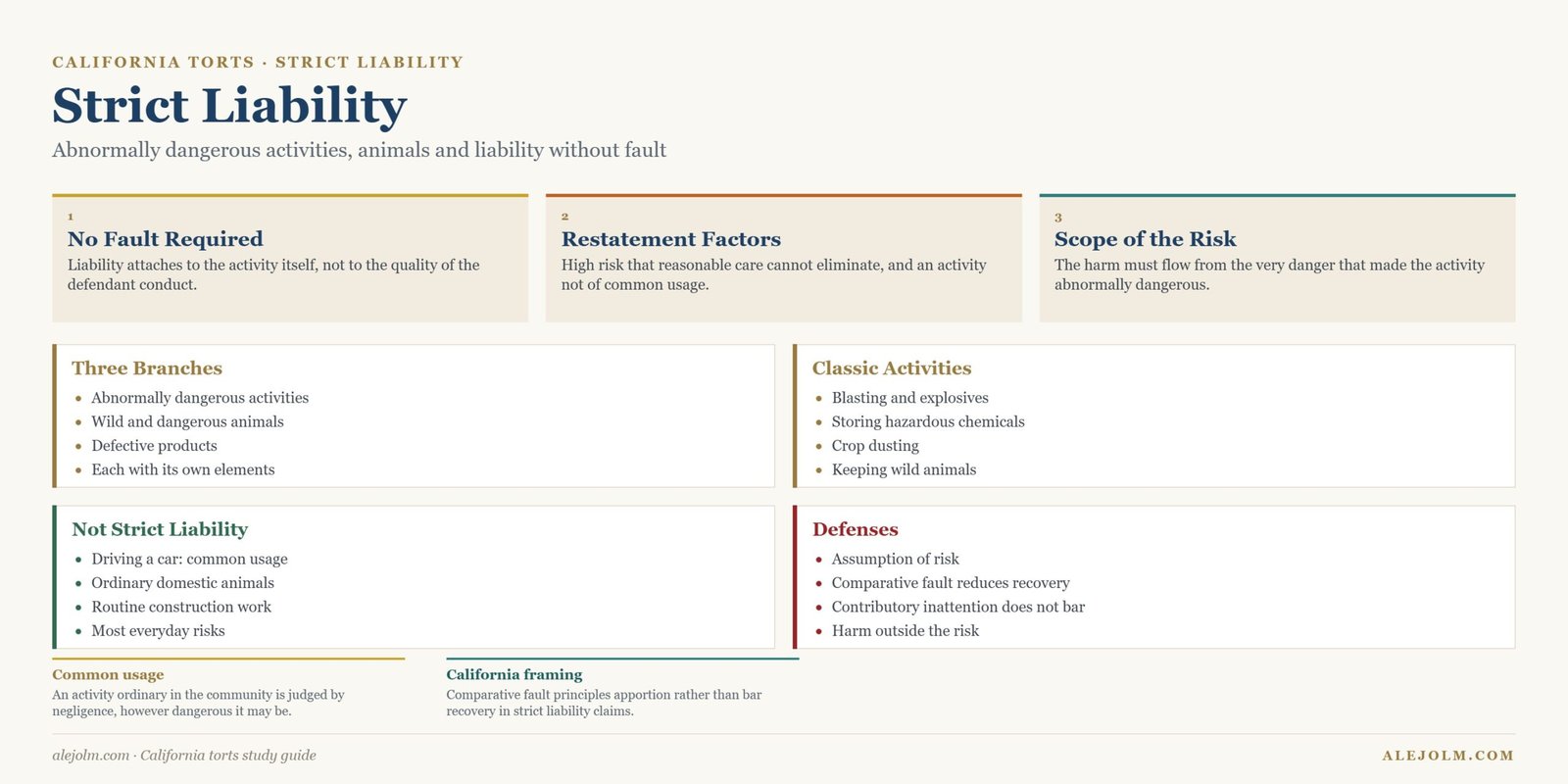
Strict liability holds a defendant answerable for harm without any proof of fault. There is no reasonable person to consult, no breach to establish, and no argument about how carefully the defendant behaved. The activity itself carries the liability, and the only questions left are whether the plaintiff harm fell within the danger and how much it is worth.
It is a narrow doctrine, and over-applying it is the most common error. Tort law recognises three pockets of no-fault liability: abnormally dangerous activities, certain animals, and defective products. They share a label and almost nothing else, so keeping them apart is the first task.
Where strict liability applies
The three branches grew from different roots. Activity based liability descends from Rylands v. Fletcher, the nineteenth century case of a reservoir that flooded a neighbouring mine, and asks whether the defendant brought an unusual danger onto the land. Animal liability turns on the character of the animal and, for domestic animals, on the owner knowledge of a particular beast. Product liability, treated separately in our guide to products liability, attaches to a defect in a thing sold. Only the first is discussed at length here.
| Branch | Trigger | Key limit |
|---|---|---|
| Abnormally dangerous activities | The nature of the activity | Common usage and scope of the risk |
| Animals | Wild animals, or a known dangerous propensity | Trespassing plaintiffs and provocation |
| Products | A defect in a product placed in the stream of commerce | Commercial sellers only |
The Restatement test for abnormally dangerous activities
An activity qualifies where it creates a high degree of risk of serious harm, that risk cannot be eliminated by the exercise of reasonable care, and the activity is not a matter of common usage in the community. Courts also weigh whether the activity is appropriate to the place where it is carried on and whether its value to the community outweighs its dangerous attributes. No single factor decides it, but the second and third do most of the work.
The insistence that reasonable care cannot remove the risk is what separates strict liability from negligence. Blasting performed to the highest professional standard still throws debris sometimes. That residual, irreducible danger is the reason the law shifts the cost onto the person who chose to create it rather than the neighbour who merely lived nearby.
Activities that qualify
Blasting and the use of explosives is the paradigm. Storing large quantities of flammable liquids or toxic chemicals, crop dusting with hazardous pesticides, transporting certain hazardous materials, and keeping wild animals are all conventional examples. What unites them is that the danger persists however careful the actor is.
Activities that do not
Driving is statistically among the most dangerous things most people do, and it is never strict liability, because it is a matter of common usage. The same reasoning excludes ordinary construction, the use of power tools, and the storage of household quantities of paint thinner. Where an activity is woven into everyday community life, negligence supplies the standard, and our guide to the elements of negligence sets out how that claim is built.
Scope of the risk
Strict liability is limited to the type of harm that made the activity abnormally dangerous. Debris from a blast striking a bystander is squarely within the danger. A horse a mile away that bolts at the noise and throws its rider presents a harder question, and many courts treat it as outside the doctrine, leaving the plaintiff to prove ordinary negligence. The limitation matters because it prevents a no-fault rule from becoming a general insurance policy for everything that happens nearby.
Defences
Ordinary inattention does not defeat a strict liability claim. A plaintiff who simply failed to notice a warning sign is not barred, because the doctrine exists precisely to relieve the plaintiff of a fault inquiry. Knowing and voluntary assumption of risk remains a defence, and conduct by the plaintiff that provokes the harm or unreasonably increases the exposure can defeat or reduce recovery. In comparative fault states the reduction is proportionate rather than total.
A worked example
A demolition contractor uses explosives to bring down an office block. A resident two streets away is struck by a piece of masonry thrown further than anyone anticipated. On a negligence theory the resident would have to show the contractor departed from professional standards, which may be impossible if the charges were correctly calculated and the exclusion zone properly set. Strict liability removes that burden entirely. Blasting is abnormally dangerous, flying debris is the danger that makes it so, and the contractor answers for the injury however carefully the work was done.
Change one fact and the analysis shifts. If the resident had climbed a fence into the marked exclusion zone to film the demolition, the contractor would argue assumption of risk, and in California the resident share of responsibility would reduce rather than extinguish the award.
Strict Liability in California and Los Angeles County in 2026
California applies the Restatement framework to abnormally dangerous activities and has been unusually influential in the product branch, where Greenman v. Yuba Power Products established liability without fault for commercial sellers and Barker v. Lull Engineering supplied the two pronged test for design defect. On the activity side, the state has treated blasting, the transport and storage of hazardous materials, and certain fumigation and pest control operations as candidates, while consistently refusing to extend the doctrine to activities of common usage.
The most practically significant California rule is that comparative fault applies. The state merged assumption of risk into the comparative scheme, so a plaintiff whose own conduct contributed to the harm sees the award reduced by a percentage rather than defeated. In Los Angeles County the doctrine surfaces most often in construction and demolition disputes, in hazardous materials incidents along the industrial corridors, and in dog bite claims, which are governed by their own statute rather than the common law.
- Restatement factors. California follows the high risk, irreducible danger and common usage analysis for abnormally dangerous activities.
- Comparative fault. Plaintiff fault apportions liability instead of barring the claim, including in strict liability actions.
- Dog bites. Civil Code section 3342 imposes statutory strict liability on owners regardless of prior knowledge of viciousness, subject to trespass and provocation limits.
- Products. Greenman and Barker place California at the origin of modern strict product liability, covered in our products liability guide.
- Scope of the risk. The harm must be the kind the activity threatened, and ordinary proximate cause limits still apply.
- Pleading in the alternative. Strict liability and negligence routinely appear together on the same facts, and pleading both is standard practice.
For 2026, confirm the current California authority on the classification of particular activities, the operation of Civil Code section 3342, and the interaction between strict liability and comparative fault directly with current authority, since these continue to develop.
Common mistakes to avoid
- Calling every dangerous activity abnormally dangerous. Common usage removes most everyday risks from the doctrine.
- Merging the three branches. Activity, animal and product liability have different elements and different defences.
- Ignoring scope of the risk. The harm must be the danger that justified no-fault treatment in the first place.
- Treating contributory inattention as a bar. It is not. Only knowing assumption of risk or provocative conduct affects recovery.
- Forgetting causation. Strict liability removes fault, not the requirement that the activity caused the harm.
- Abandoning negligence. Where the activity turns out to be of common usage, the negligence claim is the one that survives.
Frequently asked questions
What is strict liability in tort law?
It is liability imposed without proof of fault. Where the doctrine applies, the plaintiff need not show that the defendant acted unreasonably, only that the activity caused harm of the kind that made it dangerous.
What makes an activity abnormally dangerous?
A high degree of risk of serious harm that reasonable care cannot eliminate, combined with the fact that the activity is not a matter of common usage in the community. Location and community value are also weighed.
Is driving a car subject to strict liability?
No. Driving is a matter of common usage, so however dangerous it is in the aggregate, liability is governed by ordinary negligence principles.
Does comparative fault apply to strict liability in California?
Yes. California applies comparative fault principles, so a plaintiff whose own conduct contributed to the injury has the award reduced by their share rather than barred.
Are dog owners strictly liable in California?
Civil Code section 3342 makes owners liable for bites in public places or where the victim was lawfully on private property, without regard to prior knowledge of viciousness, subject to limits such as trespass and provocation.
Related guides
- Products Liability: The Three Defect Theories Explained
- The Four Elements of Negligence: Bar Exam Breakdown
- Negligence Per Se: Using a Statute to Prove Breach
- Assumption of Risk in California: Primary and Secondary
- Comparative Negligence in California: How Fault Is Split
- Proximate Cause: Foreseeability and Superseding Causes
- Trespass to Land in California: Elements and Remedies
- Premises Liability in California and Los Angeles County
Next steps
Read our guide to products liability for the branch of strict liability that generates the most litigation, then comparative negligence, which determines how a plaintiff own conduct affects a no-fault claim.
For primary sources, read California Civil Code section 3342 and the strict liability instructions published by the Judicial Council of California.