
American appellate practice rests on a simple premise: one appeal per case, taken at the end. The final judgment rule in 28 U.S.C. § 1291 gives the courts of appeals jurisdiction over appeals from all final decisions of the district courts, and a decision is final when it ends the litigation on the merits and leaves nothing for the court to do but execute the judgment.
The rule prevents piecemeal review, respects the trial judge, and lets the appellate court see a complete record. It also means that a party who suffers a serious mid-case ruling may have to try the whole case before challenging it. This guide maps the rule and every recognised route around it, including the California system, which reaches the same destination by a different road.
What counts as final
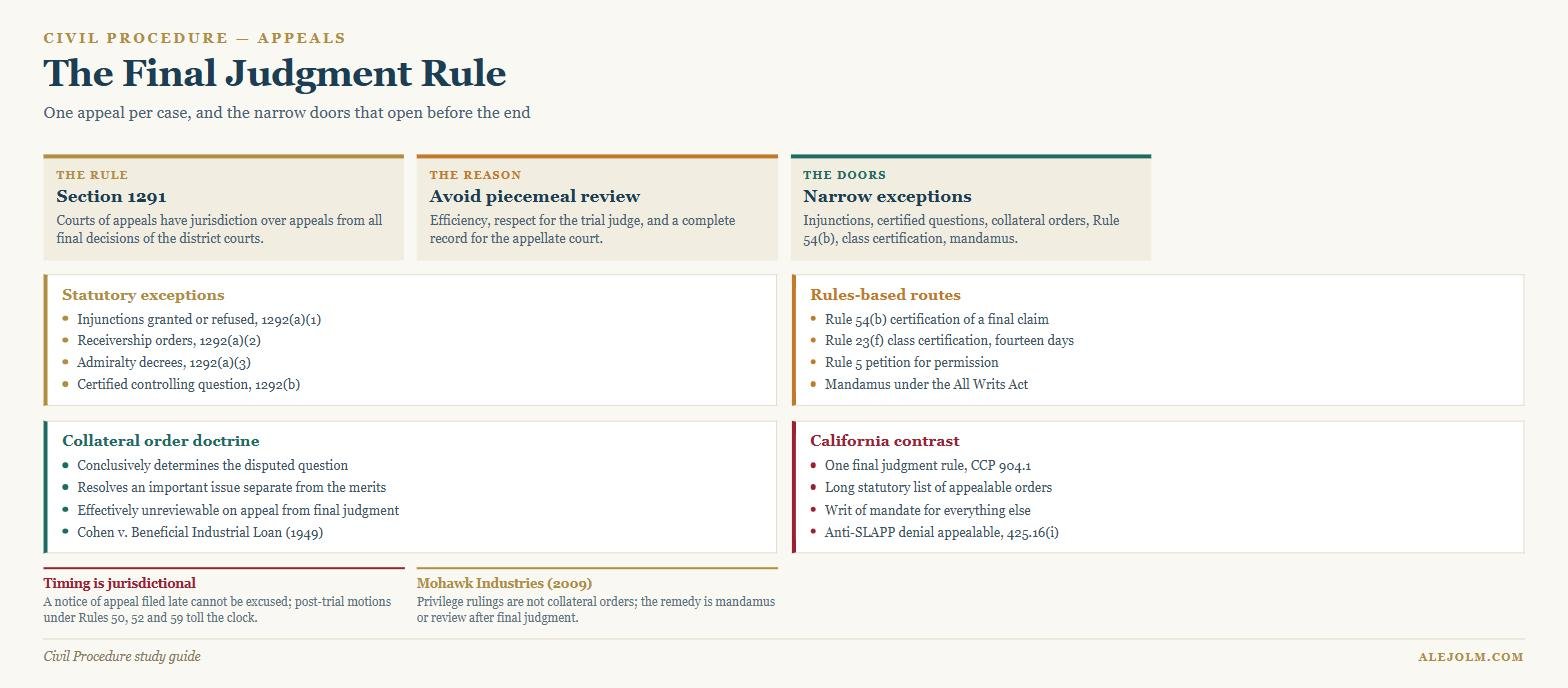
Catlin v. United States (1945) supplies the classic formulation: a decision that ends the litigation on the merits and leaves nothing for the court to do but execute the judgment. An order dismissing some claims but not others is not final. An order denying summary judgment is not final. An order awarding damages but leaving the amount of attorney fees undetermined generally is final, because the fee question is collateral.
Statutory exceptions
- Injunctions, § 1292(a)(1). Orders granting, continuing, modifying, refusing or dissolving injunctions are appealable as of right, because the practical consequences cannot wait.
- Receivers, § 1292(a)(2). Orders appointing receivers or refusing to wind up receiverships.
- Admiralty, § 1292(a)(3). Interlocutory decrees determining the rights and liabilities of parties.
- Certified questions, § 1292(b). The district judge certifies that the order involves a controlling question of law as to which there is substantial ground for difference of opinion and that immediate appeal may materially advance the termination of the litigation; the court of appeals must then agree to hear it.
The collateral order doctrine
Cohen v. Beneficial Industrial Loan Corp. (1949) recognised a small class of orders treated as final although the case continues. Three conditions must all be met: the order conclusively determines the disputed question, it resolves an important issue completely separate from the merits, and it is effectively unreviewable on appeal from a final judgment. Denials of qualified immunity, of absolute immunity and of Eleventh Amendment immunity qualify. Mohawk Industries v. Carpenter (2009) held that attorney-client privilege rulings do not, because post-judgment review and mandamus are adequate.
Rules-based routes
Rule 54(b) allows a district court to direct entry of final judgment as to one or more but fewer than all claims or parties, on an express determination that there is no just reason for delay. Rule 23(f) permits a discretionary appeal from an order granting or denying class certification if a petition is filed within fourteen days. And mandamus under the All Writs Act remains available for a clear abuse of judicial power where no other adequate means of relief exists — an extraordinary remedy, not a substitute for appeal.
Timing
| Event | Federal deadline |
|---|---|
| Notice of appeal, civil | 30 days after entry of judgment |
| Timely Rule 50, 52 or 59 motion | Clock restarts on disposal |
| Extension for excusable neglect | Up to 30 additional days |
| Rule 23(f) petition | 14 days |
| § 1292(b) petition | 10 days after certification |
| Cross-appeal | 14 days after the first notice |
A worked example
A district court denies a police officer’s motion for summary judgment on qualified immunity, holding that disputed facts must go to a jury, and in the same order denies the city’s motion on the merits.
The officer may appeal immediately as to the purely legal question of whether the facts assumed by the district court amount to a violation of clearly established law — that is a collateral order under Mitchell v. Forsyth (1985). What he may not appeal is the district court’s determination that the record presents a genuine dispute of fact, which Johnson v. Jones (1995) places outside the doctrine. The city’s denial is not appealable at all.
Appellate timing in California and Los Angeles County in 2026
California follows a one final judgment rule too, but reaches it from the opposite direction. Code of Civil Procedure section 904.1 sets out a long list of appealable judgments and orders — final judgments, orders after final judgment, orders granting new trials, orders denying judgment notwithstanding the verdict, orders granting or dissolving injunctions, orders appointing receivers, and more. Anything not on the list is generally reviewable only by extraordinary writ, and section 425.16(i) adds anti-SLAPP rulings to the appealable column.
That structure makes writ practice far more important in California than in the federal system. A Los Angeles litigant who loses a discovery motion, a motion to quash service, a demurrer sustained with leave to amend or a venue motion typically has no appeal and must file a petition for writ of mandate in the Second Appellate District. Some statutes set very short windows — ten days for a motion to quash under section 418.10(c), for example — and the Court of Appeal denies most writ petitions summarily, so the petition must be persuasive on its face.
Practical points for a 2026 Los Angeles case:
- Check section 904.1 before assuming an appeal exists. The California list is specific, and an order that feels final may not be on it.
- Diarise writ deadlines separately. Statutory writ windows are short, and the general rule of promptness applies even where no deadline is stated.
- Watch the notice of entry. California appellate deadlines run from service of notice of entry of judgment or from the date of entry, and the applicable trigger determines everything.
- Remember post-trial motions extend the time. A timely new trial motion or motion for judgment notwithstanding the verdict extends the period to appeal, but only within statutory outer limits.
- Limited civil appeals go elsewhere. They are heard by the appellate division of the superior court under different rules.
- Confirm current rules of court. The California Rules of Court governing appellate deadlines, records and briefs are amended regularly; verify with the California Courts before calendaring.
For 2026, the working rule in Los Angeles is that finality and appealability are statutory questions to be looked up, not intuited. Continue with post-trial motions, the anti-SLAPP motion and limited and unlimited civil cases.
Common mistakes to avoid
- Appealing a partial dismissal. Without a Rule 54(b) certification the order is not final and the appeal will be dismissed.
- Treating the collateral order doctrine as flexible. All three Cohen conditions must be satisfied, and the Supreme Court has repeatedly declined to expand the category.
- Missing the notice of appeal deadline. It is jurisdictional; only the narrow FRAP 4(a)(5) and 4(a)(6) routes provide relief.
- Using mandamus as a substitute for appeal. It requires a clear and indisputable right to relief and no other adequate means.
- Assuming California follows the federal list. Section 904.1 is its own catalogue, and writ review fills the gaps.
Frequently asked questions
What makes a decision final?
It ends the litigation on the merits and leaves nothing for the court to do but execute the judgment, the formulation adopted in Catlin v. United States.
What is the collateral order doctrine?
A narrow exception treating certain orders as final: those that conclusively determine a disputed question, resolve an important issue separate from the merits, and would be effectively unreviewable after final judgment.
How does Rule 54(b) work?
Where multiple claims or parties are involved, the district court may direct entry of final judgment on fewer than all of them upon an express determination that there is no just reason for delay, which makes that portion appealable.
Can a denial of summary judgment be appealed?
Generally no, because it is not final. The exception is a denial of qualified immunity on purely legal grounds, which is appealable as a collateral order.
What is the California equivalent?
Code of Civil Procedure section 904.1 lists appealable judgments and orders. Anything outside the list is reviewable only by extraordinary writ, which makes writ practice central in California.
Related guides
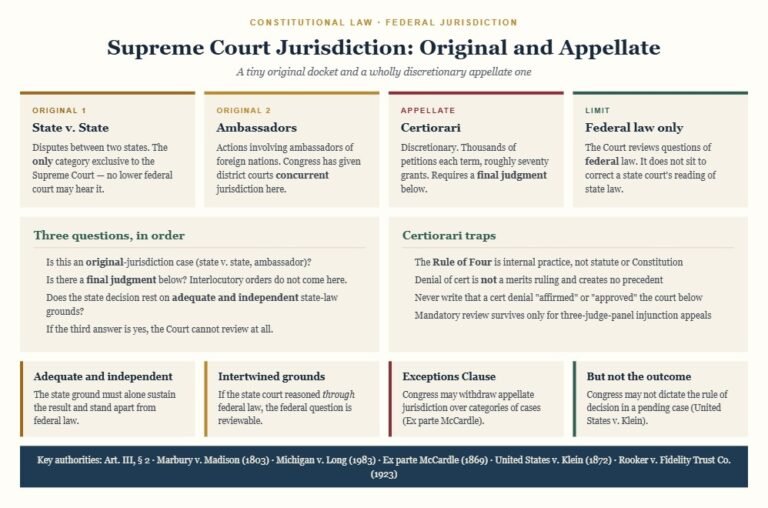 Supreme Court Jurisdiction: Original vs Appellate Power
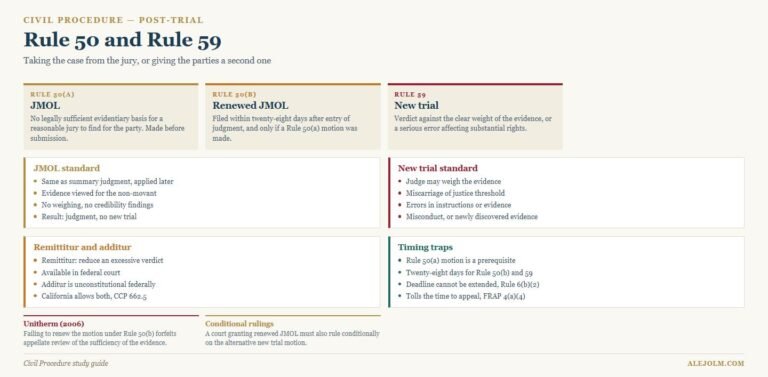 Rule 50 Judgment as a Matter of Law and New Trials
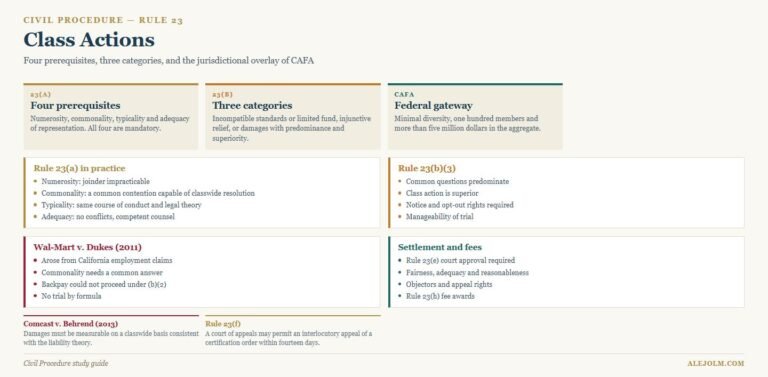 Class Actions Under Rule 23: Certification Explained
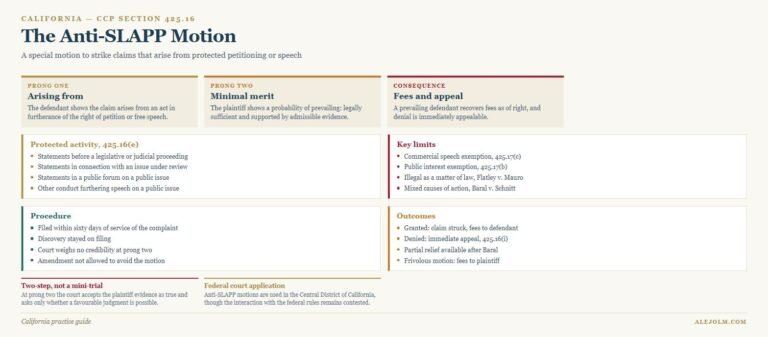 The California Anti-SLAPP Motion: Strike and Appeal
- Removal and Remand: Moving a Case to Federal Court
- The IRAC Method: How to Structure a Bar Exam Answer
- The Seventh Amendment Right to a Jury Trial Explained
- Access to the Courts: When Filing Fees Are Unconstitutional
- Limited vs Unlimited Civil Cases in California Courts
- Summary Judgment Under Rule 56: Standard and Proof
- Res Judicata vs Collateral Estoppel: Bar Exam Guide
Next steps
A final judgment does more than end a case: it fixes what can be litigated afterwards. Read res judicata and collateral estoppel, and post-trial motions for what must happen before the appeal is taken.