Alejo Leal MartínLawyer
Servicios Cómo trabajo CV Publicaciones
Hablemos
Skip to content

alejolm.com

Lawyer — real estate law, transactions and doctoral research.

  • Servicios
  • Cómo trabajo
  • CV
  • Publicaciones
  • Hablemos

Writing

Posted on August 23, 2026August 8, 2026

Section 5 Enforcement Power: Remedy, Do Not Redefine
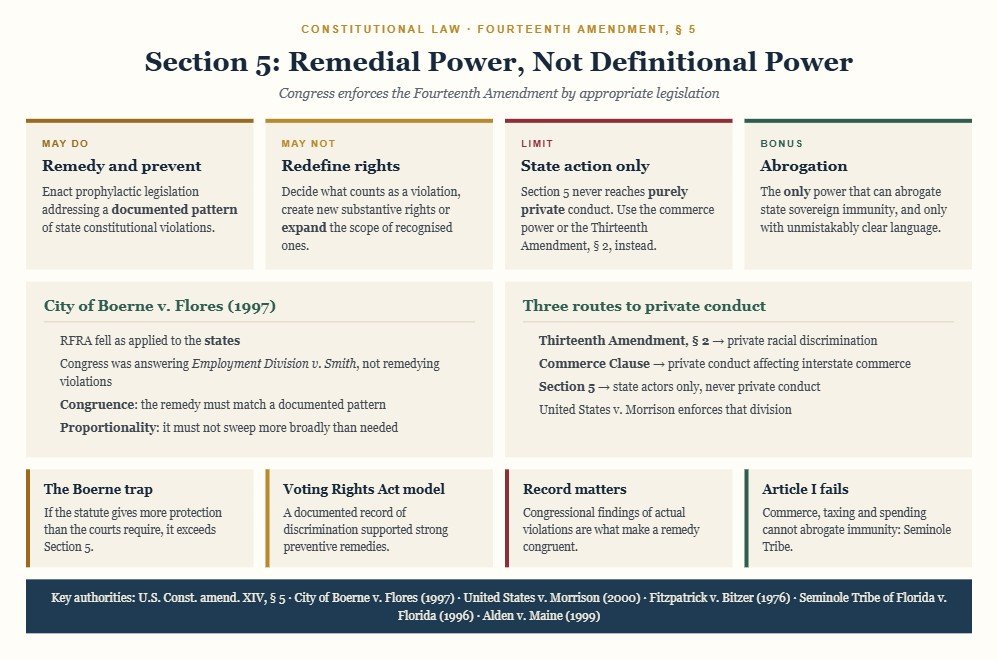
Diagram of the Section 5 enforcement power of the Fourteenth Amendment showing that the power is remedial rather than definitional, the City of Boerne v. Flores congruence and proportionality test requiring a documented pattern of violations and a tailored remedy, the state-action limit that excludes private conduct, and the rule that only Section 5 can abrogate state sovereign immunity.

Section 5 lets Congress remedy Fourteenth Amendment violations that courts have recognised, never redefine them. Learn the Boerne test, the state-action limit and the abrogation rule.

Read the full article →

Posted on August 22, 2026August 8, 2026

The Spending Power and the Five Dole Test Conditions

Diagram of the federal spending power showing the five conditional spending requirements from South Dakota v. Dole, namely general welfare, unambiguous condition, relatedness to the federal interest, no independent constitutional violation and no undue coercion, together with the NFIB v. Sebelius gun to the head test distinguishing new funds from existing funds.

Congress may spend for any public purpose and attach strings, but the Dole conditions and the NFIB anti-coercion limit control how far the strings may reach.
Read the full article →

Posted on August 22, 2026August 8, 2026

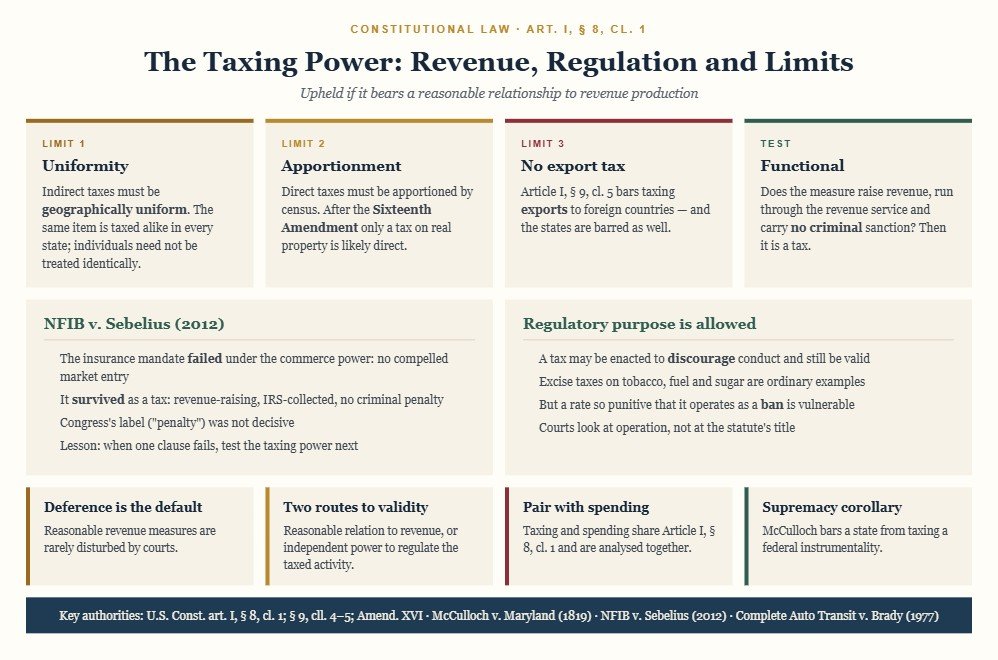
Congress’s Taxing Power: When a Penalty Is Really a Tax

Diagram of the federal taxing power showing the general welfare grant in Article I section 8 clause 1, the three structural limits of uniformity for indirect taxes, apportionment for direct taxes and no tax on exports, and the functional test from NFIB v. Sebelius for deciding whether a measure operates as a tax or as a penalty.

The taxing power is broad and deferential, but three structural limits still bite. Learn the functional tax-versus-penalty test that decided NFIB v. Sebelius.
Read the full article →

Posted on August 22, 2026August 8, 2026

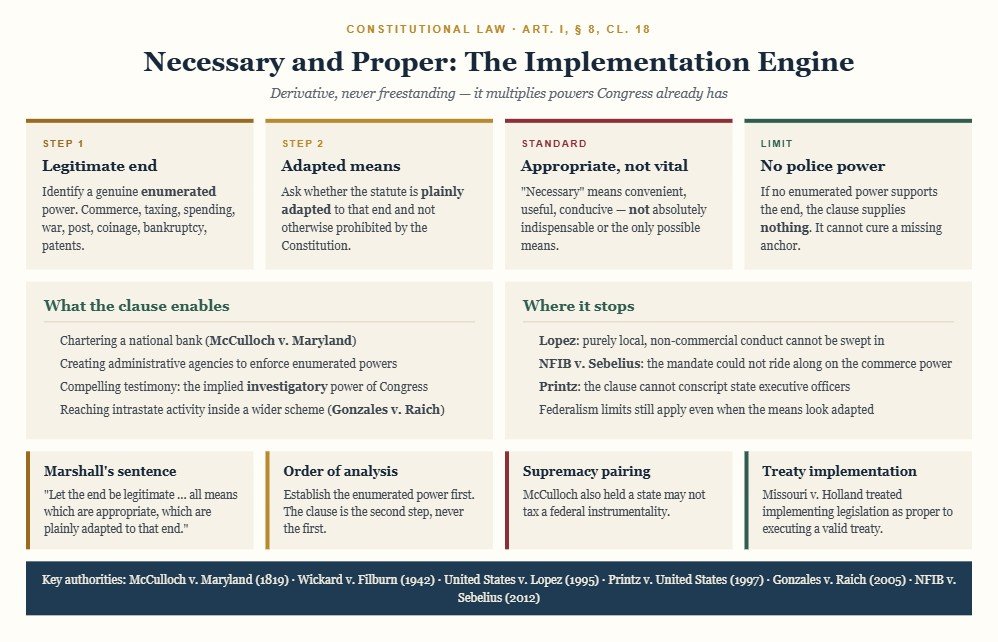
The Necessary and Proper Clause: Congress’s Multiplier

Diagram of the necessary and proper clause showing that it is derivative rather than freestanding, the two-part McCulloch v. Maryland test of a legitimate end and means plainly adapted to that end, the meaning of necessary as appropriate rather than indispensable, and the outer limits marked by United States v. Lopez and Printz v. United States.

The necessary and proper clause never grants power on its own. Learn the two-part McCulloch test, why necessary means appropriate rather than indispensable, and where the clause runs out.
Read the full article →

Posted on August 20, 2026August 8, 2026

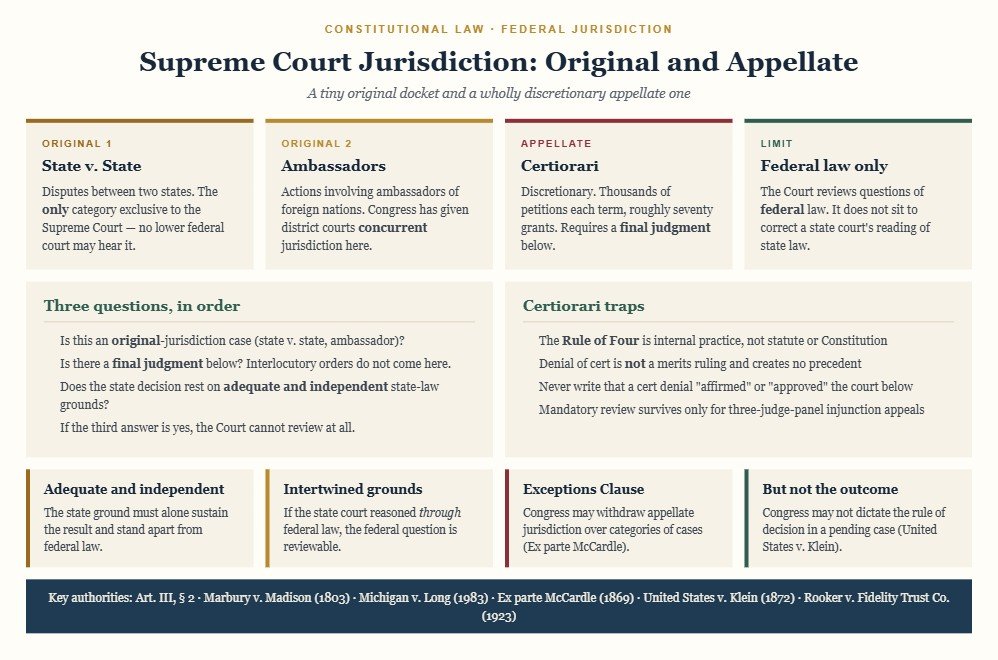
Supreme Court Jurisdiction: Original vs Appellate Power

Diagram of Supreme Court jurisdiction contrasting original jurisdiction over state versus state disputes and ambassador cases with discretionary appellate jurisdiction, showing the final judgment requirement, the Rule of Four, the rule that denial of certiorari is not a merits ruling, and the adequate and independent state-law grounds bar.

Original jurisdiction is tiny, appellate jurisdiction is discretionary, and a cert denial decides nothing. Learn the three questions that resolve any Supreme Court jurisdiction problem.
Read the full article →

Posted on August 20, 2026August 8, 2026

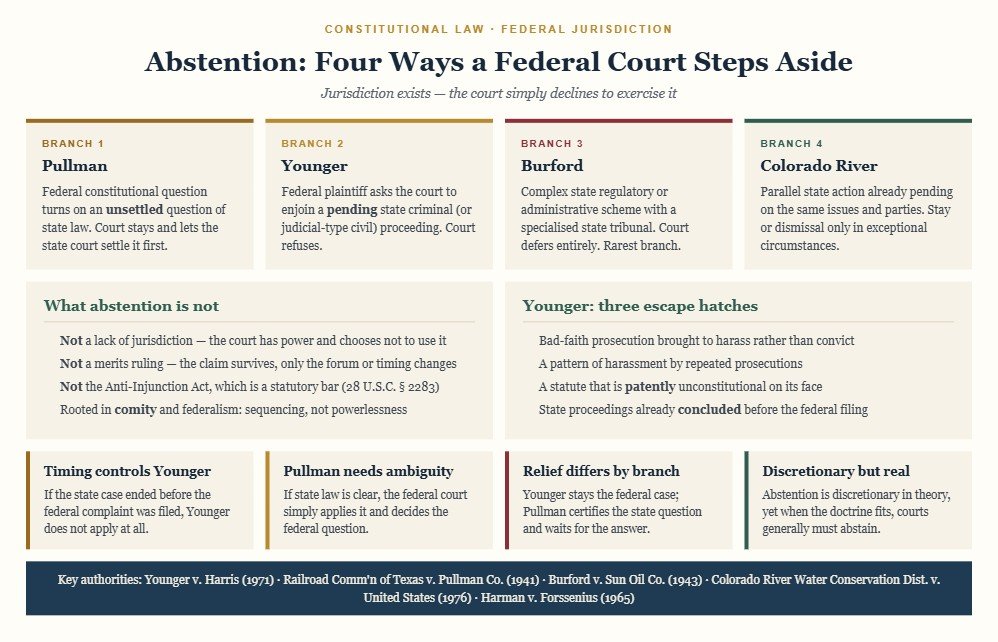
Abstention Doctrine: 4 Ways Federal Courts Step Aside

Diagram of the abstention doctrine showing four branches: Pullman abstention for unsettled state law, Younger abstention for pending state criminal proceedings, Burford abstention for complex state administrative schemes and Colorado River abstention for parallel state litigation, with triggers, remedies and the Younger exceptions of bad faith, harassment and patently unconstitutional statutes.

Abstention lets a federal court that has jurisdiction decline to exercise it out of respect for state courts. Learn the four branches, the triggers and the exam traps.
Read the full article →

Posted on August 20, 2026August 8, 2026

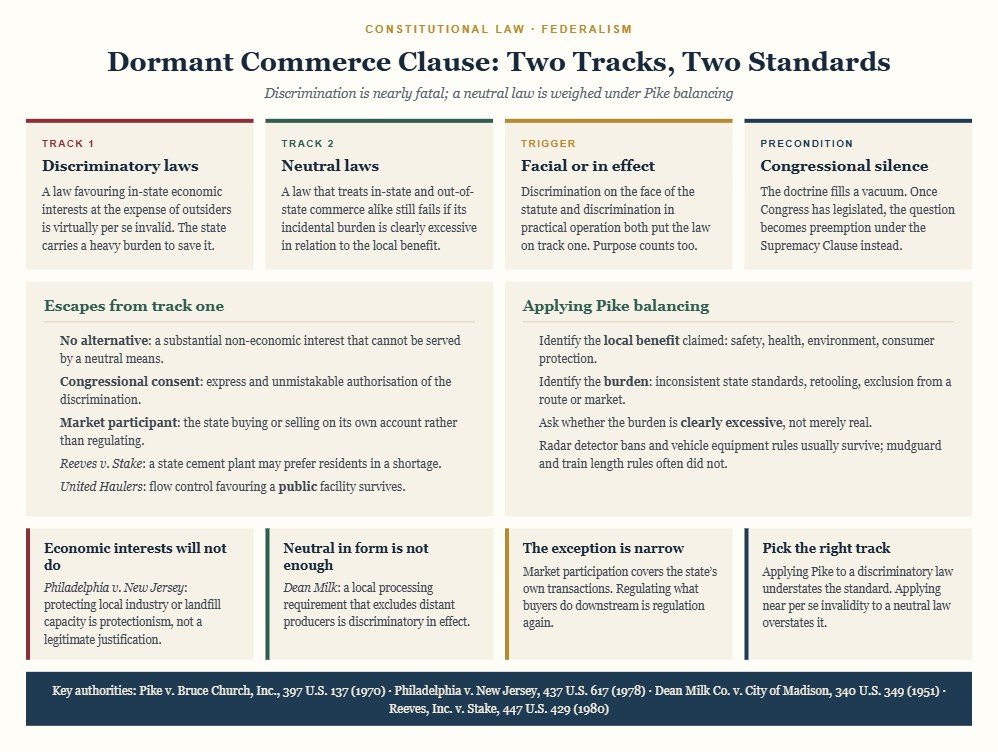
Dormant Commerce Clause: Discrimination vs Pike Balancing

Diagram of dormant Commerce Clause analysis: cards for discriminatory laws that are nearly per se invalid, neutral laws assessed under Pike balancing, discrimination on the face or in effect, and the requirement of congressional silence, with panels on the three escapes from strict review and on how to apply Pike balancing.

The dormant Commerce Clause explained: discriminatory laws that are nearly per se invalid, Pike balancing for neutral laws, and the market participant exception.
Read the full article →

Posted on August 19, 2026August 8, 2026

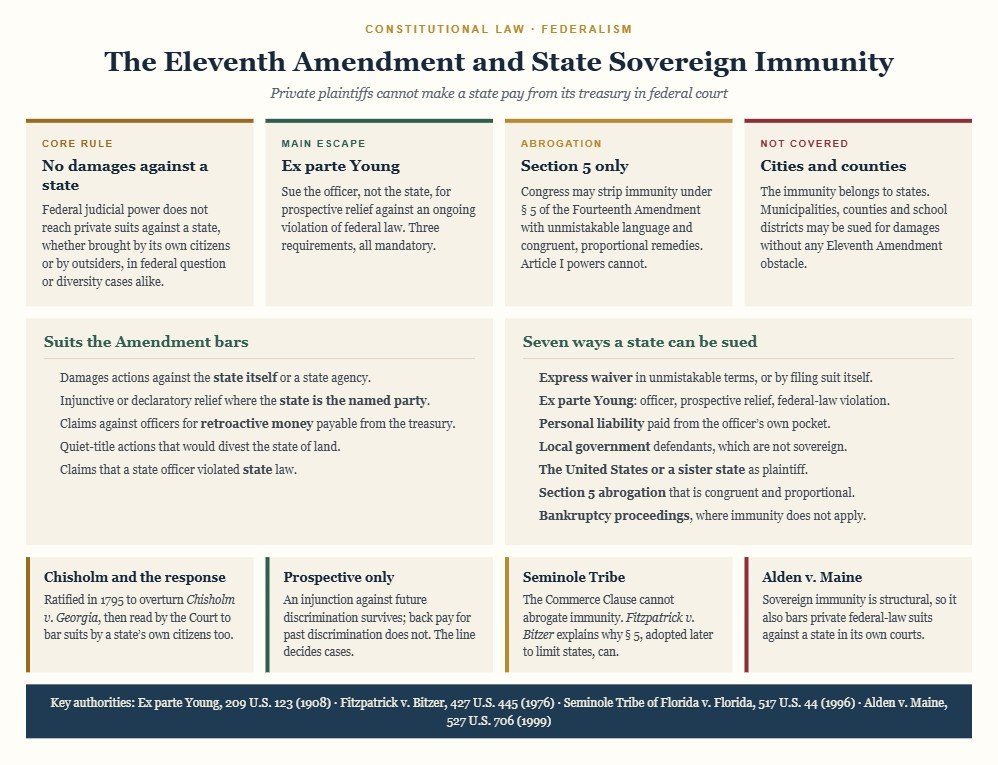
The Eleventh Amendment and State Sovereign Immunity

Diagram of Eleventh Amendment state sovereign immunity: cards on the core bar against damages suits, the Ex parte Young officer suit exception, abrogation under Section 5 of the Fourteenth Amendment and the exclusion of cities and counties, with panels listing the suits that are barred and the seven ways a state can still be sued.

The Eleventh Amendment explained: what state sovereign immunity bars, the three requirements of Ex parte Young, and why only Section 5 can abrogate.
Read the full article →

Posted on August 18, 2026August 8, 2026

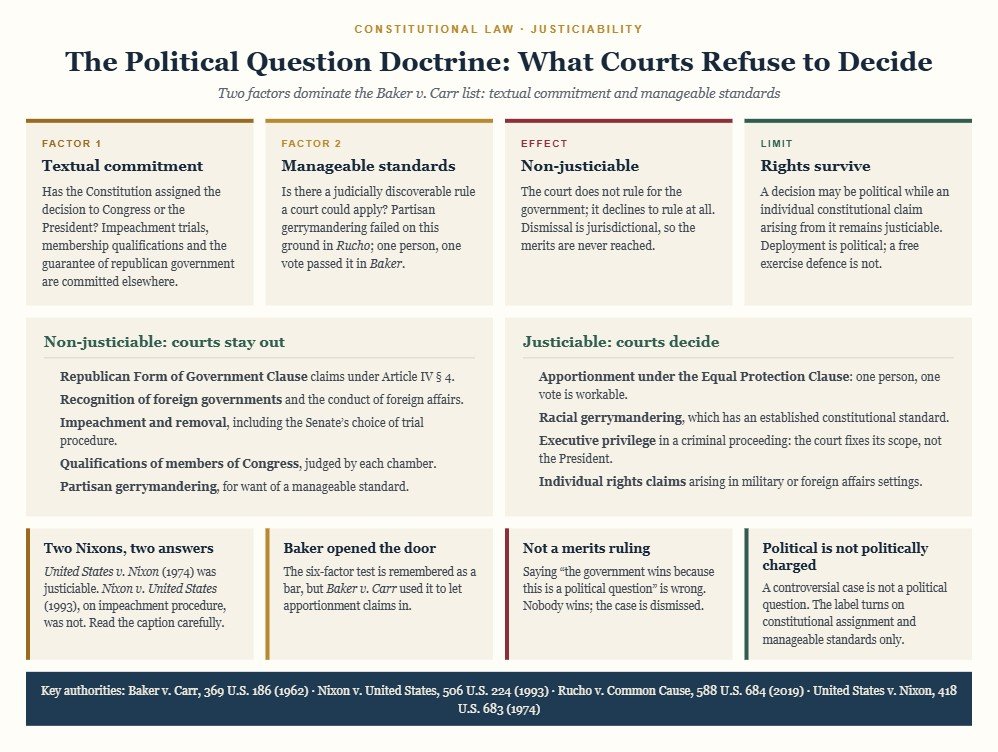
Political Question Doctrine: What Courts Will Not Decide

Diagram of the political question doctrine: cards on textual commitment to another branch, absence of judicially manageable standards, the jurisdictional effect of non-justiciability and the survival of individual rights claims, with panels listing non-justiciable categories such as impeachment and partisan gerrymandering against justiciable ones such as apportionment and executive privilege.

The political question doctrine explained: textual commitment, manageable standards, the categories on each side of the line and the two Nixon cases.
Read the full article →

Posted on August 18, 2026August 8, 2026

Ripeness and Mootness: Timing Rules in Federal Court

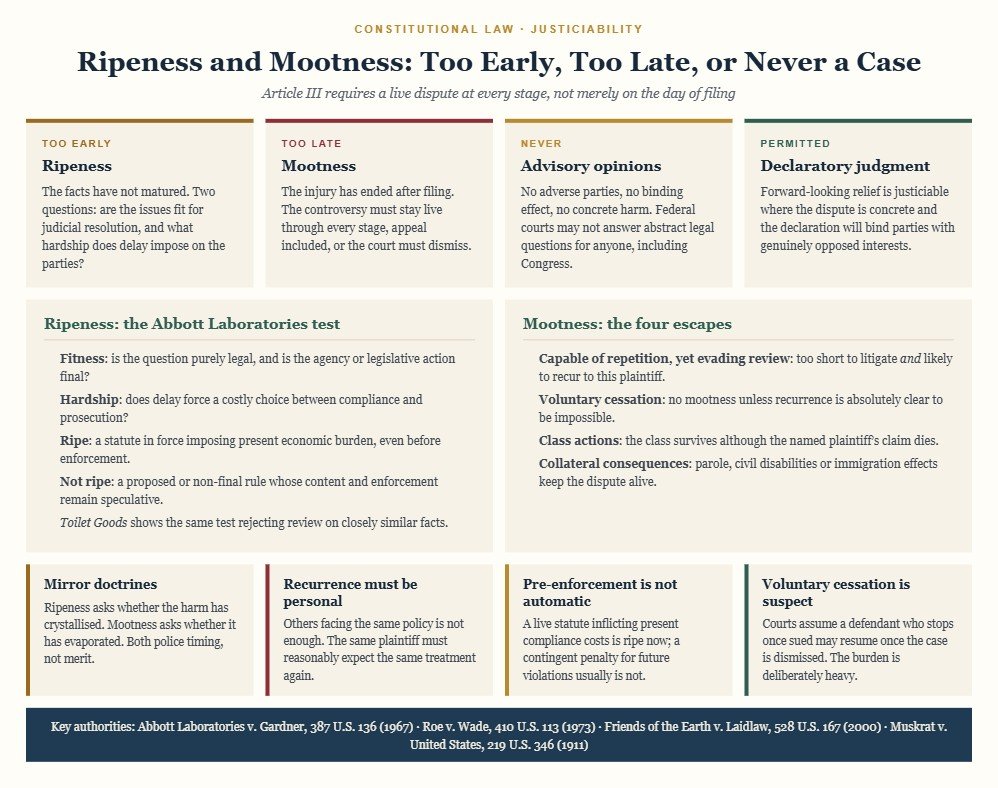
Diagram of federal court timing doctrines: cards for ripeness as too early, mootness as too late, the bar on advisory opinions, and declaratory judgments as permitted forward-looking relief, with panels on the Abbott Laboratories fitness and hardship test and the four exceptions that save a case from mootness, plus cards on personal recurrence and voluntary cessation.

Ripeness and mootness explained: the fitness and hardship test, the four exceptions to mootness, and the line between advisory opinions and declaratory judgments.

Read the full article →

Posts pagination

Previous page Page 1 … Page 4 Page 5 Page 6 Page 7 Next page

Legal notice and cookiesThis website uses technical cookies that are necessary for it to work and, with your consent, measurement cookies. By continuing to browse you declare that you have read and accept the Legal Notice, the Privacy Policy and the Cookie Policy.

Proudly powered by WordPress
