
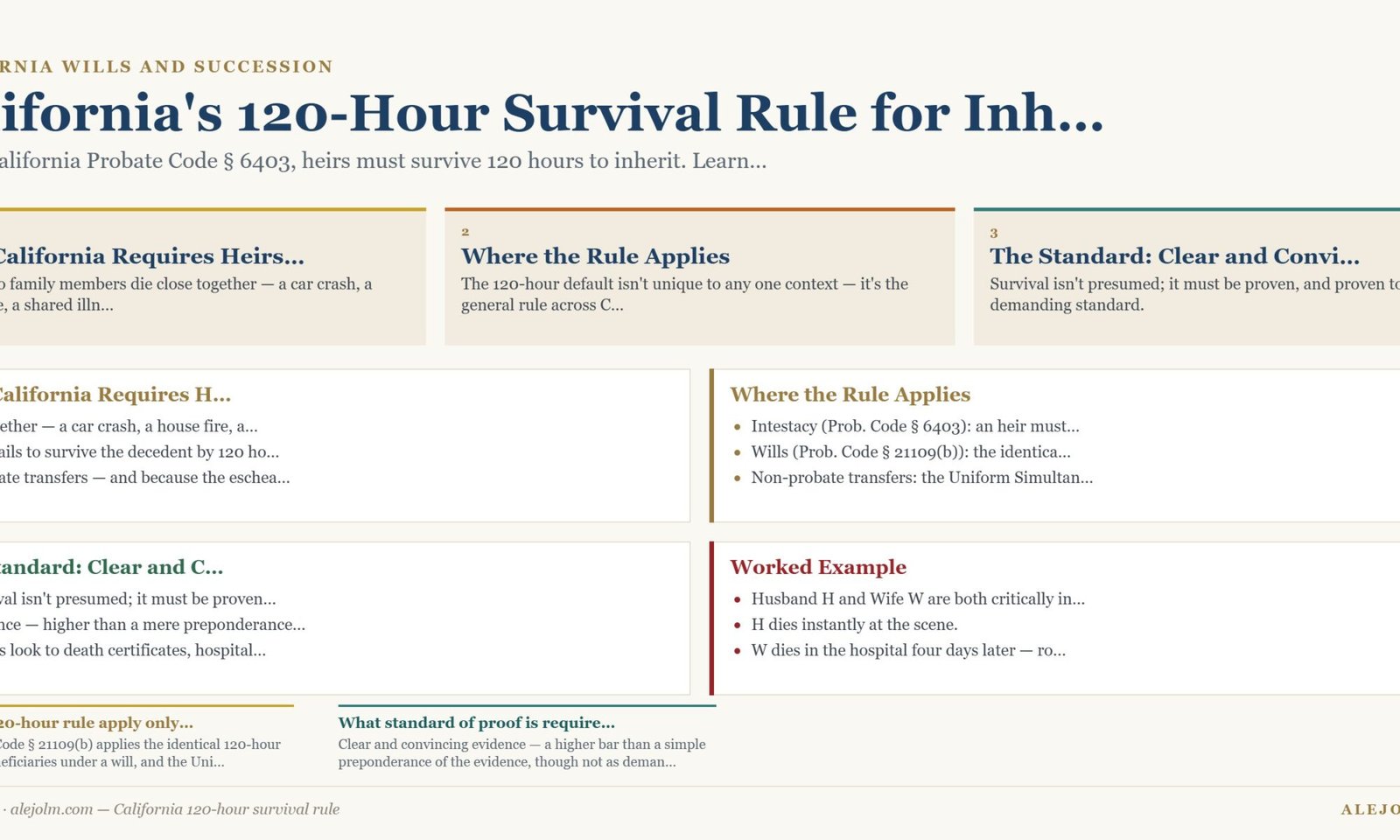
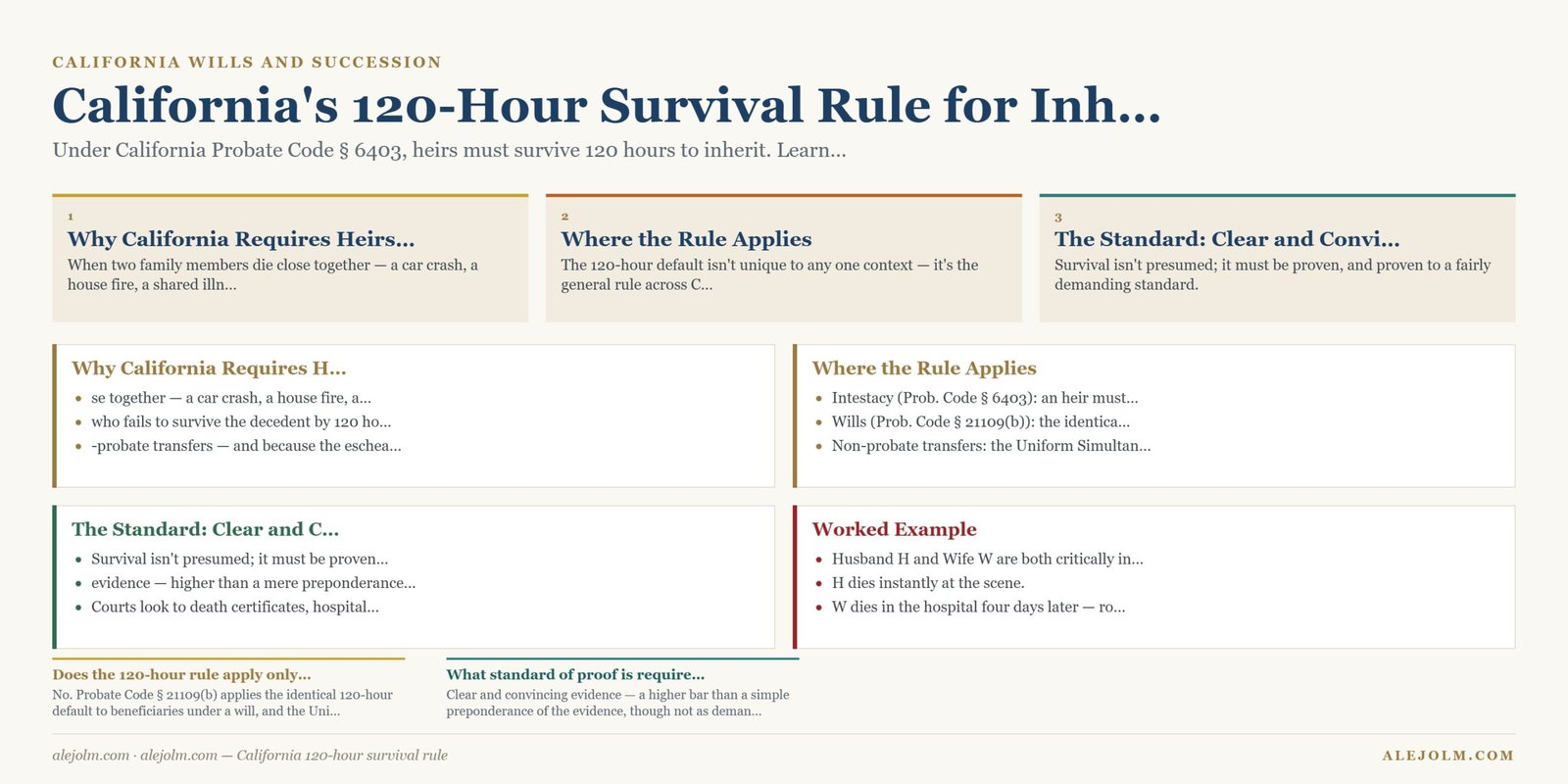
Why California Requires Heirs to Survive by 120 Hours
When two family members die close together — a car crash, a house fire, a shared illness — who inherits from whom can become a genuine puzzle. California solves it with the 120-hour survival rule: an heir, will beneficiary, or non-probate transferee who fails to survive the decedent by 120 hours (five full days) is legally treated as having predeceased them.
This rule is a fixture of the California Bar Exam because it quietly governs three different areas at once — intestacy, wills, and non-probate transfers — and because the escheat exception creates a genuinely tricky twist examiners love to test.
In plain terms: if you can’t prove someone survived the decedent by a full 120 hours using clear and convincing evidence, the law treats that person as if they died first, and their inheritance passes to the next eligible heir instead.
Where the Rule Applies
The 120-hour default isn’t unique to any one context — it’s the general rule across California succession law:
- Intestacy (Prob. Code § 6403): an heir must survive the decedent by 120 hours, proven by clear and convincing evidence, or they’re deemed to have predeceased.
- Wills (Prob. Code § 21109(b)): the identical 120-hour default applies to will beneficiaries, unless the will contains contrary survival language.
- Non-probate transfers: the Uniform Simultaneous Death Act (Prob. Code §§ 220 et seq.) extends the same 120-hour default to joint tenancy property, life insurance, and other will substitutes.
In every context, a governing instrument can override the default. A will that says a beneficiary need only survive “for any period” — or that supplies its own survival clause, like “survives me by thirty days” — displaces the statutory 120-hour rule for that specific gift.
The Standard: Clear and Convincing Evidence
Survival isn’t presumed; it must be proven, and proven to a fairly demanding standard. Whoever claims through the surviving heir carries the burden of establishing 120-hour survival by clear and convincing evidence — higher than a mere preponderance, though lower than the criminal “beyond a reasonable doubt” bar. Courts look to death certificates, hospital records, medical examiner reports, and expert testimony on timing.
The rule is applied with strict, unforgiving precision: 119 hours, 59 minutes, and 59 seconds does not satisfy it. Only a full 120 hours counts.
Worked Example
Husband H and Wife W are both critically injured in a plane crash. H dies instantly at the scene. W dies in the hospital four days later — roughly 96 hours after H — from injuries sustained in the same crash.
Analysis: 96 hours is less than 120 hours, so W does not satisfy the survival requirement. Under Probate Code § 6403, W is treated as having predeceased H for purposes of H’s intestate estate. If H has an adult child from a prior relationship, that child inherits H’s entire intestate estate; W’s own family inherits nothing through H, even though W was, in fact, alive for several days after H died.
Change the facts slightly: W instead dies on day five, 121 hours after H, and medical records clearly document the timing. Now W satisfies the 120-hour requirement, and if W qualifies as H’s heir, W’s estate (and from there, W’s own beneficiaries) inherits from H.
The Escheat Exception
California strongly disfavors property escheating — reverting — to the State. So the 120-hour rule includes a built-in safety valve: if strictly applying the rule would send the entire estate to the State because no one can prove 120-hour survival, the rule is disregarded, and the potential heir is deemed to have survived.
This exception only kicks in when no other heir clearly qualifies. If a second heir does satisfy the 120-hour requirement independently, the exception doesn’t rescue the first, disqualified heir — the clearly-qualifying heir simply takes instead.
| Scenario | 120-hour rule applies? | Outcome |
|---|---|---|
| Sole heir’s survival time is unclear; no other heirs exist | No (escheat exception) | Heir is deemed to survive; property passes to them |
| Sole heir survived only 72 hours; a second heir clearly survived 150+ hours | Yes, against the 72-hour heir | Second heir takes; first heir is excluded |
| Heir clearly survived less than 120 hours, and other qualifying heirs exist | Yes | Disqualified heir is excluded; next-in-line heir takes |
Drafting Around the Default
Because § 21109(b) imposes the 120-hour default on will beneficiaries too, estate planning attorneys frequently draft explicit survival clauses to control the outcome precisely — for example, “to my spouse if my spouse survives me by thirty days,” which replaces the statutory 120-hour period with a 30-day one for that particular gift. A will’s custom survival clause, however, only controls property passing under that will; it has no effect on the separate § 6403 rule governing any portion of the estate that passes by intestacy.
Frequently Asked Questions
Does the 120-hour rule apply only to people who die without a will?
No. Probate Code § 21109(b) applies the identical 120-hour default to beneficiaries under a will, and the Uniform Simultaneous Death Act extends a similar default to non-probate transfers like life insurance and joint tenancy property.
What standard of proof is required to establish 120-hour survival?
Clear and convincing evidence — a higher bar than a simple preponderance of the evidence, though not as demanding as the criminal “beyond a reasonable doubt” standard.
Can the 120-hour rule cause property to escheat to the State?
It can, in theory, but California’s escheat exception prevents that outcome whenever no other qualifying heir exists: the questionable heir is presumed to have survived rather than let the property revert to the State.
Key Takeaways
- An heir, will beneficiary, or non-probate transferee who can’t prove 120-hour survival by clear and convincing evidence is deemed to have predeceased the decedent.
- The rule applies across intestacy (§ 6403), wills (§ 21109(b)), and non-probate transfers under the Uniform Simultaneous Death Act.
- A governing instrument’s contrary survival language always controls over the statutory default.
- 119 hours and 59 minutes does not satisfy the requirement — only a full 120 hours does.
- The escheat exception presumes survival when strict application would otherwise send the estate to the State.
This article is educational and is not legal advice. Consult a licensed California attorney about your situation.
Related guides
- the California slayer rule
- per capita with representation under § 240
- the surviving spouse’s intestate share
- testamentary power at death