
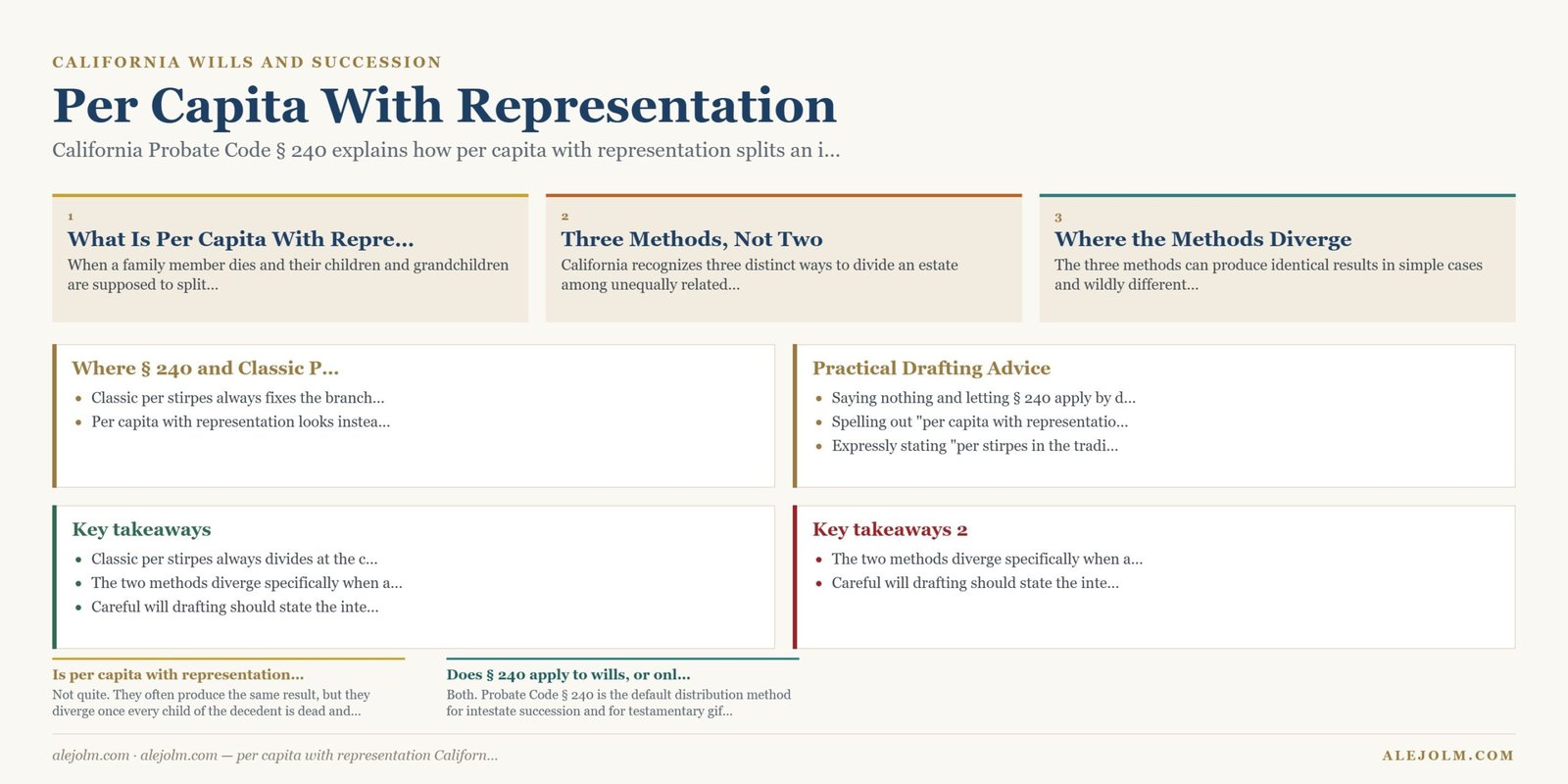
What Is Per Capita With Representation?
When a family member dies and their children and grandchildren are supposed to split an inheritance, how exactly do you divide it? California answers that question with per capita with representation, codified at Probate Code § 240 — the default distribution method for both intestate succession and testamentary gifts unless a will or trust says otherwise.
This concept is a perennial California Bar Exam trap because it looks almost identical to “classic per stirpes,” a different method with a different result. Getting the two confused is one of the most common wills-and-trusts mistakes examinees make — and it’s also a genuinely useful thing for anyone drafting or interpreting a will to understand.
Per capita with representation, defined: California’s default distribution method divides an estate into equal shares at the first generation with at least one living member; each living member takes a full share, and each deceased member’s share passes down, per capita, to that person’s own descendants (Prob. Code § 240).
Three Methods, Not Two
California recognizes three distinct ways to divide an estate among unequally related descendants, and the bar exam turns on keeping them straight.
- Pure per capita. Every living descendant, of any generation, is treated as one “head” and takes an identical share. Representation is ignored completely. This method rarely governs by default; it applies only when an instrument expressly calls for it.
- Per capita with representation (§ 240 — California’s default). Divides at the first generation with a living member, then represents deceased members of that generation through their own descendants.
- Classic (strict) per stirpes. Always divides at the children’s generation, even if every child is dead, so long as at least one child left descendants. Applies only if a will or trust expressly directs it.
Where the Methods Diverge
The three methods can produce identical results in simple cases and wildly different results in others. Compare all three on the same facts: Decedent D has one surviving child, A, and two grandchildren, G1 and G2, through a predeceased child, B.
| Method | A’s share | G1’s share | G2’s share |
|---|---|---|---|
| Pure per capita | 1/3 | 1/3 | 1/3 |
| Per capita with representation (§ 240) | 1/2 | 1/4 | 1/4 |
| Classic per stirpes | 1/2 | 1/4 | 1/4 |
Under § 240, the estate is divided at the children’s generation because A is alive there. A takes a full share (1/2); B’s share (1/2) is divided per capita between G1 and G2 (1/4 each). Pure per capita ignores this entirely and treats A, G1, and G2 as three equal heads.
Where § 240 and Classic Per Stirpes Diverge
The two methods look alike whenever a member of the pivot generation survives, but they split apart once every child of the decedent is dead and those children left unequal numbers of descendants.
Example: D’s two children, X and Y, are both deceased. X left one child (X1); Y left three children (Y1, Y2, Y3).
- Classic per stirpes always fixes the branches at the children’s level: X’s branch gets 1/2 (all to X1); Y’s branch gets 1/2 (split 1/6 each among Y1, Y2, Y3). X1 ends up with three times as much as each of Y’s children.
- Per capita with representation looks instead for the first generation with a living member. Since neither X nor Y survives, the pivot shifts to the grandchildren’s generation — the first generation with living people. All four grandchildren split the estate equally: 1/4 each.
That single difference — 1/2 for X1 under per stirpes versus 1/4 under § 240 — is exactly the kind of fact pattern the bar exam loves to test.
Worked MBE-Style Hypo
Decedent has three children: A (alive), B (predeceased, leaving two children), and C (predeceased, leaving one child). Under § 240, where does the split happen?
Analysis: At the first generation with a living taker — here, the children’s generation, because A is alive. A takes 1/3. B’s 1/3 is divided per capita between B’s two children (1/6 each). C’s 1/3 passes entirely to C’s one surviving child.
Now suppose A is also deceased, and A left two children of her own. With no living member at the children’s generation, the pivot shifts down to the grandchildren’s generation. All grandchildren from every branch — A’s two children, B’s two children, and C’s one child — divide the estate as a single class, five equal shares of 1/5 each, regardless of which parent they descend from.
Practical Drafting Advice
Many older wills use “per stirpes” language intending the modern, equitable per capita with representation result — but under California law, “per stirpes” language alone doesn’t automatically get you § 240’s outcome if a court interprets it as classic per stirpes. To avoid ambiguity, California estate planners generally recommend either:
- Saying nothing and letting § 240 apply by default; or
- Spelling out “per capita with representation” explicitly if that’s the intent; or
- Expressly stating “per stirpes in the traditional sense” only if classic per stirpes is truly what the client wants (rare in modern practice).
Frequently Asked Questions
Is per capita with representation the same as per stirpes?
Not quite. They often produce the same result, but they diverge once every child of the decedent is dead and the surviving grandchildren come from branches with different numbers of children. Per capita with representation pools shares at the first living generation; classic per stirpes always preserves the branch division at the children’s level.
Does § 240 apply to wills, or only to intestacy?
Both. Probate Code § 240 is the default distribution method for intestate succession and for testamentary gifts under wills and trusts, unless the instrument specifies a different method.
What happens if a beneficiary’s share lapses instead of passing to their descendants?
Lapse and per capita with representation are separate doctrines. The lapse doctrine and California’s anti-lapse statute determine whether a deceased beneficiary’s gift lapses to the residuary estate or passes to their descendants; § 240 only governs how a non-lapsed share is divided among the takers.
Key Takeaways
- California defaults to per capita with representation (Probate Code § 240) for both intestacy and testamentary gifts.
- § 240 divides the estate at the first generation with a living member, then represents deceased members through their own descendants.
- Classic per stirpes always divides at the children’s generation, even if no child survives — it applies only when a document expressly requires it.
- The two methods diverge specifically when all children are deceased and leave unequal numbers of descendants.
- Careful will drafting should state the intended method explicitly to avoid litigation.
This article is educational and is not legal advice. Consult a licensed California attorney about your situation.
Related guides
- the surviving spouse’s intestate share
- California’s 120-hour survival rule
- half-blood siblings and inheritance
- intestate succession and the surviving spouse