
What Is a Subordination Agreement?
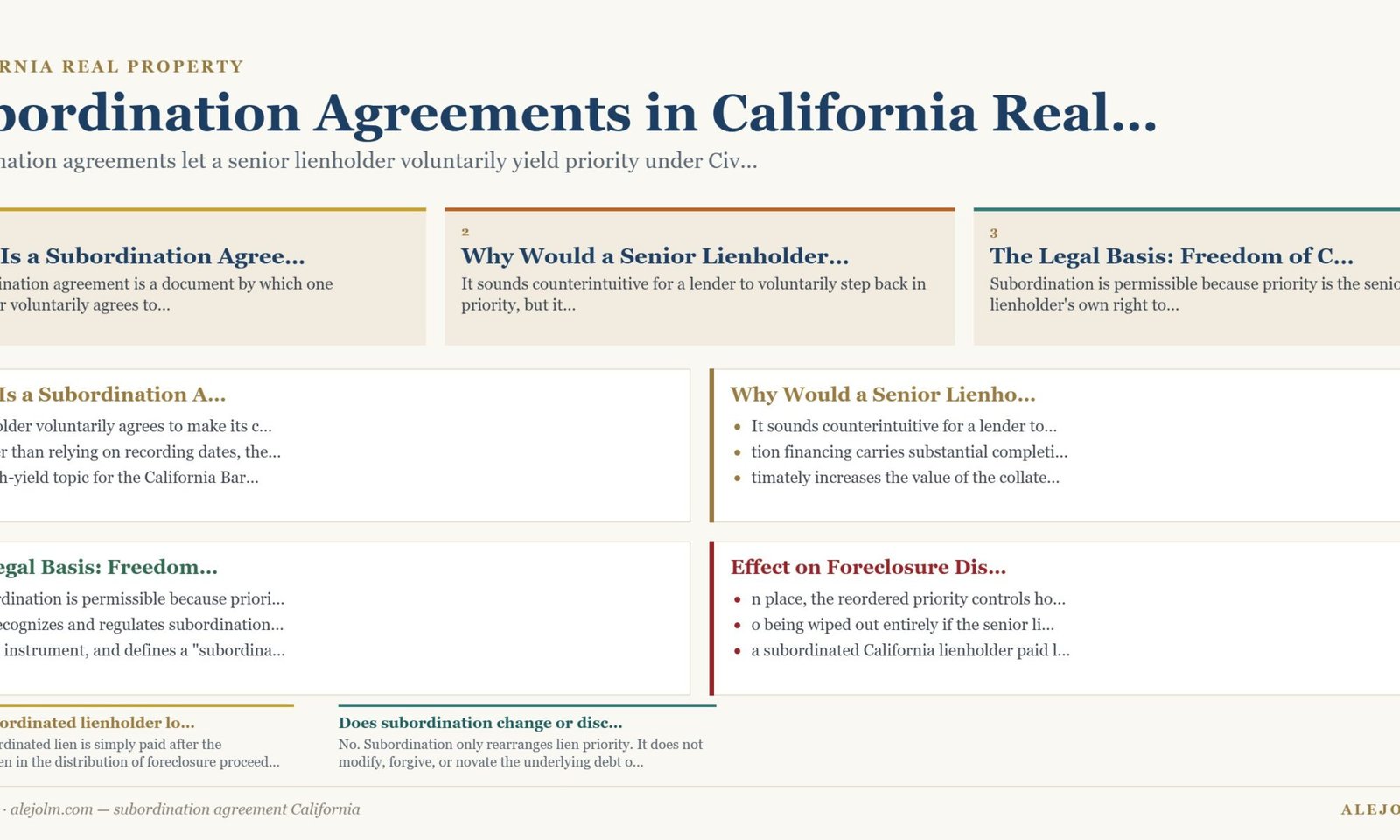
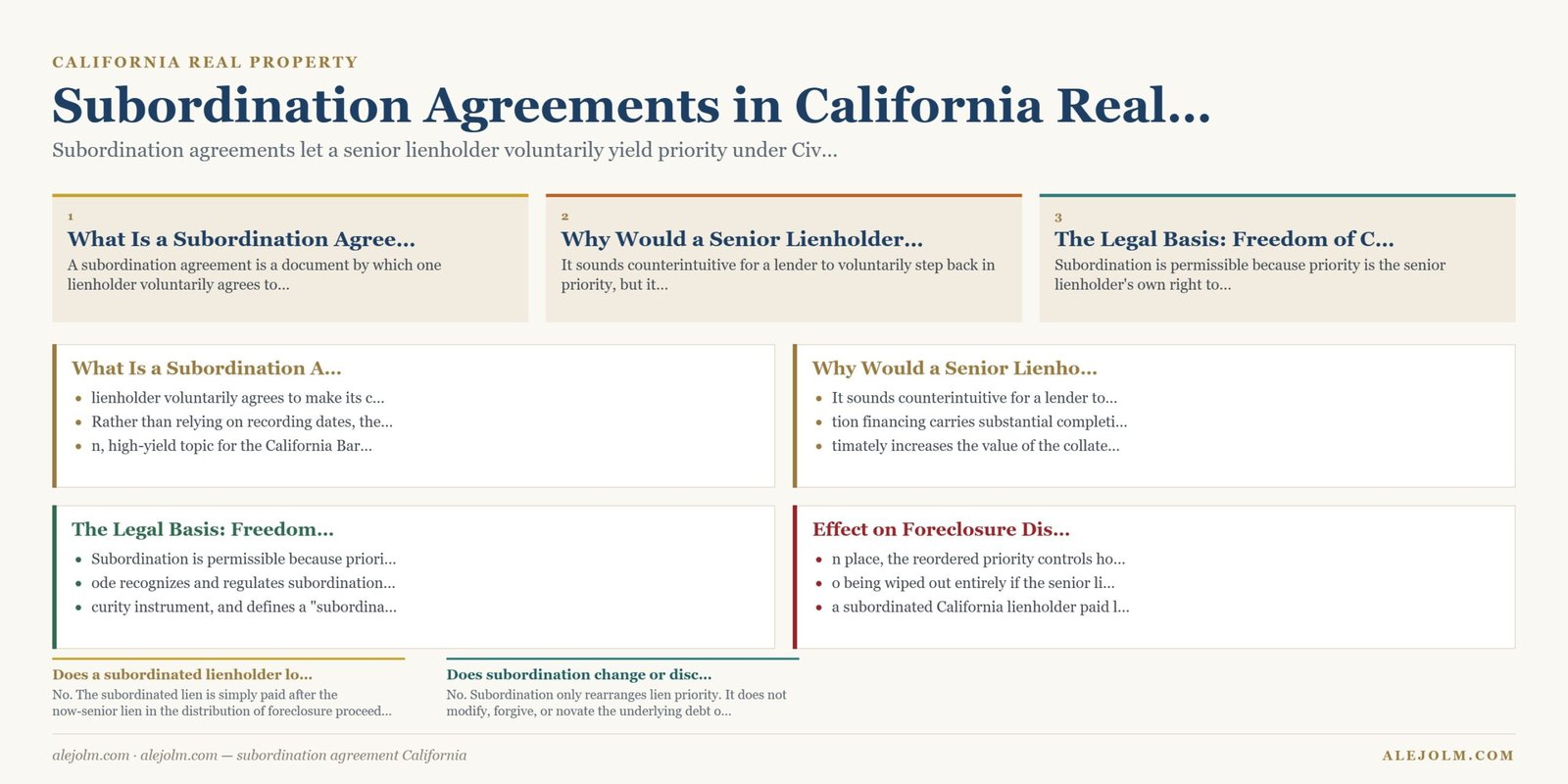
A subordination agreement is a document by which one lienholder voluntarily agrees to make its claim junior — inferior in priority — to another lienholder’s claim. Rather than relying on recording dates, the parties simply rearrange priority by contract. It’s a routine, everyday tool in California construction lending and seller financing, and it’s a clean, high-yield topic for the California Bar Exam because the rule itself is simple once you see the pattern.
Why Would a Senior Lienholder Ever Subordinate?
It sounds counterintuitive for a lender to voluntarily step back in priority, but it happens constantly. The classic scenario: a landowner has an existing recorded mortgage and wants a new construction loan, but the construction lender insists on first-lien status as a condition of funding the project (since construction financing carries substantial completion risk, and the lender wants first claim on the improved property). The existing lender may agree to subordinate — accepting junior status — because a completed, improved project ultimately increases the value of the collateral securing everyone’s loan, including its own now-junior position.
The Legal Basis: Freedom of Contract
Subordination is permissible because priority is the senior lienholder’s own right to give away. California’s Civil Code recognizes and regulates subordination clauses and subordination agreements directly — Civil Code § 2953.1 defines a “subordination clause” as a provision in a real property security instrument by which the holder agrees that, on the occurrence of specified conditions, its security interest will become subordinate to the lien of another security instrument, and defines a “subordination agreement” as a separate instrument achieving that same result. Because vague, open-ended future subordination promises invited real disputes historically, California law and case authority (notably Handy v. Gordon) have pushed toward requiring subordination arrangements to specify essential terms clearly to be enforceable.
Effect on Foreclosure Distribution
Once a subordination agreement is in place, the reordered priority controls how sale proceeds get distributed if the property is later foreclosed. The now-junior (subordinated) lien is paid only after the newly senior lien is satisfied in full — and, like any junior interest, it’s subject to being wiped out entirely if the senior lien forecloses and the proceeds don’t stretch far enough to cover it.
Worked Example: Bank A Subordinates to Bank B
A landowner has an existing recorded mortgage with Bank A. She wants a construction loan from Bank B, which insists on first priority as a condition of lending. Bank A signs a subordination agreement placing Bank B’s new construction mortgage ahead of its own, even though Bank A recorded first. On a later foreclosure, Bank B is paid in full before Bank A receives a single dollar — the subordination agreement displaces the ordinary first-to-record rule entirely as between these two parties.
Strict Priority, Not Pro-Rata
Bar questions frequently test whether foreclosure proceeds get split proportionally among lienholders. They don’t. California follows strict priority distribution: senior liens are paid in full before junior liens receive anything at all, not a pro-rata share based on the size of each debt.
For example: Mortgagee 1 recorded in 2020 subordinates to Mortgagee 2, who recorded in 2023. The property later sells at foreclosure for $80,000, but the two lenders’ combined debt is $200,000. Mortgagee 2 — now senior by virtue of the subordination agreement — is paid the full $80,000. Mortgagee 1 gets nothing. Proceeds are not divided proportionally between the two.
Subordination vs. Related Priority Doctrines
| Doctrine | Mechanism | Requires Agreement? |
|---|---|---|
| Subordination agreement | Contractual reordering of priority | Yes — voluntary contract |
| Purchase-money mortgage super-priority | Statutory priority under Civil Code § 2898 | No — automatic by operation of law |
| Equitable subrogation | Equitable substitution into a payoff lender’s position | No — arises from the payoff transaction itself |
FAQ
Does a subordinated lienholder lose its claim entirely?
No. The subordinated lien is simply paid after the now-senior lien in the distribution of foreclosure proceeds; it’s not extinguished by the subordination itself, though it may end up unpaid if proceeds run out before reaching it.
Does subordination change or discharge the underlying debt?
No. Subordination only rearranges lien priority. It does not modify, forgive, or novate the underlying debt or the lien securing it — the subordinated lienholder is still owed the full amount, just paid later in the distribution order.
Are foreclosure sale proceeds split proportionally among lienholders?
No. California applies strict priority: senior liens (including any lien elevated by a subordination agreement) are paid in full before junior liens receive anything, rather than splitting proceeds pro rata by debt size.
Key Takeaways
- A subordination agreement lets a senior lienholder voluntarily accept junior status by contract, displacing the first-to-record rule between the parties.
- California Civil Code § 2953.1 defines and regulates subordination clauses and subordination agreements in real property security instruments.
- Subordination is common in construction lending, where an existing lender yields priority to a new construction lender.
- Subordination does not discharge or modify the underlying debt — it only reorders payment priority.
- Foreclosure proceeds are distributed by strict priority, not pro rata, so a subordinated lender can be paid last or not at all.
This article is educational and is not legal advice. Consult a licensed California attorney about your situation.
Related guides
- purchase-money mortgage priority
- deeds of trust in California
- California’s mortgage foreclosure process
- equitable subrogation in California