

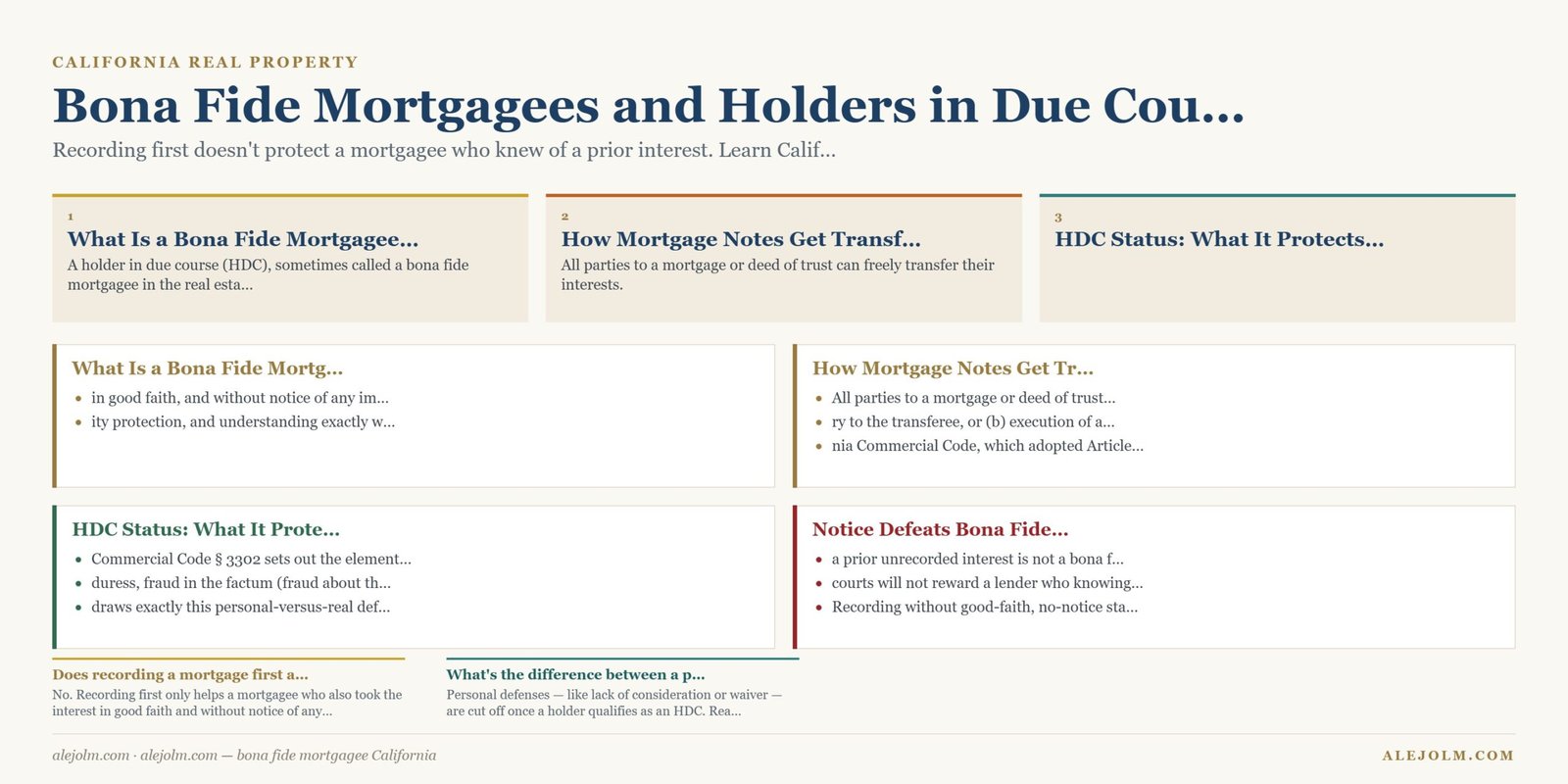
What Is a Bona Fide Mortgagee / Holder in Due Course?
A holder in due course (HDC), sometimes called a bona fide mortgagee in the real estate context, is someone who takes a negotiable promissory note — made out to the holder — for valuable consideration, in good faith, and without notice of any impediment or competing interest in the property securing it. Only a taker who satisfies all three elements gets the law’s fullest priority protection, and understanding exactly what defeats that status is a frequent California Bar Exam issue.
How Mortgage Notes Get Transferred
All parties to a mortgage or deed of trust can freely transfer their interests. When a lender sells or assigns its loan, the security instrument follows the properly transferred note — accomplished either by (a) endorsement of the note plus delivery to the transferee, or (b) execution of a separate written assignment of the mortgage or deed of trust. California codifies the mechanics of negotiable-instrument transfer, including holder-in-due-course status, in the California Commercial Code, which adopted Article 3 of the Uniform Commercial Code governing negotiable instruments.
HDC Status: What It Protects Against
Commercial Code § 3302 sets out the elements: value, good faith, and no notice of a claim or defense. An HDC takes free of the mortgagor’s personal defenses — things like lack of consideration, prior payment, or waiver — but remains subject to real defenses, such as duress, fraud in the factum (fraud about the very nature of the instrument being signed), forgery, or infancy. Commercial Code § 3305 draws exactly this personal-versus-real defense line, and it’s the single most tested distinction in this area.
| Defense Type | Examples | Effect Against an HDC |
|---|---|---|
| Personal defenses | Lack of consideration, waiver, prior payment, ordinary breach of contract | Cut off — HDC takes free of these |
| Real defenses | Duress, fraud in the factum, forgery, infancy, illegality voiding the obligation | Survive — HDC remains subject to these |
Notice Defeats Bona Fide Status — Even With Recording
Here’s the doctrine’s sharpest, most tested edge: recording gives notice to subsequent parties, but recording is not required to secure an interest, and a mortgagee who takes with actual knowledge of a prior unrecorded interest is not a bona fide mortgagee or HDC — even if that mortgagee records first. California courts will not reward a lender who knowingly takes a competing interest into a race to the recorder’s office. Recording without good-faith, no-notice status is legally worthless for priority purposes.
Worked Example: Ira’s Machine Shop
Ira buys a machine shop, giving the seller, Jane, a promissory note secured by a deed of trust for part of the price — Jane’s deed of trust is a vendor purchase-money interest, but it’s never recorded. Ira also borrows $400,000 from Acme Bank for the balance. Acme records its deed of trust promptly, but Acme’s loan officer knew about Jane’s unrecorded deed of trust before escrow closed.
On foreclosure, does Acme’s recorded-first status protect it? No. Because Acme took with actual knowledge of Jane’s prior interest, Acme is not a bona fide mortgagee, regardless of recording first. Jane’s senior, vendor purchase-money interest is paid ahead of Acme’s loan. Recording is not a laundering mechanism for actual notice.
A Second Worked Example: Personal vs. Real Defenses
A lender assigns a mortgage note by endorsement and delivery to an investor, who pays full value, acts in good faith, and has no notice that the original borrower claims the underlying loan lacked consideration. The borrower later raises that lack-of-consideration defense against the investor’s attempt to enforce the note.
The investor wins as an HDC. Lack of consideration is a personal defense, and the investor takes free of it. The investor would remain subject to a real defense — such as duress at signing, or the note being forged — but a personal defense like this one simply doesn’t survive against a genuine HDC.
The Two-Screen Framework for Priority Disputes
Whenever a fact pattern raises competing mortgagee claims, run two separate screens:
- Is the claimant an HDC or bona fide mortgagee? Check value, good faith, and no notice.
- Does California’s recording act protect the claimant? California follows a race-notice approach: the claimant needs both no notice of the prior interest and to have recorded first.
A mortgagee with actual knowledge fails both screens simultaneously — recording first can never cure or “launder” actual notice of a competing interest.
FAQ
Does recording a mortgage first always guarantee priority in California?
No. Recording first only helps a mortgagee who also took the interest in good faith and without notice of any prior competing claim. A mortgagee with actual knowledge of an earlier unrecorded interest is not a bona fide mortgagee, even after recording first.
What’s the difference between a personal defense and a real defense against a holder in due course?
Personal defenses — like lack of consideration or waiver — are cut off once a holder qualifies as an HDC. Real defenses — like duress, forgery, or fraud in the factum — survive and remain enforceable even against a genuine HDC.
How is a mortgage note properly transferred to a new holder in California?
Either by endorsing the note and delivering it to the transferee, or by executing a separate written assignment of the mortgage or deed of trust; the security instrument follows a properly transferred note.
Key Takeaways
- A bona fide mortgagee/HDC takes a note for value, in good faith, and without notice of competing claims or defenses.
- HDC status cuts off personal defenses like lack of consideration but never defeats real defenses like duress or forgery.
- Actual knowledge of a prior unrecorded interest defeats bona fide status even if the later mortgagee records first.
- California’s race-notice recording framework requires both no notice and first recording — failing either one is fatal.
- Vendor purchase-money interests can still prevail over a later-recorded bank loan if the bank had actual knowledge of the earlier interest.
This article is educational and is not legal advice. Consult a licensed California attorney about your situation.
Mostrando SEO-06-real-property.md.
Related guides
- deeds of trust in California
- bona fide purchaser rules
- bona fide purchaser notice types
- purchase-money mortgage priority
- wild deeds and chain of title