
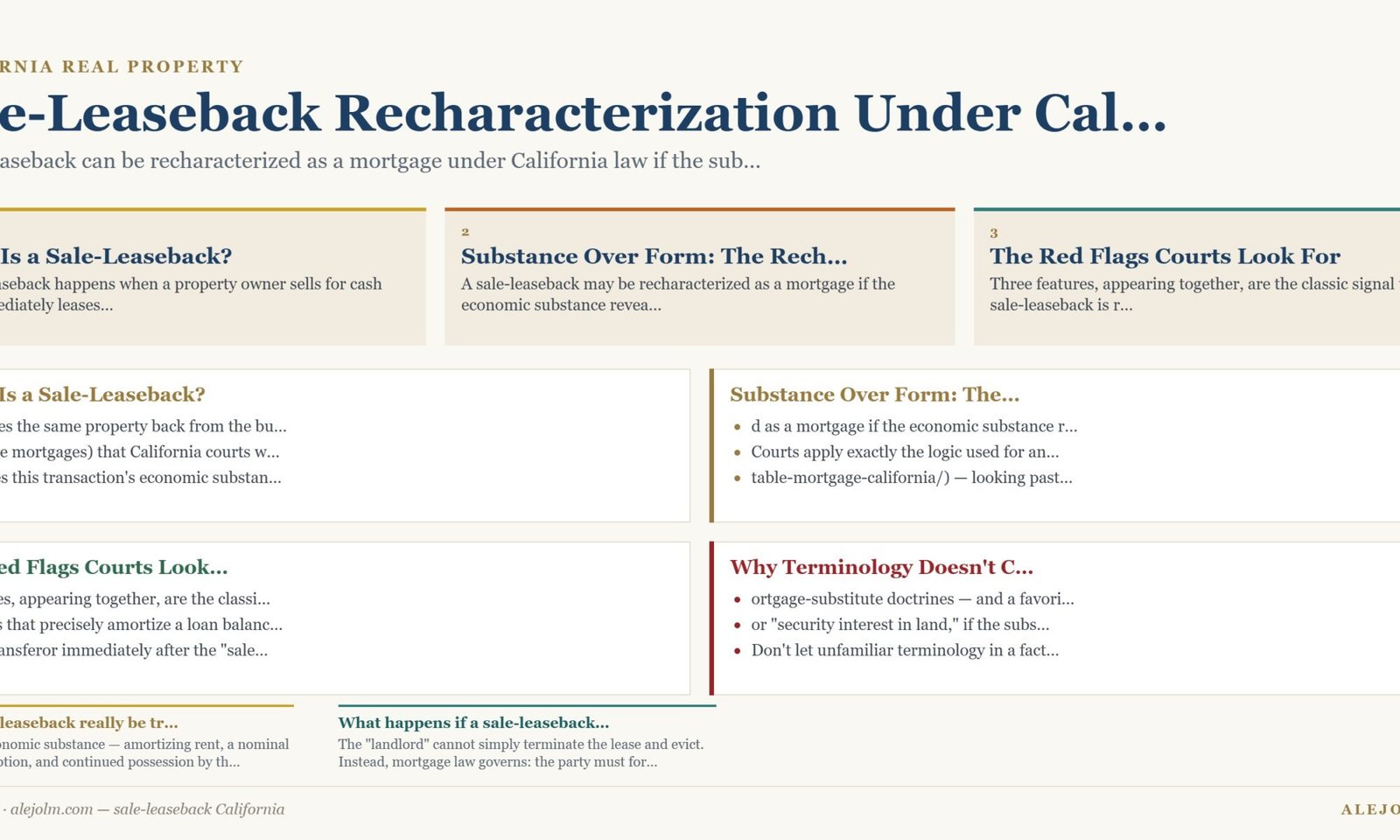
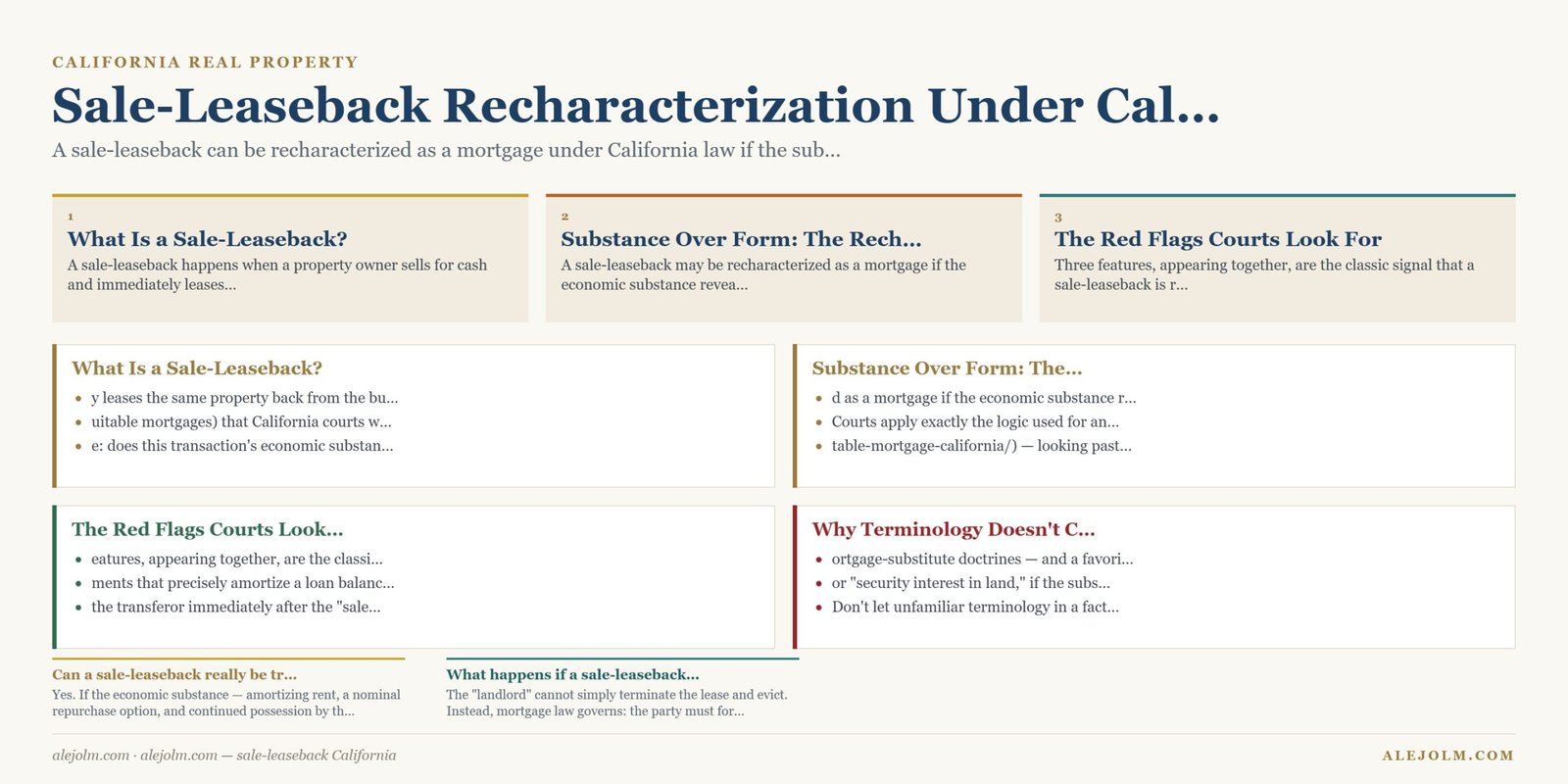
What Is a Sale-Leaseback?
A sale-leaseback happens when a property owner sells for cash and immediately leases the same property back from the buyer, keeping possession while converting equity into liquid capital. It’s a legitimate, common commercial financing tool — but it’s also one of several mortgage-substitute security devices (alongside deeds of trust, installment land contracts, and equitable mortgages) that California courts will look past if the real substance of the deal is a disguised loan.
For anyone studying real property for the California Bar Exam, or structuring a commercial sale-leaseback, the central question is always the same: does this transaction’s economic substance reveal a true sale, or a financing arrangement dressed up as one?
Substance Over Form: The Recharacterization Test
A sale-leaseback may be recharacterized as a mortgage if the economic substance reveals a security intent rather than a genuine, arm’s-length sale. Courts apply exactly the logic used for an absolute deed given as security — looking past the labels the parties chose to what the deal actually accomplishes. California’s statutory hook for this principle is the same one that underlies equitable mortgage doctrine: Civil Code § 2925 allows evidence that a transfer, however it’s dressed up, was really made only as security for an obligation.
If a court recharacterizes the transaction, mortgage protections kick in: the “seller” is treated as a mortgagor holding an equity of redemption, which can only be extinguished through foreclosure — not through simple lease termination or eviction.
The Red Flags Courts Look For
Three features, appearing together, are the classic signal that a sale-leaseback is really a financing arrangement:
- A continuing debt or repayment stream — “rent” payments that precisely amortize a loan balance plus interest, rather than reflecting fair market rental value;
- Retained possession by the transferor immediately after the “sale,” with no real change in who occupies and uses the property; and
- A repurchase right or option letting the original owner reacquire title, often for a token or nominal sum once the payment stream concludes.
When all three line up, courts and bar examiners alike will treat the deal as a mortgage in substance, regardless of what the closing documents call it.
Why Terminology Doesn’t Control
A recurring theme across California’s mortgage-substitute doctrines — and a favorite bar-exam trap — is that the label on the document never controls. Whether the paperwork says “note,” “deed of trust,” “sale-leaseback agreement,” “mortgage deed,” or “security interest in land,” if the substance is land collateralizing a debt, courts treat it as a mortgage. Don’t let unfamiliar terminology in a fact pattern distract from the underlying substance-over-form analysis.
Tax and Bankruptcy Consequences Diverge Sharply
Beyond the litigation context, the true-sale-versus-financing characterization matters enormously outside the courtroom too. Tax treatment (depreciation, interest deductions, gain recognition) and bankruptcy treatment (whether the “buyer” holds title free of the bankrupt “seller’s” estate, or merely holds a secured claim subject to the automatic stay and potential cramdown) can diverge sharply depending on which characterization ultimately controls. Parties structuring a genuine sale-leaseback for legitimate tax or balance-sheet reasons should build in real, negotiated rent tied to fair market value — not a repayment schedule that mirrors a loan amortization table — to avoid unintended recharacterization risk.
Worked Example: Ferro Manufacturing’s Sale-Leaseback
Ferro Manufacturing, short on working capital, “sells” its Fresno warehouse to an investor, Meridian Capital, for $1.5 million. Simultaneously, Ferro signs a fifteen-year lease-back with monthly payments that, run through an amortization calculator, precisely track a $1.5 million loan at a market interest rate — plus an option letting Ferro repurchase the warehouse for $10 at the end of the lease term.
Two years later, Ferro misses several “rent” payments, and Meridian tries to terminate the lease and evict Ferro as a mere defaulting tenant. Ferro argues the arrangement should be recharacterized as an equitable mortgage. If the court agrees — and the amortizing “rent” plus the nominal repurchase option strongly support that reading — Meridian cannot simply evict; it must foreclose, and Ferro retains its equity of redemption until the foreclosure sale actually occurs.
True Sale-Leaseback vs. Disguised Financing
| Feature | True Sale-Leaseback | Disguised Financing (Recharacterized) |
|---|---|---|
| Rent amount | Reflects fair market rental value | Precisely amortizes a fixed principal balance |
| Repurchase right | None, or at fair market value | Nominal/token repurchase price |
| Remedy on “tenant” default | Ordinary lease termination and eviction | Foreclosure; equity of redemption preserved |
| Economic driver | Genuine capital-raising sale | Loan collateralized by the land |
FAQ
Can a sale-leaseback really be treated as a mortgage in California?
Yes. If the economic substance — amortizing rent, a nominal repurchase option, and continued possession by the seller — reveals a security intent rather than a true sale, California courts will recharacterize the arrangement as a mortgage under the same substance-over-form principle applied to equitable mortgages.
What happens if a sale-leaseback is recharacterized after the “tenant” defaults?
The “landlord” cannot simply terminate the lease and evict. Instead, mortgage law governs: the party must foreclose, and the original owner retains an equity of redemption until the foreclosure sale is complete.
Does calling the deal a “lease” instead of a “loan” protect the transaction from recharacterization?
No. Courts look past labels entirely. Whatever the documents call the transaction — note, deed of trust, sale-leaseback, or otherwise — if the substance is land collateralizing a debt, it is treated as a mortgage.
Key Takeaways
- A sale-leaseback converts equity to cash while the seller keeps possession under an immediate lease-back.
- Courts may recharacterize a sale-leaseback as a mortgage if the economic substance shows a security intent.
- Amortizing rent, retained possession, and a nominal repurchase option together are the classic recharacterization red flags.
- Recharacterization triggers mortgage protections: foreclosure is required, and an equity of redemption survives until the sale.
- Tax and bankruptcy treatment can diverge sharply depending on whether a sale-leaseback is treated as a true sale or as financing.
This article is educational and is not legal advice. Consult a licensed California attorney about your situation.
Related guides
- equitable mortgages in California
- installment land contracts in California
- equity of redemption
- deeds of trust in California