
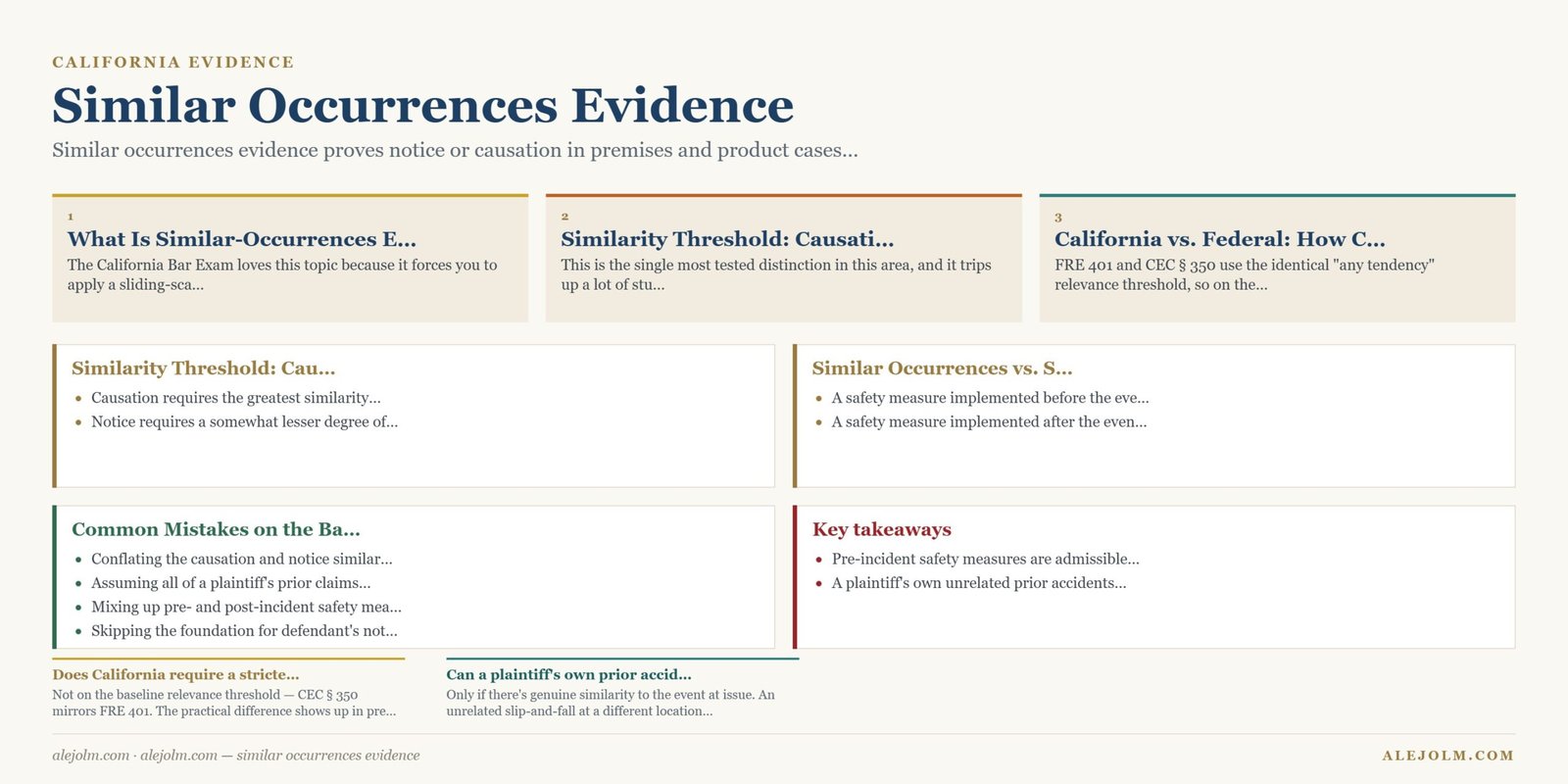
What Is Similar-Occurrences Evidence?
Similar-occurrences evidence is proof of accidents, incidents, or conditions distinct from the event in the lawsuit, offered because they resemble it closely enough to be probative. Courts admit it under the ordinary relevance framework to show causation, notice of a dangerous condition, a pattern of conduct, or a plaintiff’s own habit.
The California Bar Exam loves this topic because it forces you to apply a sliding-scale similarity test rather than a fixed rule. Get the purpose wrong, and you’ll get the required degree of similarity wrong too.
Similar-occurrences evidence is proof of other accidents or conditions that resemble the event at issue closely enough to make causation, notice, or a hazardous condition more or less probable. The required degree of resemblance depends entirely on why the evidence is being offered.
Similarity Threshold: Causation vs. Notice
This is the single most tested distinction in this area, and it trips up a lot of students who treat “similar occurrence” as one uniform standard.
- Causation requires the greatest similarity. If the prior incident happened on an icy stairway and the current one happened on a dry stairway, the dissimilar surface condition can defeat admissibility entirely.
- Notice requires a somewhat lesser degree of similarity. The prior incident doesn’t need to be a near-clone of the current one — it just needs to be similar enough that a reasonable defendant would have been alerted to the general hazard.
Timing matters too. An incident from years earlier is stale and weakens the notice argument; one from days or weeks before the event strengthens it considerably.
California vs. Federal: How CEC § 352 Balancing Differs
FRE 401 and CEC § 350 use the identical “any tendency” relevance threshold, so on the core admissibility question, California and federal law line up. The divergence shows up one step later, in how courts apply prejudice balancing and the defendant’s-knowledge requirement.
| Issue | Federal Approach | California Approach |
|---|---|---|
| Baseline relevance standard | FRE 401 — “any tendency” | CEC § 350 — same “any tendency” standard |
| Prejudice balancing of cumulative similar-occurrence evidence | FRE 403 | CEC § 352 — California courts have applied this somewhat more liberally to exclude cumulative or marginally probative incidents |
| Defendant’s “notice” of prior incident | Generally inferred from role/position | Some CA courts require actual knowledge; others infer knowledge from defendant’s role (e.g., a property manager) — courts are split |
| Governing statute | FRE 401 / FRE 403 | CEC § 350 / CEC § 352 |
The practical upshot: California trial judges have more room to exclude a pile of similar incidents as needlessly cumulative, and the “did the defendant actually know” question gets litigated more granularly in California courts than it typically does under a straightforward FRE 401 analysis.
Similar Occurrences vs. Subsequent Remedial Measures
Don’t confuse similar-occurrences evidence with the subsequent-remedial-measures rule (FRE 407). They interact, but they’re not the same doctrine.
- A safety measure implemented before the event at issue is admissible under ordinary relevance rules — it can rebut a defendant’s argument that a fix wasn’t feasible.
- A safety measure implemented after the event is excluded under FRE 407, precisely to avoid discouraging defendants from making things safer post-incident.
Similarly, a plaintiff’s own unrelated prior accidents are generally inadmissible unless they share genuine similarity with the current event — courts won’t let a defendant (or plaintiff) manufacture a “pattern” out of loosely related incidents.
Worked Example: The Office Stairwell
Dana slips on a dark, wet stairwell in an office building owned by Meridian Properties. At trial, Dana offers four pieces of evidence:
- Three other tenants slipped on the same stairwell in the preceding month, under materially identical conditions — wet, poorly lit, no warning signs.
- Meridian’s building manager received incident reports on each of those slips and did nothing.
- Dana herself slipped two years earlier at an unrelated building owned by a different company.
- Meridian installed handrails on the stairwell after Dana’s fall.
Item 1 is admissible to prove notice — the prior slips are similar enough, recent enough, and at the same location. Item 2 supplies the actual-knowledge foundation California courts often demand. Item 3 is inadmissible: different building, different owner, no genuine similarity. Item 4 is excluded under FRE 407 as a subsequent remedial measure, regardless of how relevant it might otherwise seem.
Common Mistakes on the Bar Exam
- Conflating the causation and notice similarity thresholds. Causation demands near-identical conditions; notice tolerates more variation. Answers that apply one uniform standard lose points.
- Assuming all of a plaintiff’s prior claims are admissible as a “pattern.” Without genuine similarity, this evidence is excluded and may raise improper character-evidence concerns.
- Mixing up pre- and post-incident safety measures. Pre-incident measures are fair game under relevance rules; post-incident measures are barred by FRE 407.
- Skipping the foundation for defendant’s notice. Simply proving a prior incident happened isn’t enough — the proponent must show the defendant knew, or should have known, about it.
Frequently Asked Questions
Does California require a stricter similarity showing than federal law?
Not on the baseline relevance threshold — CEC § 350 mirrors FRE 401. The practical difference shows up in prejudice balancing under CEC § 352, where California courts have sometimes been more willing to exclude cumulative similar-occurrence evidence.
Can a plaintiff’s own prior accidents be used against them?
Only if there’s genuine similarity to the event at issue. An unrelated slip-and-fall at a different location, under different conditions, is generally inadmissible and risks improper character-evidence use.
Is evidence of a safety fix admissible to prove the defendant was negligent?
Only if the fix predates the event. A safety measure implemented after the incident is excluded under FRE 407, precisely to encourage — not punish — post-accident improvements.
Key Takeaways
- Similar-occurrences evidence is analyzed under ordinary relevance rules (FRE 401 / CEC § 350), not a separate exclusionary doctrine.
- Causation requires near-identical prior conditions; notice tolerates a somewhat lesser degree of similarity.
- California courts sometimes apply CEC § 352 balancing more liberally to exclude cumulative similar-incident evidence than federal courts do under FRE 403.
- Pre-incident safety measures are admissible to rebut feasibility; post-incident measures are excluded under FRE 407.
- A plaintiff’s own unrelated prior accidents are generally inadmissible absent genuine similarity to the current event.
This article is educational and is not legal advice. Consult a licensed California attorney about your situation.
Related guides
- premises liability standards
- products liability elements
- residual hearsay exception
- witness examination objections