
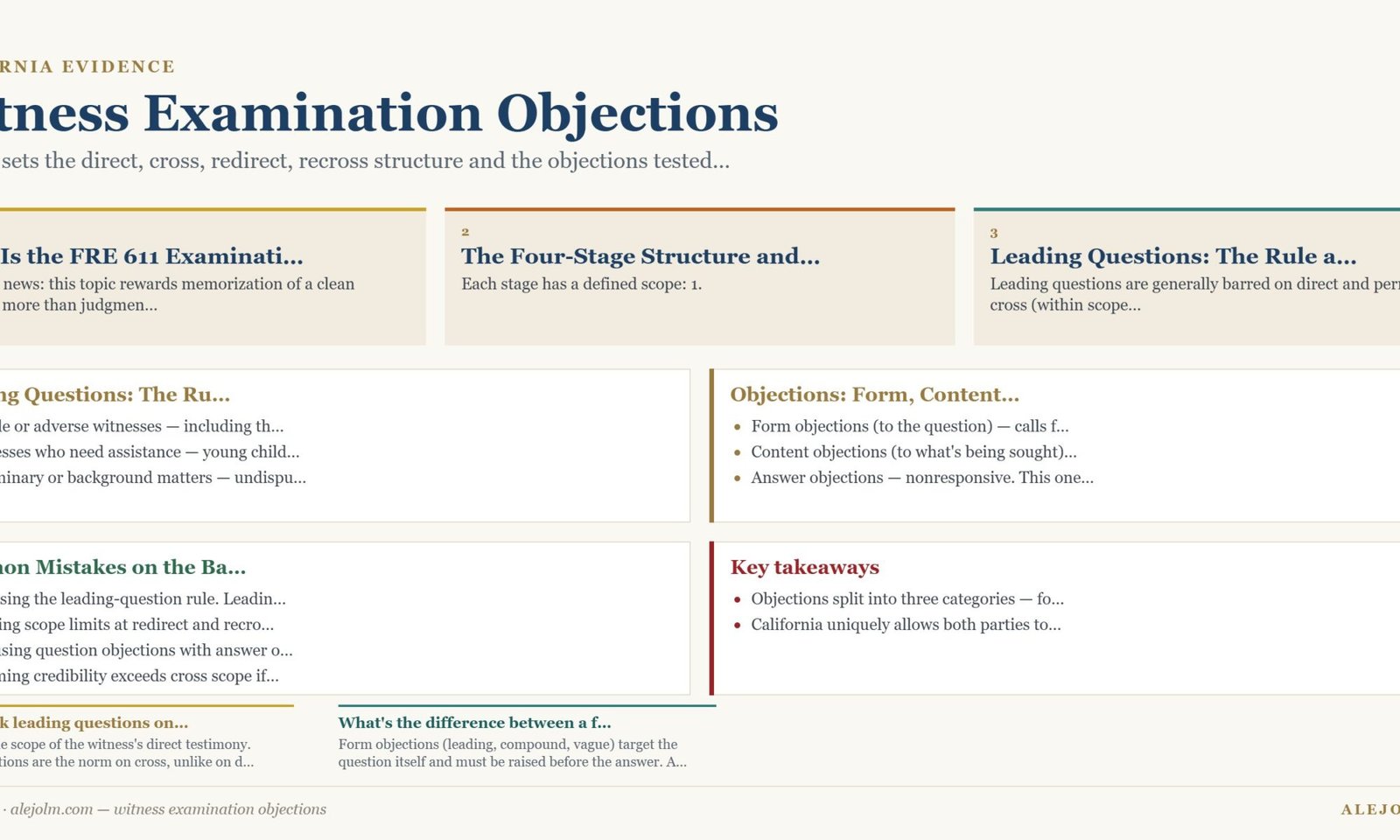
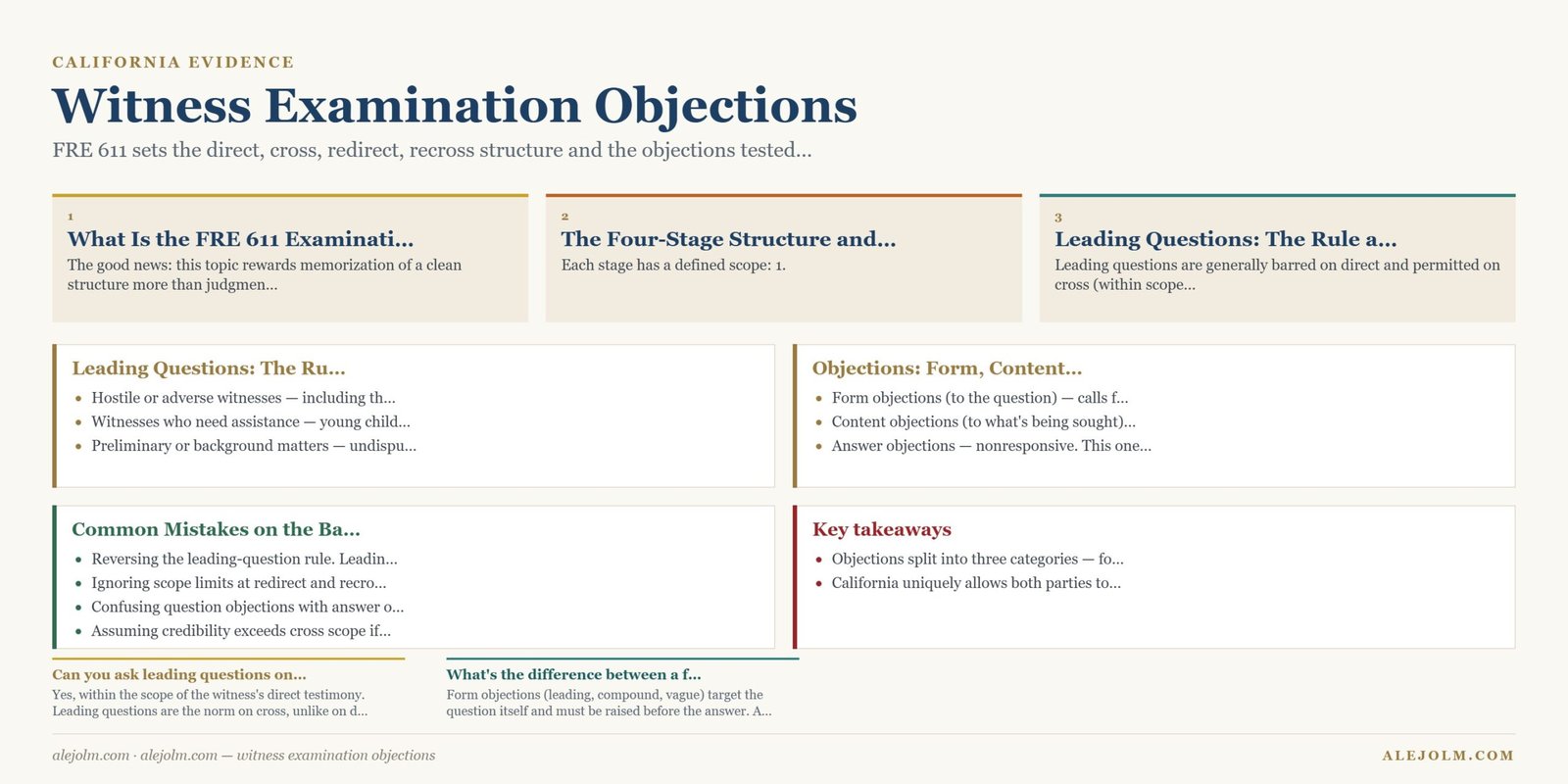
What Is the FRE 611 Examination Structure?
Witness examination under FRE 611 follows a mandatory four-stage sequence — direct, cross, redirect, recross — each with its own scope limits and its own rules about leading questions. Bar examiners build entire questions around whether a single question violates the scope or form limits of whichever stage it’s in.
The good news: this topic rewards memorization of a clean structure more than judgment calls. Learn the stages, the leading-question exceptions, and the objection categories, and most fact patterns resolve quickly.
FRE 611 gives trial courts control over the mode and order of witness examination, requiring non-leading questions on direct, permitting leading questions on cross within the scope of direct, and limiting redirect and recross to matters raised in the immediately preceding stage. Everything else in this topic builds on that structure.
The Four-Stage Structure and Its Scope Limits
Each stage has a defined scope:
- Direct examination — the calling party questions their own witness, non-leading, establishing the substance of the testimony.
- Cross-examination — limited to the subject matter of direct and matters affecting credibility. Credibility is always fair game on cross, even if direct never touched it.
- Redirect — limited to matters the opponent opened up on cross.
- Recross — limited to matters opened up on redirect.
If a judge allows cross to wander into genuinely new subject matter beyond the scope of direct, that new material must be questioned as if it were direct examination — meaning no leading questions for that new portion, even though leading questions were fine for the material within the original scope of direct.
Leading Questions: The Rule and Its Exceptions
Leading questions are generally barred on direct and permitted on cross (within scope). The exceptions to the direct-examination bar are worth memorizing cold:
- Hostile or adverse witnesses — including the opposing party’s witness, or the calling party’s own witness shown to be biased or evasive.
- Witnesses who need assistance — young children, witnesses with cognitive impairment, or significant language barriers.
- Preliminary or background matters — undisputed foundational facts, like confirming a witness’s name or occupation.
FRE 611 vs. CEC § 765: A Narrow but Testable Difference
The federal and California structures are nearly identical, but California gives one procedural tool more broadly than federal practice does.
| Issue | Federal Approach (FRE 611) | California Approach (CEC § 765 et seq.) |
|---|---|---|
| Four-stage structure (direct/cross/redirect/recross) | Yes | Yes |
| Leading questions barred on direct, allowed on cross | Yes | Yes |
| Credibility always within cross scope | Yes | Yes |
| Who may move to strike a nonresponsive answer | Generally only the questioning party | BOTH the questioning party and the opposing party |
| Trial court discretion to relax cross-examination scope | Yes, limited | Yes — CEC § 765 gives CA judges similar discretion, applied flexibly when fairness requires |
The nonresponsive-answer rule is the one worth memorizing for a comparative essay: California’s broader rule lets either side clean up an evasive or rambling answer, not just the party who asked the question.
Objections: Form, Content, and the Answer Itself
Objections fall into three buckets, and mixing them up costs points:
- Form objections (to the question) — calls for a narrative, compound question, vague/ambiguous, argumentative, assumes facts not in evidence, asked and answered.
- Content objections (to what’s being sought) — irrelevant, hearsay, lack of foundation.
- Answer objections — nonresponsive. This one is unique: it targets the witness’s answer, not the examiner’s question, and the remedy is an immediate motion to strike after the answer is given.
All objections must be timely (generally before the answer, except nonresponsive) and specific — a bare “objection” without a stated ground is generally insufficient to preserve the issue.
Worked Example: The Leading Question on Direct
During direct examination of his own client, plaintiff’s counsel asks: “And then, when the light turned red, didn’t you immediately put on the brakes?” Defense counsel objects.
This is a form objection — the question is leading, and none of the exceptions apply: the witness isn’t hostile, doesn’t need assistance, and the light-and-brakes sequence is a substantive, disputed fact, not preliminary background. The objection is sustained. Had the identical question been posed on cross-examination of an adverse witness, within the scope of that witness’s direct testimony, it would have been entirely proper.
Common Mistakes on the Bar Exam
- Reversing the leading-question rule. Leading is barred on direct (with exceptions), permitted on cross within scope — not the other way around.
- Ignoring scope limits at redirect and recross. Each stage is tethered to the immediately preceding one; new subject matter isn’t automatically fair game.
- Confusing question objections with answer objections. A nonresponsive objection is raised via motion to strike after the answer, unlike form or content objections.
- Assuming credibility exceeds cross scope if direct didn’t address it. Credibility is always open on cross, regardless of what direct covered.
Frequently Asked Questions
Can you ask leading questions on cross-examination?
Yes, within the scope of the witness’s direct testimony. Leading questions are the norm on cross, unlike on direct where they’re generally barred.
What’s the difference between a form objection and a nonresponsive objection?
Form objections (leading, compound, vague) target the question itself and must be raised before the answer. A nonresponsive objection targets the witness’s answer and is raised through an immediate motion to strike after the answer is given.
Does California let both sides move to strike a nonresponsive answer?
Yes. California allows both the questioning party and the opposing party to move to strike a nonresponsive answer, which is broader than the general federal practice limiting the motion to the questioning party.
Key Takeaways
- FRE 611 establishes a four-stage examination structure — direct, cross, redirect, recross — each scoped to the stage before it.
- Leading questions are barred on direct (with exceptions for hostile witnesses, witnesses needing assistance, and preliminary matters) and allowed on cross within scope.
- Credibility is always a proper subject for cross-examination, even if direct never raised it.
- Objections split into three categories — form, content, and answer (nonresponsive) — each with different timing rules.
- California uniquely allows both parties to move to strike a nonresponsive answer, unlike the narrower federal practice.
This article is educational and is not legal advice. Consult a licensed California attorney about your situation.