
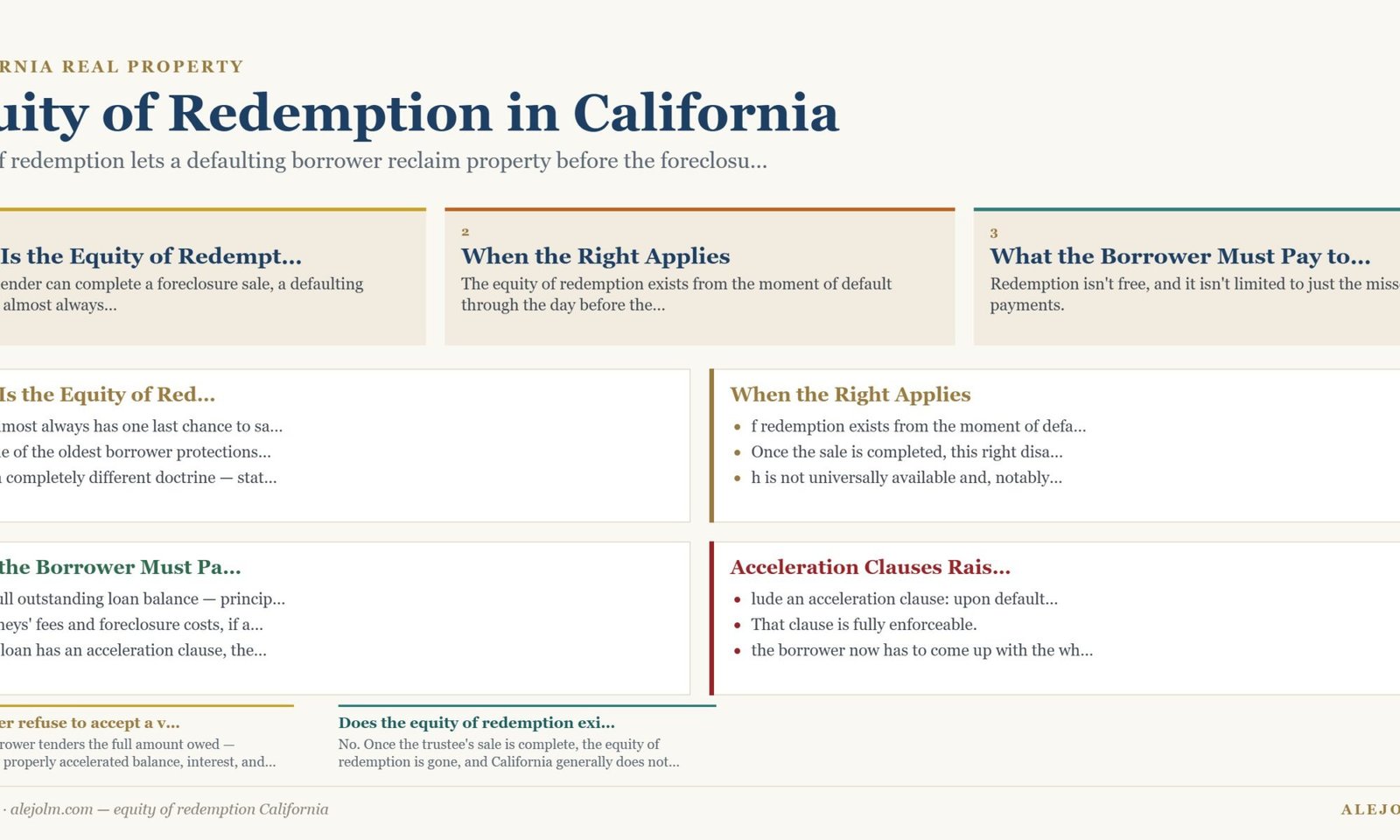
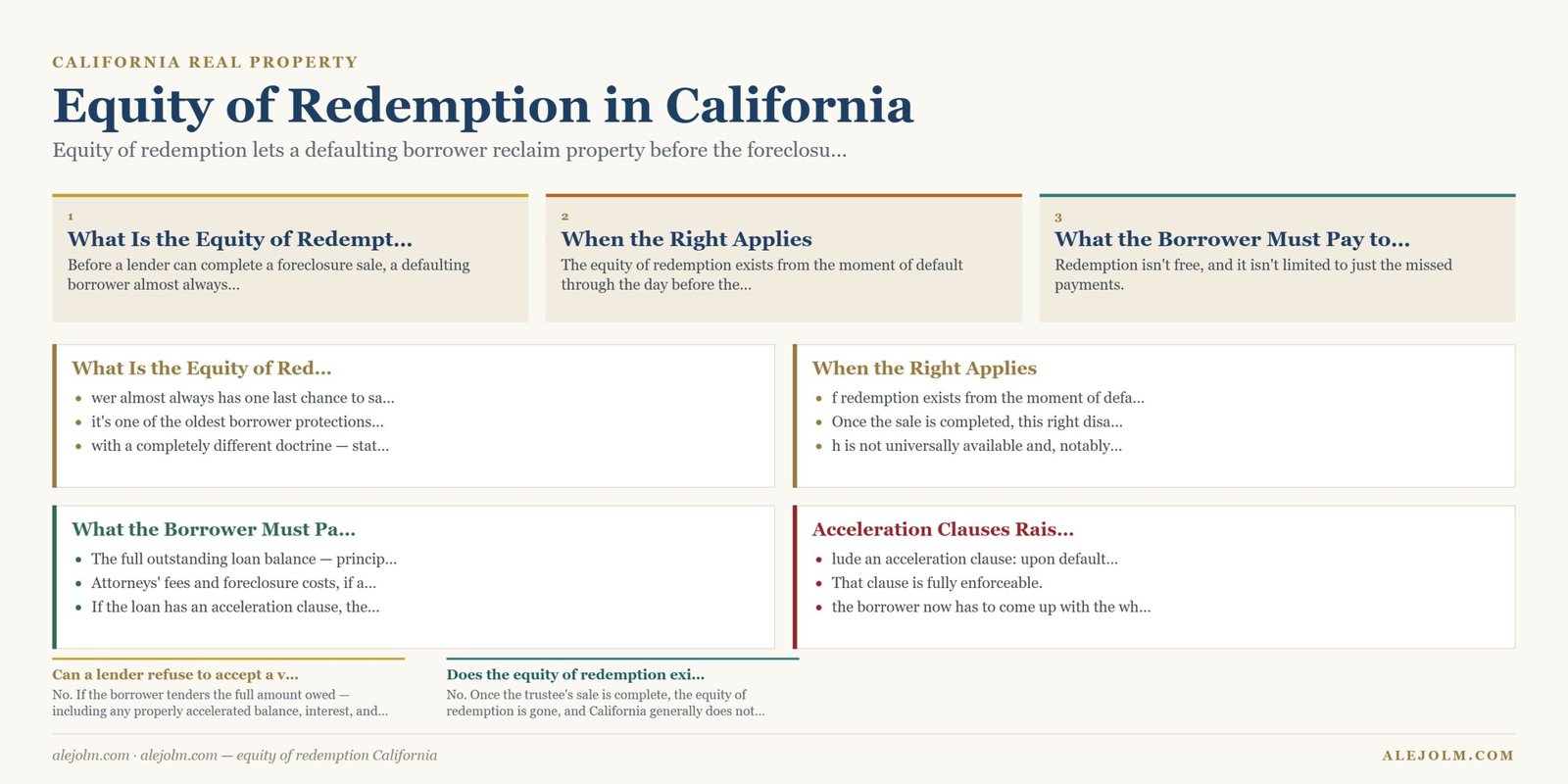
What Is the Equity of Redemption?
Before a lender can complete a foreclosure sale, a defaulting borrower almost always has one last chance to save the property: pay off the debt in full and the foreclosure stops. That right is the equity of redemption, and it’s one of the oldest borrower protections in mortgage law, dating back centuries to English courts of equity.
For California Bar Exam purposes, this concept is a favorite trap because students confuse it with a completely different doctrine — statutory redemption — that applies only after the sale, not before it.
In one sentence: the equity of redemption is a mortgagor’s inherent right to stop a pending foreclosure at any point before the sale by paying the full outstanding debt, including any accelerated balance, attorneys’ fees, and costs — a right that cannot be waived or contracted away.
When the Right Applies
The equity of redemption exists from the moment of default through the day before the foreclosure sale actually occurs. Once the sale is completed, this right disappears entirely. Whatever happens after the sale is governed by a different doctrine — statutory redemption — which is not universally available and, notably, is not available in California after a nonjudicial trustee’s sale.
What the Borrower Must Pay to Redeem
Redemption isn’t free, and it isn’t limited to just the missed payments. A borrower must generally pay:
- The full outstanding loan balance — principal plus accrued interest.
- Attorneys’ fees and foreclosure costs, if authorized by the loan documents or statute.
- If the loan has an acceleration clause, the entire accelerated balance, not merely the payments that were missed.
Acceleration Clauses Raise the Price of Redemption
Most modern loans include an acceleration clause: upon default, the lender can declare the entire remaining balance immediately due. That clause is fully enforceable. It doesn’t destroy the equity of redemption — but it does mean redemption gets much more expensive, because the borrower now has to come up with the whole remaining loan balance, not just a few missed monthly payments.
| Scenario | Amount needed to redeem |
|---|---|
| No acceleration clause; borrower missed 3 payments | The 3 missed payments, plus interest and costs |
| Acceleration clause triggered by default | The entire remaining loan balance, plus interest and costs |
Why a “Waiver of Redemption” Clause Never Works
This is the doctrine’s core protection, and it’s absolute: any contract term that restricts or eliminates the equity of redemption is void as against public policy — a rule courts describe as forbidding a “clog on the equity of redemption.” A lender cannot get a borrower to sign away this right at loan origination, no matter how the document is worded. Courts will strike the waiver and let the borrower redeem anyway.
This traces back to the historical maxim “once a mortgage, always a mortgage” — a security transaction can’t be dressed up as something else specifically to defeat the borrower’s right to get the property back by paying the debt.
Equity of Redemption vs. Statutory Redemption
These two doctrines get confused constantly, and the bar exam relies on that confusion:
| Feature | Equity of Redemption | Statutory Redemption |
|---|---|---|
| Timing | Before the foreclosure sale | After the foreclosure sale |
| Source of the right | Inherent common-law right; cannot be waived | Created by statute; varies by state |
| Who the borrower pays | The lender | The foreclosure sale buyer |
| Available in California | Yes, always, before the sale | Not after a nonjudicial trustee’s sale; limited availability after some judicial sales |
Worked Example
A borrower takes a $100,000 loan at 10% interest, payable over 10 years. Two years in, the borrower misses three payments totaling $3,819. The loan documents include an acceleration clause and also state: “Borrower hereby waives any right of redemption.” The lender declares the full remaining balance due and begins foreclosure. The borrower offers to pay the $3,819 plus costs to stop the sale.
Can the borrower redeem, and for how much?
The acceleration clause is valid, so the lender can properly demand the full remaining balance — roughly $86,000, not just the $3,819 in missed payments. But the waiver-of-redemption language is void as a clog on the equity of redemption; it has no legal effect. The borrower still has the right to redeem, but must come up with the full accelerated balance plus interest and costs to do it, not the smaller missed-payment amount.
FAQ
Can a lender refuse to accept a valid redemption offer before the sale?
No. If the borrower tenders the full amount owed — including any properly accelerated balance, interest, and authorized costs — before the sale, the lender generally must accept it and the pending foreclosure must stop.
Does the equity of redemption exist after a California nonjudicial trustee’s sale?
No. Once the trustee’s sale is complete, the equity of redemption is gone, and California generally does not provide statutory post-sale redemption after a nonjudicial trustee’s sale.
Is a “clog on the equity of redemption” only about explicit waiver language?
No. Courts look at substance over form — any arrangement, however labeled, that effectively strips the borrower’s ability to redeem by paying the debt can be treated as a void clog, not just a clause that says “waiver” outright.
Key Takeaways
- The equity of redemption lets a defaulting borrower stop a foreclosure any time before the sale by paying the full debt.
- Acceleration clauses are valid and can require payment of the entire remaining balance, not just missed payments, to redeem.
- Any contract clause waiving or restricting the equity of redemption is void as against public policy — a “clog” courts will not enforce.
- The equity of redemption ends the moment the foreclosure sale is completed.
- Statutory redemption is a separate, post-sale doctrine that is generally unavailable in California after a nonjudicial trustee’s sale.
Related guides
- California foreclosure process explained
- deficiency judgments in California
- California deed of trust basics
Sources and further reading
- Cal. Civ. Code § 2903 (right to redeem before sale)
- Cal. Code Civ. Proc. § 729.030 (statutory redemption after judicial sale)
This article is educational and is not legal advice. Consult a licensed California attorney about your situation.