
Real Covenants and the WITHN Test: California’s Framework for Running Promises
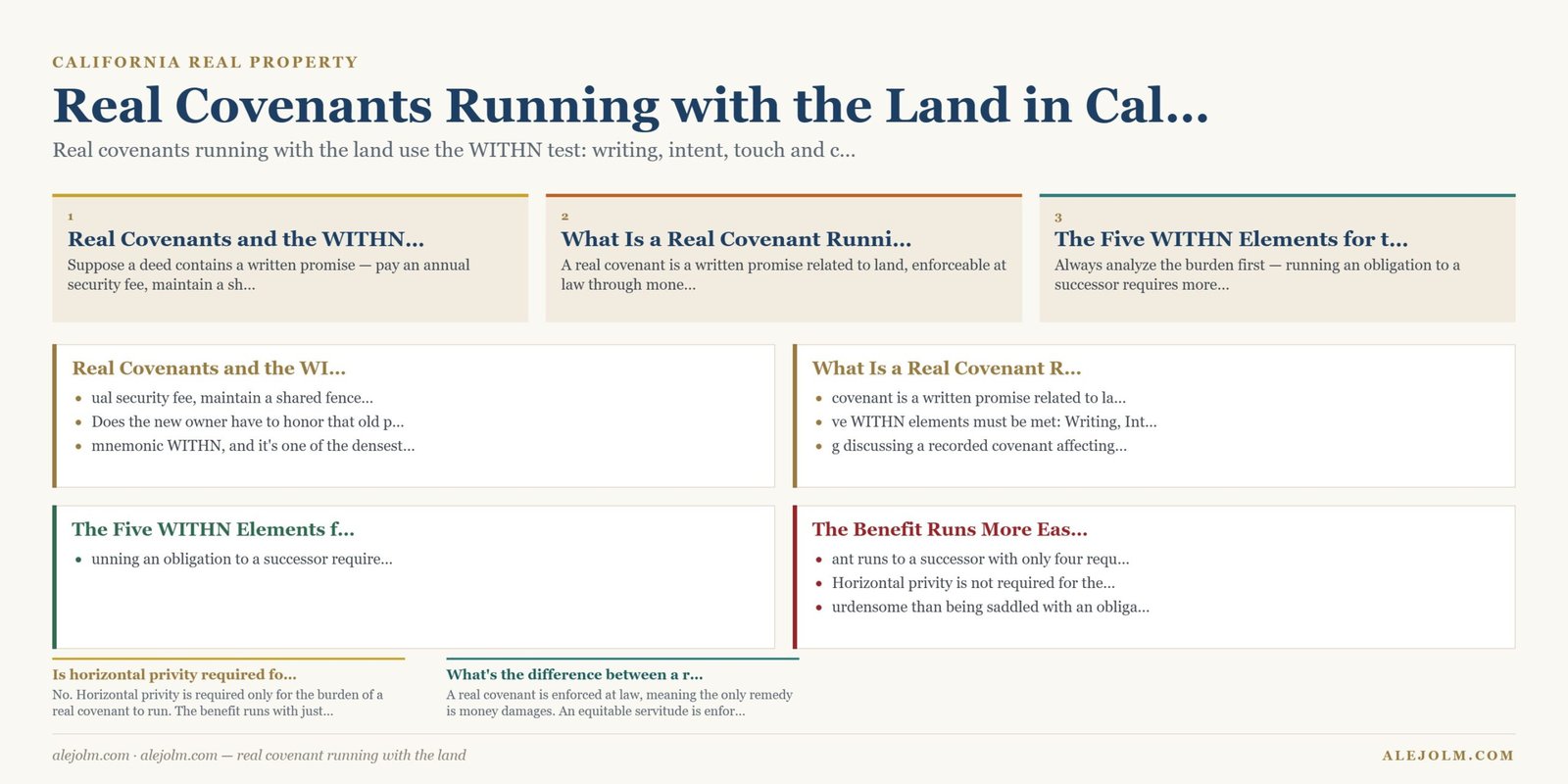
Suppose a deed contains a written promise — pay an annual security fee, maintain a shared fence, carry hazard insurance — and years later the property changes hands. Does the new owner have to honor that old promise? Whether a real covenant runs with the land to bind (or benefit) successive owners is governed by a five-part test known by the mnemonic WITHN, and it’s one of the densest, most heavily tested doctrines in California real property law.
Getting this right matters far beyond the exam: HOA assessments, private security fees, and maintenance obligations recorded against California properties all depend on whether a covenant’s burden actually runs to the current owner.
What Is a Real Covenant Running with the Land?
A real covenant is a written promise related to land, enforceable at law through money damages (not an injunction). For the burden of that promise to bind a successor owner, all five WITHN elements must be met: Writing, Intent, Touch and concern, Horizontal and vertical privity, and Notice.
The Five WITHN Elements for the Burden
Always analyze the burden first — running an obligation to a successor requires more, and stricter, elements than running the right to enforce it.
| Letter | Element | What it requires |
|---|---|---|
| W | Writing | Satisfies the Statute of Frauds |
| I | Intent | Original parties intended the burden to bind successors |
| T | Touch and Concern | Covenant affects the parties’ legal relationship as landowners, not a purely personal obligation |
| H | Horizontal + Vertical Privity | A pre-existing property relationship (grantor/grantee, landlord/tenant, mortgagor/mortgagee) between the original parties, plus the successor taking the covenantor’s entire estate |
| N | Notice | Actual, imputed, record, or inquiry notice |
The Benefit Runs More Easily — Only Four Elements
Here’s the single most tested asymmetry in this area: the benefit of a covenant runs to a successor with only four requirements — Writing, Intent, Touch and Concern, and Vertical Privity. Horizontal privity is not required for the benefit to run. Courts justify this because enforcing a right is less burdensome than being saddled with an obligation, so the law is more generous about letting benefits pass along.
Touch and Concern: The Filter for Personal Obligations
A covenant “touches and concerns” the land when it affects the parties’ use, value, or enjoyment of the property as landowners — not when it’s a purely personal arrangement. A promise to maintain a shared fence or pay a security-monitoring fee touches and concerns the land. A promise to hire a specific person’s relative as a handyman generally does not; it’s too personal, unrelated to the land itself.
Horizontal Privity: The Sharpest Trap
Horizontal privity requires a pre-existing property relationship — grantor/grantee, landlord/tenant, or mortgagor/mortgagee — between the original parties who made the covenant, at the time they made it. An arm’s-length covenant between two strangers with no property connection to each other generally does not create horizontal privity, and the burden won’t run to a successor, no matter how clearly the parties intended it to.
Vertical privity is a separate requirement layered on top for the burden: the successor must take the covenantor’s entire remaining estate — not a partial interest — for the burden to transfer.
Worked Example: An Insurance Covenant That Runs
A commercial lease requires the tenant, “on behalf of herself, her assigns, and successors,” to maintain hazard insurance on the leased premises. The tenant later assigns her entire remaining leasehold interest to a successor, who never buys the insurance. The building burns down.
Applying WITHN to the burden:
- Writing — the promise is in the written lease.
- Intent — the lease expressly names “assigns and successors.”
- Touch and concern — insuring the premises protects and preserves the value of the land itself.
- Horizontal privity — the original landlord and tenant had a landlord/tenant relationship, which satisfies horizontal privity.
- Notice — the successor took a recorded, assigned lease and is on notice of its terms.
- Vertical privity — satisfied because the successor took the tenant’s entire remaining leasehold interest.
Conclusion: the burden runs, and the landlord can sue the successor tenant directly for breaching the insurance covenant.
Real Covenant vs. Equitable Servitude: Pick Your Remedy First
If a plaintiff wants an injunction rather than money damages, the WITHN framework for real covenants isn’t the right tool — that calls for an equitable servitude analysis instead, which drops the horizontal-privity requirement entirely. Always identify the remedy the plaintiff is actually asking for before choosing which doctrine to apply; using WITHN when the plaintiff wants an injunction is a common, avoidable error.
Common Mistakes to Avoid
- Requiring horizontal privity for the benefit. It’s required only for the burden.
- Forgetting vertical privity is a separate, additional requirement on top of horizontal privity for the burden.
- Confusing real covenants (damages, at law) with equitable servitudes (injunctions, in equity) — the remedy sought determines which framework applies.
- Assuming any written promise “touches and concerns” the land. Purely personal obligations don’t run, even if written and recorded.
FAQ
Is horizontal privity required for a covenant’s benefit to run to a successor?
No. Horizontal privity is required only for the burden of a real covenant to run. The benefit runs with just writing, intent, touch and concern, and vertical privity.
What’s the difference between a real covenant and an equitable servitude?
A real covenant is enforced at law, meaning the only remedy is money damages. An equitable servitude is enforced in equity through an injunction, and it does not require horizontal privity at all.
Does a covenant to hire a specific handyman run with the land?
Generally no. That kind of promise is too personal and doesn’t touch and concern the land — it doesn’t affect the parties’ relationship as landowners, so it fails the WITHN test regardless of the other elements.
Key Takeaways
- WITHN — Writing, Intent, Touch and concern, Horizontal/vertical privity, Notice — governs whether a real covenant’s burden runs.
- The benefit runs with only four elements; horizontal privity is not required for the benefit.
- Vertical privity requires the successor to take the covenantor’s entire remaining estate.
- Real covenants are enforced at law with damages; equitable servitudes are enforced in equity with an injunction.
- Purely personal obligations fail the touch-and-concern requirement, even if written and recorded.
This article is educational and is not legal advice. Consult a licensed California attorney about your situation.
Related guides
- easement termination methods
- rights and duties of co-tenants
- lease surrender and abandonment
- recording acts