
Easement Termination in California: Nine Ways (and Only Nine) to Kill an Easement
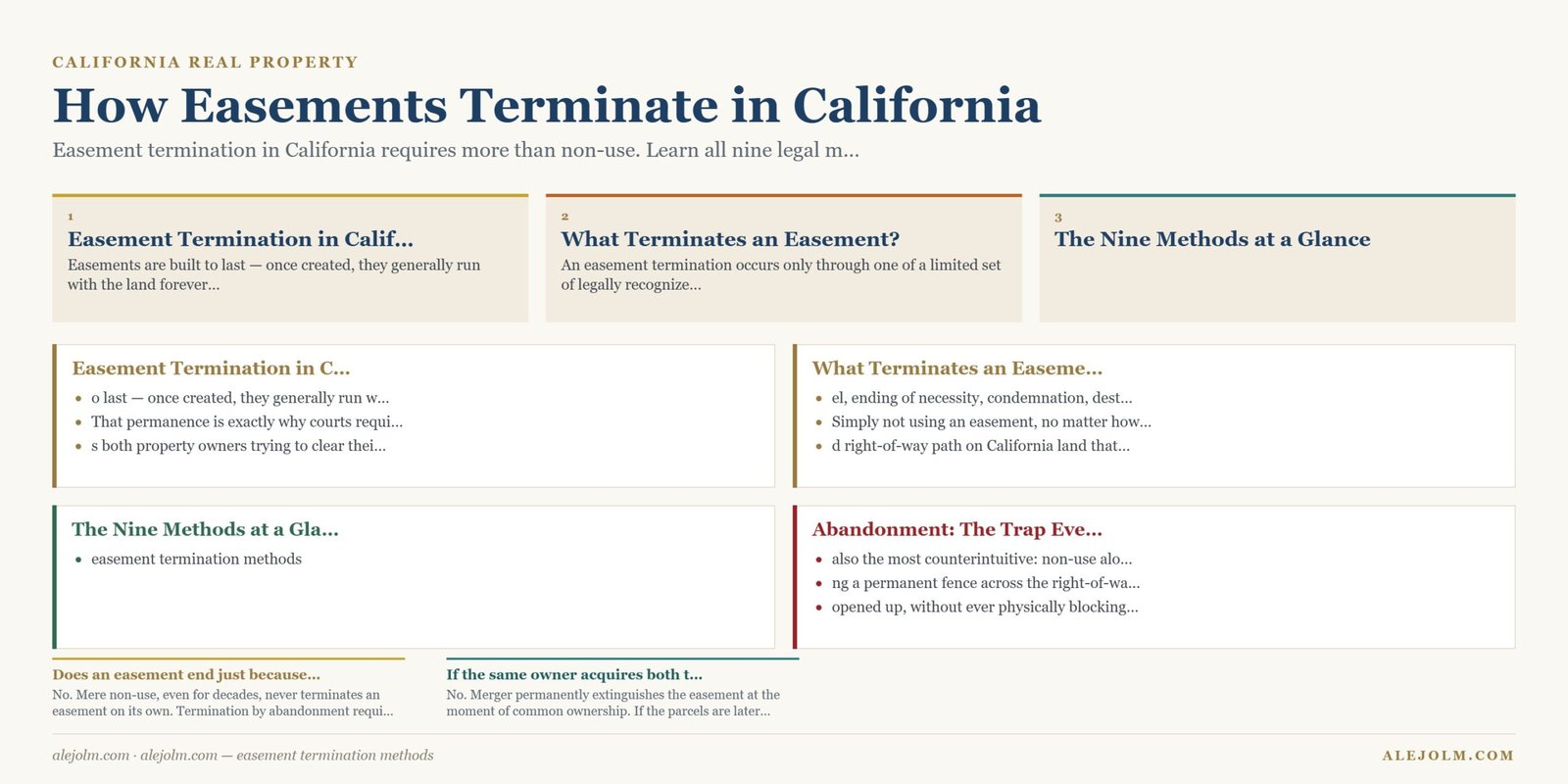
Easements are built to last — once created, they generally run with the land forever, binding whoever owns the servient parcel next. That permanence is exactly why courts require a real, recognized method before an easement disappears. California law recognizes a closed list of ways an easement can terminate, and understanding them protects both property owners trying to clear their title and easement holders trying to preserve their access rights.
This topic is dense with traps on the California Bar Exam, and it comes up constantly in title searches, subdivision planning, and neighbor disputes across California.
What Terminates an Easement?
An easement termination occurs only through one of a limited set of legally recognized methods — expiration by its own terms, merger, release, abandonment (which requires more than non-use), estoppel, ending of necessity, condemnation, destruction of the servient land, or prescription by the servient owner. Simply not using an easement, no matter how long, is never enough by itself.
The Nine Methods at a Glance
| # | Method | Key requirement |
|---|---|---|
| 1 | Expiration | Easement’s own stated terms or conditions run out |
| 2 | Merger | Same person acquires both dominant and servient parcels |
| 3 | Written release | Signed release meeting deed formalities |
| 4 | Abandonment | Non-use plus an outward physical act showing intent to abandon |
| 5 | Estoppel | Servient owner detrimentally relies on holder’s representation the easement ended |
| 6 | End of necessity | Applies only to easements by necessity; automatic once necessity ends |
| 7 | Condemnation | Government takes the servient estate by eminent domain |
| 8 | Destruction | Servient land destroyed — unless the servient owner willfully caused it |
| 9 | Prescription | Servient owner adversely blocks use for the statutory period |
Abandonment: The Trap Everyone Falls Into
The most heavily tested rule here is also the most counterintuitive: non-use alone never terminates an easement, no matter how many years pass. Termination by abandonment requires non-use combined with an affirmative physical act clearly showing intent to permanently give up the right — building a permanent fence across the right-of-way, filling in a private road, or removing a gate structure entirely.
An easement holder who stops using a right-of-way for fifteen years because a more convenient route opened up, without ever physically blocking or renouncing the original path, still owns a fully valid easement.
Merger: Once Gone, It Doesn’t Spring Back
If the same person ends up owning both the dominant and servient parcels, the easement is automatically extinguished — nobody can hold an easement over their own land. The trap: if that owner later sells the two parcels off separately again, the easement does not automatically come back to life. A brand-new express easement has to be created for the new owners.
Worked Example: The Merger Rejoining Trap
Property owner Alan owns a lot benefited by a right-of-way easement across his neighbor’s lot, then years later buys that neighbor’s entire servient lot outright. At that moment, the easement is extinguished by merger — Alan can’t hold an easement over land he now owns himself.
Ten years later, Alan sells the originally dominant lot to Priya and, separately, sells the originally servient lot to a different buyer, Grant. Does Priya still get the benefit of the old right-of-way easement across Grant’s land? No. Merger permanently destroyed it, and re-dividing the parcels afterward doesn’t automatically resurrect it. Priya would need a brand-new express easement negotiated with Grant — the old one is simply gone.
Estoppel Runs Both Directions
Estoppel can protect either party. If an easement holder tells the servient owner, “go ahead, I don’t need the easement anymore,” and the servient owner then builds a structure over the easement area in reliance on that statement, the holder is estopped from later reasserting the easement. But the doctrine also protects an easement holder who reasonably relied on the servient owner’s own assurance that the easement would be honored.
Destruction and Condemnation
If the government condemns the servient parcel through eminent domain, the easement is destroyed along with the underlying property right. If the servient land is destroyed by a natural event — fire, earthquake, flood — the easement terminates too. But there’s an important carve-out: if the servient owner willfully causes the destruction (say, intentionally demolishing a structure the easement crossed), the easement doesn’t terminate, and the servient owner remains liable for damages.
Prescription by the Servient Owner
Just as a claimant can acquire a prescriptive easement through adverse use, a servient owner can extinguish an existing easement by adversely blocking it — actually, openly, hostilely, and continuously — for the full statutory period. It’s the mirror image of how a prescriptive easement is created in the first place; see our companion article on easement by prescription for the elements.
Common Mistakes to Avoid
- Treating long non-use as termination by itself. It’s never enough without a physical act.
- Assuming merger reverses automatically when parcels are later re-divided. It doesn’t — a new easement must be created.
- Missing the willful-destruction exception, which keeps the easement alive (and the servient owner liable) if they deliberately destroyed the servient property.
- Forgetting that a written release must meet deed formalities and typically needs to be recorded to protect against later purchasers.
FAQ
Does an easement end just because nobody has used it in years?
No. Mere non-use, even for decades, never terminates an easement on its own. Termination by abandonment requires an additional affirmative physical act — like building a permanent fence across the right-of-way — showing clear intent to give up the easement.
If the same owner acquires both the dominant and servient parcels, does the easement come back after they’re sold separately again?
No. Merger permanently extinguishes the easement at the moment of common ownership. If the parcels are later sold to different owners, a brand-new express easement is required — the original one does not automatically revive.
Can a servient landowner get rid of an easement by simply blocking it?
Yes, but only through prescription — the servient owner must adversely, openly, and continuously block the easement for the full statutory period, essentially mirroring how a prescriptive easement is created in reverse.
Key Takeaways
- Only nine recognized methods terminate an easement; non-use alone is never one of them.
- Abandonment requires non-use plus an affirmative physical act evidencing intent to give it up.
- Merger permanently destroys an easement, and re-dividing the parcels later does not revive it.
- Willful destruction of the servient estate by its own owner does not terminate the easement.
- A servient owner can extinguish an easement through prescription by adversely blocking it for the statutory period.
This article is educational and is not legal advice. Consult a licensed California attorney about your situation.
Related guides
- easement by implication and necessity
- easement by prescription
- real covenant running with the land
- easements