
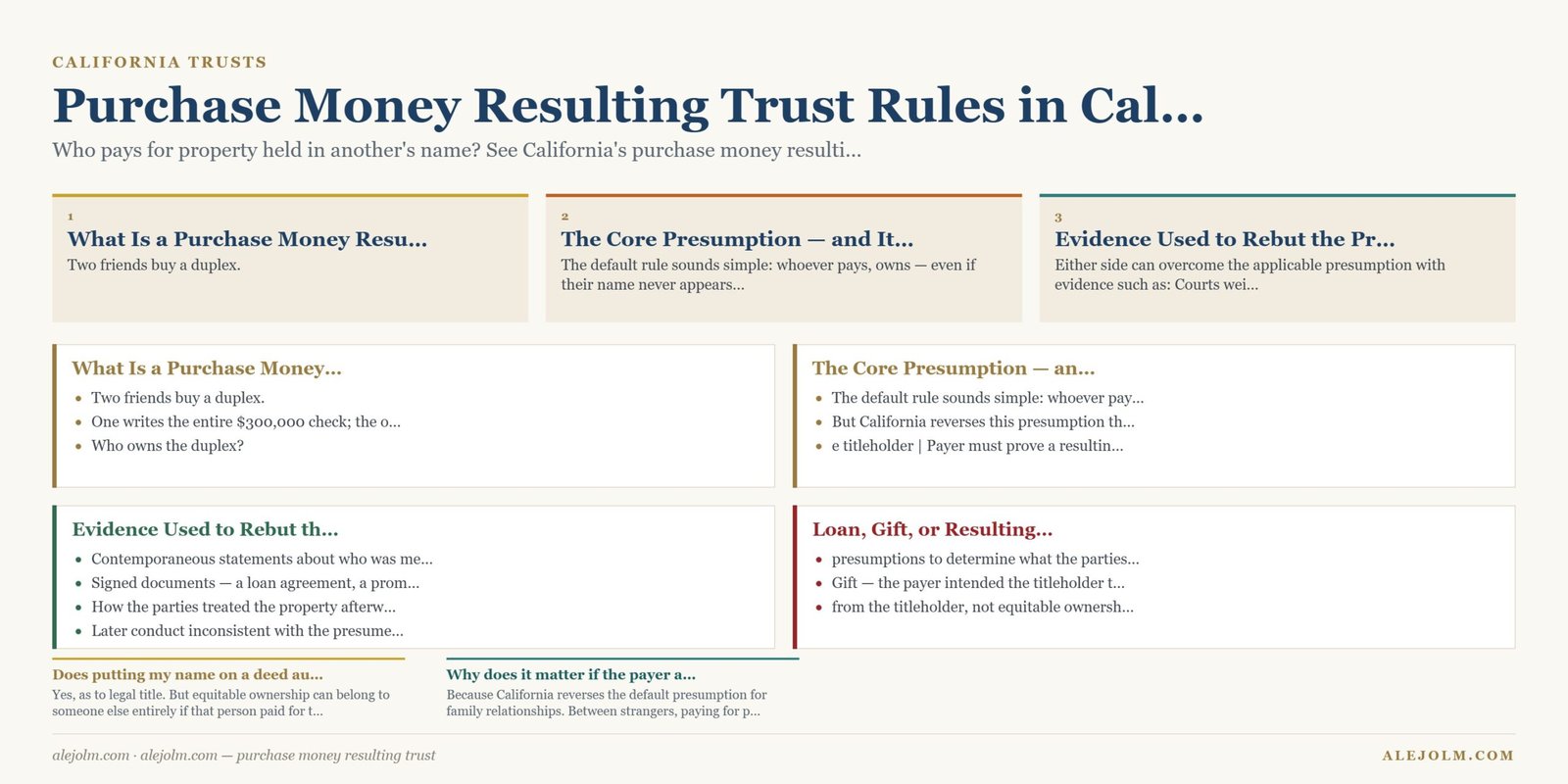
What Is a Purchase Money Resulting Trust?
Two friends buy a duplex. One writes the entire $300,000 check; the other’s name goes on the deed because the payer’s credit is a mess. Who owns the duplex? On paper, the friend with clean credit does. In equity, California may see it very differently through a purchase money resulting trust.
A purchase money resulting trust arises when one person pays the purchase price for property but title is taken in someone else’s name. California presumes the titleholder holds the property in trust for the person who actually paid — a rebuttable presumption that can flip entirely depending on the relationship between the parties.
The Core Presumption — and Its Big Exception
The default rule sounds simple: whoever pays, owns — even if their name never appears on the deed. But California reverses this presumption the moment the payer and the titleholder are family.
| Relationship between payer and titleholder | Default presumption | Who has the burden to rebut it |
|---|---|---|
| Non-family (friends, business partners, strangers) | Resulting trust — titleholder holds for the payer | Titleholder must prove gift intent |
| Family (parent-child, spouses, siblings) | Gift to the titleholder | Payer must prove a resulting trust was intended |
This reversal matters enormously in practice. A parent who pays for a home and puts the title in an adult child’s name is presumed to have made a gift — even if the parent always assumed they still “owned” the house in substance. The parent bears the heavy burden of proving otherwise.
Evidence Used to Rebut the Presumption
Either side can overcome the applicable presumption with evidence such as:
- Contemporaneous statements about who was meant to own the property
- Signed documents — a loan agreement, a promissory note, or deed language addressing ownership
- How the parties treated the property afterward (who paid the taxes, insurance, and maintenance; who collected any rent)
- Later conduct inconsistent with the presumed relationship, such as the titleholder accounting to the payer for profits
Courts weigh the totality of this evidence. A single ambiguous statement rarely settles the question; consistent post-purchase conduct tends to carry more weight than what someone claims they meant at the time.
Loan, Gift, or Resulting Trust?
Modern California courts increasingly look past rigid presumptions to determine what the parties actually intended, which usually falls into one of three buckets:
- Gift — the payer intended the titleholder to own the property outright; no resulting trust arises.
- Loan — the payer intended repayment personally from the titleholder, not equitable ownership of the property itself; the titleholder owes money, not property.
- Resulting trust — the payer intended to remain the true owner despite using the titleholder’s name; the titleholder must convey the property (or its value) back.
Which bucket applies is a fact question, and it can be the difference between a beneficiary owning real estate outright and merely holding an unsecured debt claim against an insolvent relative.
Worked Example
Non-family scenario: Marcus pays $250,000 cash for a Sacramento condo but puts the title in his business partner Lena’s name to keep it off his personal credit report while he closes on another loan. Marcus never discusses a gift. Under California’s default rule, Lena is presumed to hold the condo in resulting trust for Marcus. If Lena later refuses to transfer it, Marcus can sue and, absent evidence Lena rebuts the presumption with proof of gift intent, recover the property.
Family scenario: Now change the facts — Marcus is Lena’s father. He pays the same $250,000 and titles the condo in Lena’s name as a college graduation gift. Here, the presumption flips: California presumes a gift to Lena. Marcus (or his estate, if he later wants the condo back) bears the burden of proving he actually intended a resulting trust, not a gift — a much harder case to win without contemporaneous documentation.
Why the Distinction Matters for Estate Planning
Purchase money resulting trust disputes show up constantly in probate litigation, usually after the payer dies and the family disagrees about whether a transfer decades earlier was a gift or a loan-in-substance. Careful California estate planners avoid the ambiguity entirely: if a parent fronts money for a child’s house but intends to retain an ownership interest, that intent belongs in a written agreement, a deed reflecting joint or fractional ownership, or a promissory note — not left to a court’s after-the-fact reconstruction of intent.
FAQ
Does putting my name on a deed automatically make me the legal owner?
Yes, as to legal title. But equitable ownership can belong to someone else entirely if that person paid for the property and the purchase money resulting trust presumption applies and is not rebutted.
Why does it matter if the payer and titleholder are related?
Because California reverses the default presumption for family relationships. Between strangers, paying for property presumes a resulting trust in the payer’s favor. Between close family, the same payment presumes a gift to the titleholder.
Can I rebut the presumption with my own testimony about what I intended?
Testimony helps, but courts weigh it against contemporaneous documents and post-purchase conduct. Testimony alone, offered years later and self-serving in nature, is rarely enough on its own.
Key Takeaways
- A purchase money resulting trust presumes the titleholder holds property in trust for whoever actually paid — but only between non-family parties by default.
- Family relationships flip the presumption to a gift, shifting the burden of proof onto the payer.
- Either presumption can be rebutted with documents, statements, and post-purchase conduct.
- Courts increasingly look for the parties’ actual intent rather than applying the presumption mechanically.
- Document intended ownership arrangements in writing to avoid decades-later probate disputes.
This article is educational and is not legal advice. Consult a licensed California attorney about your situation.
Related guides
- resulting trust in California
- community property and real estate transfers
- trustee duties in California
- probate process in California