
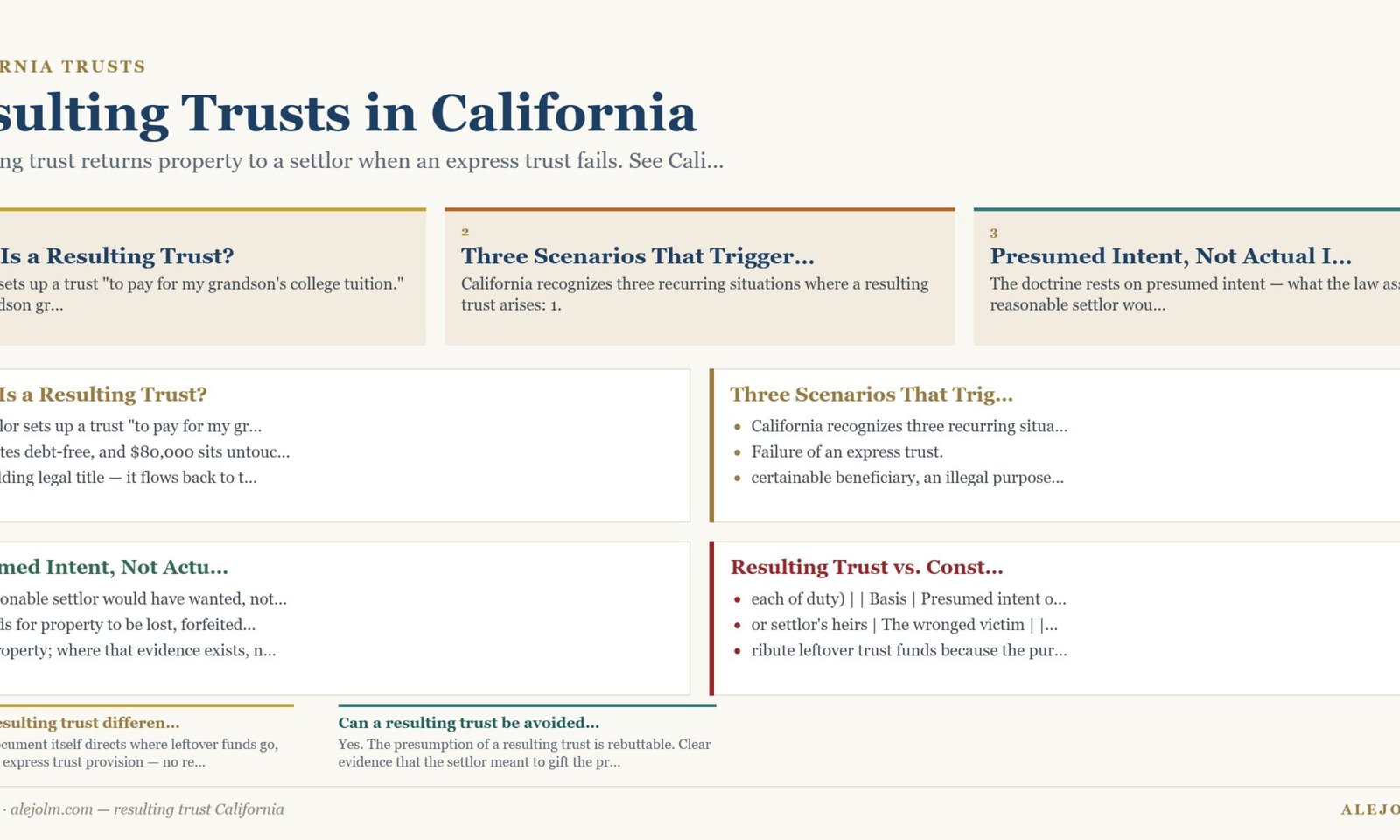
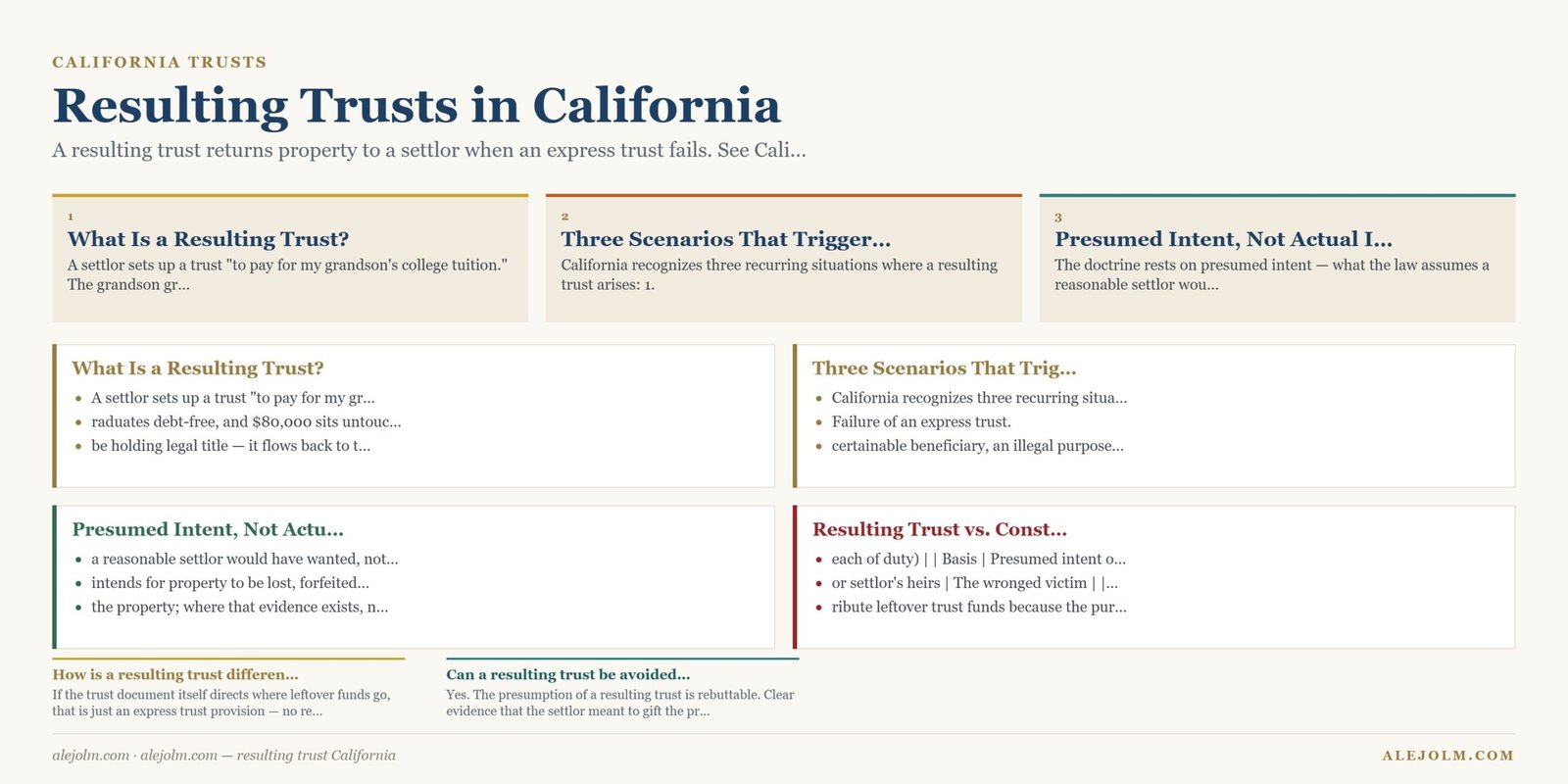
What Is a Resulting Trust?
A settlor sets up a trust “to pay for my grandson’s college tuition.” The grandson graduates debt-free, and $80,000 sits untouched in the trust account with no instructions for what happens next. That leftover money does not vanish, and it does not go to whoever happens to be holding legal title — it flows back to the settlor (or the settlor’s estate) through a resulting trust.
A resulting trust is an implied trust that California law imposes to carry out a settlor’s presumed intent when an express trust fails or its stated purpose has been fully accomplished but property remains. Unlike an express trust, nobody signs a document creating it — the law implies it automatically to prevent an unintended windfall.
Three Scenarios That Trigger a Resulting Trust
California recognizes three recurring situations where a resulting trust arises:
- Failure of an express trust. The trust was defectively created (no ascertainable beneficiary, an illegal purpose, or a missing formal element), so it never took effect as intended.
- Exhaustion of the trust’s purpose. The trust accomplished exactly what it was set up to do, and excess property remains with no further instructions.
- Purchase money resulting trust. One person pays for property, but title is taken in someone else’s name — a distinct doctrine covered in detail in our purchase money resulting trust guide.
Presumed Intent, Not Actual Intent
The doctrine rests on presumed intent — what the law assumes a reasonable settlor would have wanted, not what the settlor actually said or wrote about the specific failure. Courts presume no settlor intends for property to be lost, forfeited to a stranger, or kept by a trustee once that trustee’s job is done. That presumption can be rebutted with evidence the settlor actually intended a gift to whoever is currently holding the property; where that evidence exists, no resulting trust arises and the holder keeps the property outright.
Resulting Trust vs. Constructive Trust
These two implied trusts get confused constantly on exams, so keep the distinction sharp:
| Feature | Resulting Trust | Constructive Trust |
|---|---|---|
| Trigger | Failure or exhaustion of an express trust | Wrongdoing (fraud, theft, breach of duty) |
| Basis | Presumed intent of the settlor | Equity remedying misconduct |
| Wrongdoing required? | No | Yes |
| Who takes the property | Settlor or settlor’s heirs | The wronged victim |
| See also | — | Constructive trust in California |
A trustee who simply fails to distribute leftover trust funds because the purpose is finished has done nothing wrong — a resulting trust applies. A trustee who steals trust funds has done something wrong — a constructive trust applies.
What the Resulting Trustee Must Do
Once a resulting trust arises, whoever holds legal title becomes a resulting trustee with narrow, temporary duties: segregate the property, account for it, and return it to the settlor or the settlor’s heirs. There is no ongoing administration, no discretion over investments, and no beneficiary relationship to manage — the sole job is to give the property back.
Worked Example
Settlor Anita creates a trust: “Income to be used exclusively for the medical care of my four children, in equal shares, until each turns 25.” Three of Anita’s children die in a car accident before turning 25, leaving only her youngest child, Owen, still eligible. Anita has since died as well, and the trust document says nothing about what happens if some of the named children predecease the vesting age.
Does Owen take the whole trust? No. Because the trust was drafted for “my four children” as a defined group and the trust instrument never addressed this contingency, the express trust fails as to the deceased children’s shares. A resulting trust arises: those shares do not pass to Owen by default. They revert to Anita’s estate and pass under her will’s residuary clause or by intestate succession — unless the trust language or extrinsic evidence shows Anita intended survivors to take the whole amount.
Common Confusion Points
Two mistakes show up repeatedly in practice exams. First, students assume a resulting trust requires bad faith — it does not; it is purely a mechanical response to a failed or exhausted trust. Second, students assume the named beneficiary of a failed trust gets something anyway out of fairness — they do not. The resulting trust doctrine sends property back to the settlor’s side of the ledger, full stop, unless a gift-intent exception applies.
FAQ
How is a resulting trust different from a trust that simply says who gets the leftover money?
If the trust document itself directs where leftover funds go, that is just an express trust provision — no resulting trust is needed. A resulting trust only fills the gap when the document is silent or the trust failed outright.
Can a resulting trust be avoided if the settlor intended a gift?
Yes. The presumption of a resulting trust is rebuttable. Clear evidence that the settlor meant to gift the property to the current holder defeats the resulting trust and lets the holder keep it.
Does a resulting trust last indefinitely?
No. It is a temporary, mechanical device. Once the resulting trustee returns the property to the settlor or the settlor’s heirs, the resulting trust terminates — there is no ongoing fiduciary relationship.
Key Takeaways
- A resulting trust is an implied trust that returns property to the settlor (or heirs) when an express trust fails or its purpose is exhausted.
- It rests on presumed intent, not actual intent, and the presumption can be rebutted by evidence of a gift.
- It requires no wrongdoing — that is what separates it from a constructive trust.
- The resulting trustee’s only duties are to segregate, account for, and return the property.
- Watch for defectively drafted class gifts and “leftover funds” fact patterns on the California Bar Exam.
This article is educational and is not legal advice. Consult a licensed California attorney about your situation.
Related guides
- constructive trust in California
- purchase money resulting trust
- trustee duties in California
- probate process in California