
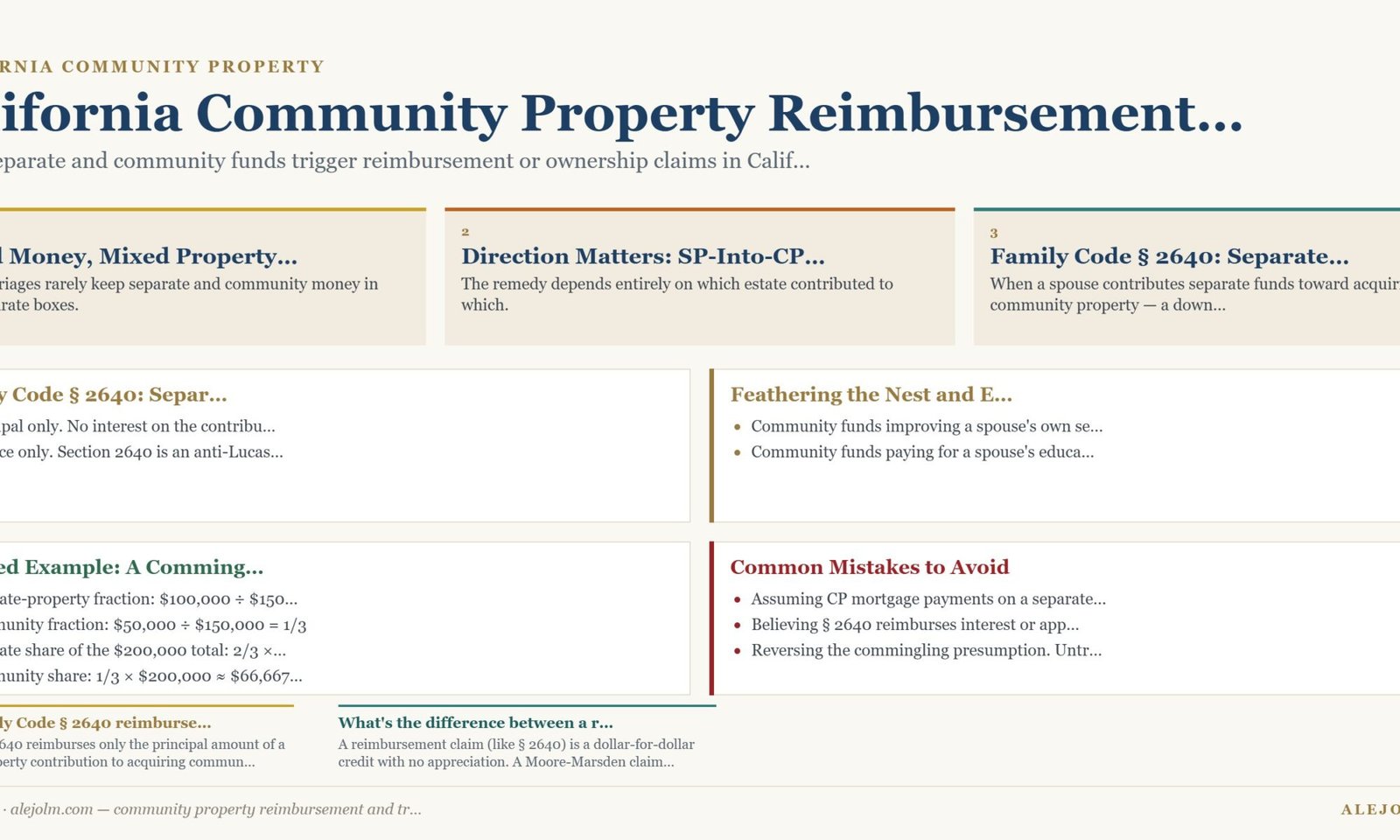
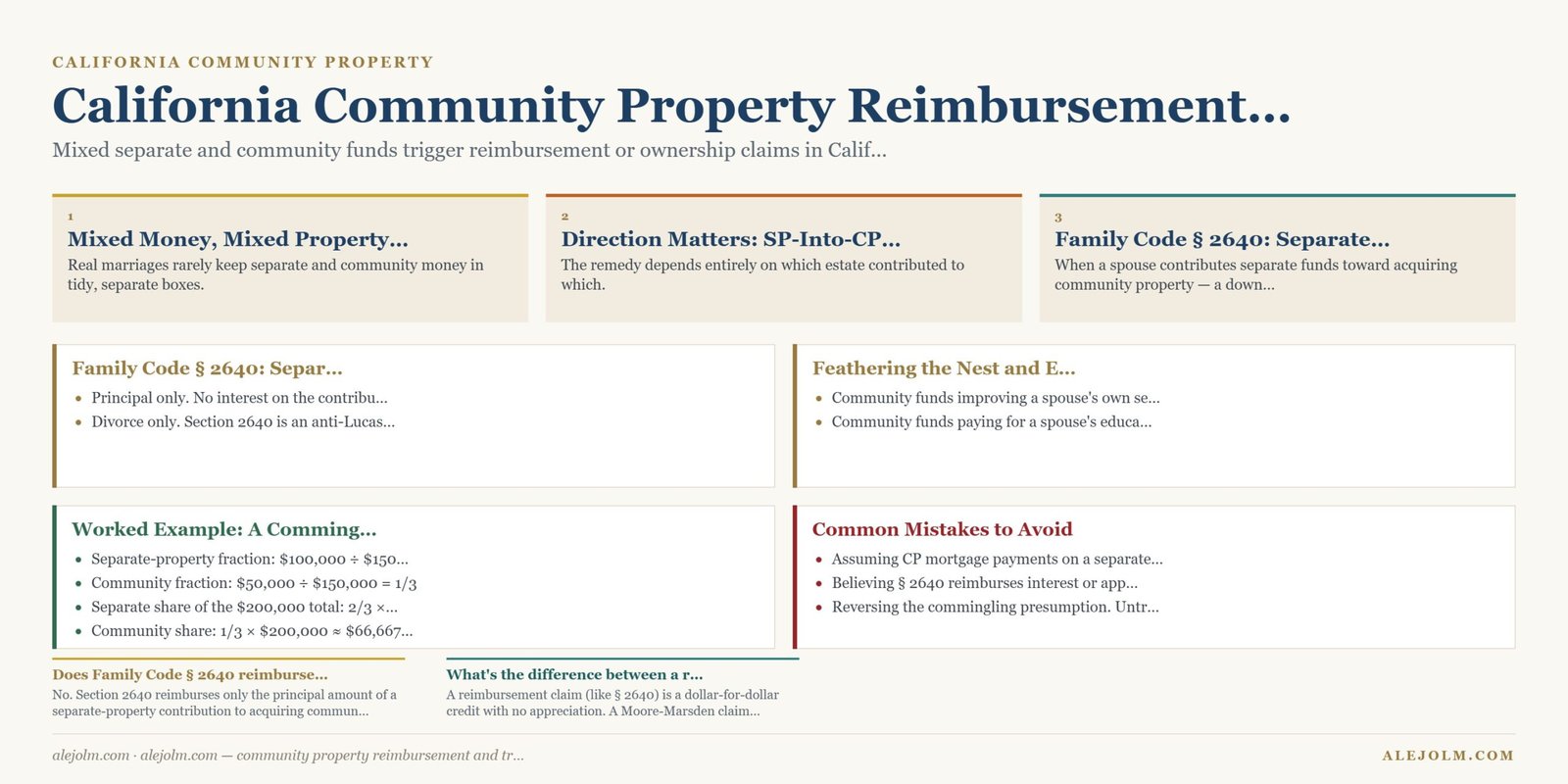
Mixed Money, Mixed Property: How Reimbursement and Tracing Work
Real marriages rarely keep separate and community money in tidy, separate boxes. A down payment comes from savings acquired before the wedding; mortgage payments come from paychecks earned during the marriage; renovations get paid for out of whatever account had money in it that month. California’s reimbursement and tracing rules exist to sort out who gets credit for what when the money is mixed.
Reimbursement and tracing is the process of identifying separate and community contributions to mixed property and applying the correct remedy — principal-only reimbursement, a pro rata ownership share, or a presumption of full community ownership — depending on the direction the money flowed and whether it can be traced to its source. Getting the direction right is the single biggest scoring factor on this topic.
Direction Matters: SP-Into-CP vs. CP-Into-SP
The remedy depends entirely on which estate contributed to which. Confusing the two directions is the most common error on this topic.
| Direction of contribution | Governing rule | Remedy |
|---|---|---|
| Separate funds → acquisition of community property | Family Code § 2640 | Reimbursement, principal only, no interest, no appreciation |
| Community funds → principal reduction on a spouse’s separate-property mortgage | Moore-Marsden | Pro rata ownership share, including appreciation |
| Community funds → improvements on a spouse’s own separate property | “Feathering the nest” doctrine | Reimbursement for the greater of cost or value added |
| Community funds → a spouse’s premarital/separate debts | Family Code § 2625 | Reimbursement on divorce |
| Community funds → a spouse’s education or training | Family Code § 2641 | Reimbursement of principal plus interest at the legal rate |
Family Code § 2640: Separate Contributions to Community Property
When a spouse contributes separate funds toward acquiring community property — a down payment, a principal reduction, or improvements — that spouse is entitled to reimbursement on divorce under FC § 2640. Two limits matter enormously:
- Principal only. No interest on the contribution and no share of any appreciation. Contributions to interest, taxes, insurance, or maintenance aren’t reimbursable at all — only principal, down payment, and improvement costs count.
- Divorce only. Section 2640 is an anti-Lucas rule that applies at divorce. At death, the older Lucas rule still governs: absent a written agreement, a separate-property contribution to jointly titled property is presumed a gift to the community, with no reimbursement.
Moore-Marsden: When Community Payments Buy an Ownership Share
The reverse direction — community funds reducing principal on a spouse’s own separate-property mortgage — is not a mere reimbursement claim. It’s an ownership claim. Under the Moore-Marsden formula, the community acquires a pro rata ownership share of the separate-property home, including a proportional share of any appreciation since the marriage:
Community share = [(community principal reduction ÷ purchase price) × appreciation since marriage] + community principal reduction
Only principal reduction counts in the numerator — interest, taxes, and insurance payments contribute nothing to the community’s ownership share, even though they’re real expenses the couple paid.
Feathering the Nest and Education Reimbursement
Two more scenarios round out the reimbursement picture:
- Community funds improving a spouse’s own separate property (“feathering the nest”): the community is reimbursed for the greater of the cost of the improvement or the value it added — not both, and not automatically the higher of appreciation-based measures.
- Community funds paying for a spouse’s education or professional training (FC § 2641): if the training substantially enhanced that spouse’s earning capacity, the community is reimbursed principal plus interest at the legal rate on divorce. This is a distinct statute from § 2640 — the community never owns a share of the degree itself, only a reimbursement claim for what it paid.
The Tracing Methodology
Whichever direction the money flowed, tracing follows the same three steps:
- Identify the source of the funds (community income vs. a separate source like inheritance or premarital savings).
- Track how those funds were applied (improvement, mortgage principal, acquisition, etc.).
- Calculate the reimbursement or ownership share owed under the applicable rule.
Untraceable commingled funds are presumed community property, and the burden falls on the spouse claiming a separate interest. Tracing failure means the whole account — and anything purchased from it — gets characterized as community property.
Worked Example: A Commingled Stock Portfolio
Facts: Husband owns a stock portfolio worth $100,000 at the time of marriage — clearly his separate property. During the marriage, Husband and Wife add $50,000 of community funds to buy additional stock in the same portfolio, bringing its value to $150,000. By the time of divorce, the whole portfolio has appreciated to $200,000.
Analysis: Because the contributions are traceable, the portfolio is divided proportionally rather than treated as entirely community or entirely separate:
- Separate-property fraction: $100,000 ÷ $150,000 = 2/3
- Community fraction: $50,000 ÷ $150,000 = 1/3
- Separate share of the $200,000 total: 2/3 × $200,000 ≈ $133,333, awarded to Husband
- Community share: 1/3 × $200,000 ≈ $66,667, split equally between the spouses (roughly $33,333 each)
If Husband could not trace which shares came from which source — for example, if the stock had been sold and repurchased repeatedly through a single commingled brokerage account without records — the entire portfolio would default to community property, and Husband would lose the benefit of his original separate contribution entirely.
Common Mistakes to Avoid
- Assuming CP mortgage payments on a separate-property home only create a reimbursement right. Wrong — Moore-Marsden gives the community a pro rata ownership interest, including appreciation, not just a dollar-for-dollar refund.
- Believing § 2640 reimburses interest or appreciation. It doesn’t. Section 2640 reimburses principal contributions only, and it doesn’t apply at death absent a written agreement (Lucas still governs there).
- Reversing the commingling presumption. Untraceable commingled funds are presumed community, not separate — the burden is always on the spouse claiming the separate interest.
FAQ
Does Family Code § 2640 reimburse interest paid on separate contributions?
No. Section 2640 reimburses only the principal amount of a separate-property contribution to acquiring community property — interest paid and any share of appreciation are excluded entirely.
What’s the difference between a reimbursement claim and a Moore-Marsden claim?
A reimbursement claim (like § 2640) is a dollar-for-dollar credit with no appreciation. A Moore-Marsden claim arises when community funds reduce principal on a spouse’s separate-property mortgage, and it gives the community a proportional ownership share, including appreciation.
What happens if a spouse can’t trace separate funds in a commingled account?
The untraceable funds — and any asset purchased with them — are presumed community property. The burden is on the spouse claiming a separate interest to trace the funds to their source.
Key Takeaways
- Direction of the contribution determines the remedy: separate-into-community triggers § 2640 reimbursement (principal only); community-into-separate mortgage principal triggers Moore-Marsden ownership.
- Community improvements to a spouse’s own separate property are reimbursed at the greater of cost or value added.
- Education and training reimbursement under § 2641 includes interest, unlike ordinary § 2640 reimbursement.
- Section 2640 applies at divorce; at death, Lucas treats an untraced separate contribution to joint title as a gift to the community.
- Untraceable commingled funds are presumed community property — always know which side carries the tracing burden.
This article is educational and is not legal advice. Consult a licensed California attorney about your situation.
Related guides
- separate property and commingling
- tracing methods for commingled funds
- community property presumptions