
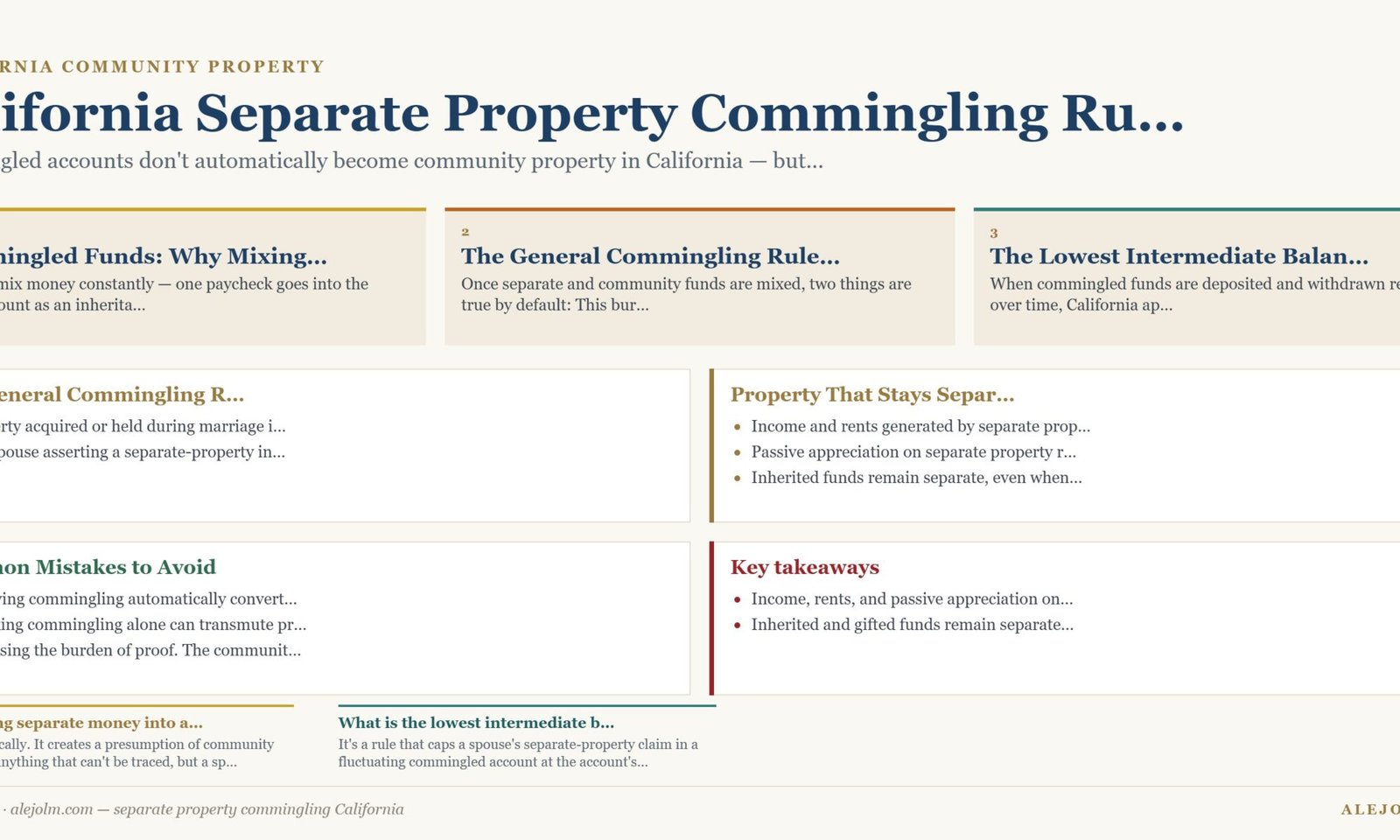
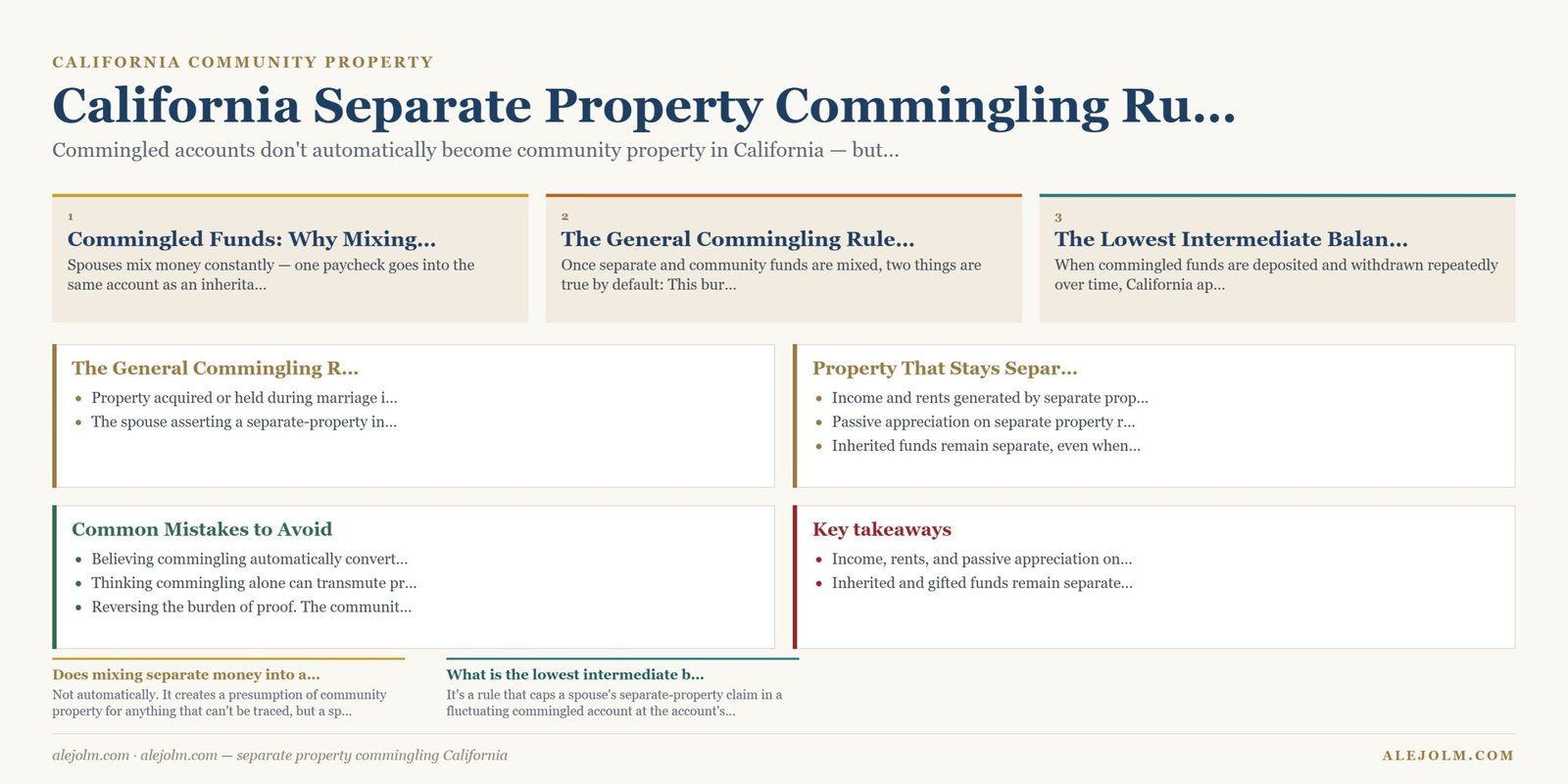
Commingled Funds: Why Mixing Money Doesn’t Erase Separate Property
Spouses mix money constantly — one paycheck goes into the same account as an inheritance, or community earnings pay down a mortgage on a house one spouse owned before the wedding. California law does not automatically convert that separate property into community property just because the funds touched the same account. But it does make proving the separate character much harder.
Commingling occurs when separate and community property are mixed together in the same account or asset, making it difficult to identify which portion belongs to which estate. When that happens, California presumes the mixed property is community property, and the spouse claiming a separate interest bears the burden of tracing it back to its source.
The General Commingling Rule and Burden of Proof
Once separate and community funds are mixed, two things are true by default:
- Property acquired or held during marriage is presumed community property.
- The spouse asserting a separate-property interest carries the burden of proving the separate source and tracing it into the disputed asset.
This burden is real, not theoretical. Courts require actual tracing evidence — bank records, transaction histories, contemporaneous documentation — not just a general assertion that “some of this money was mine before we married.”
The Lowest Intermediate Balance Rule
When commingled funds are deposited and withdrawn repeatedly over time, California applies the lowest intermediate balance rule to cap how much separate property a spouse can claim.
The logic: under the family expense presumption, community funds are presumed spent first on family expenses. So once an account balance drops below the amount of separate funds a spouse claims are still in it, some of that separate money was necessarily consumed along the way — and the claim is capped at whatever the account’s lowest point was between the deposit and the divorce.
| Step | Amount |
|---|---|
| Wife deposits separate funds | $50,000 |
| Community funds already in account | $10,000 |
| Total after deposit | $60,000 |
| Account drops (family expenses) to | $20,000 |
| Account later rises to | $70,000 |
| Wife’s separate claim | Capped at $20,000 |
Even though the account eventually holds $70,000 — more than Wife’s original $50,000 deposit — her separate-property claim cannot exceed the lowest point the account ever reached, because the family-expense presumption treats the community’s $10,000 as spent first, meaning the drop to $20,000 necessarily consumed $30,000 of her separate money along the way.
Commingling Is Not Transmutation
A separate but related trap: commingling, by itself, does not change the character of property from separate to community, no matter how strongly the circumstances might suggest donative intent.
For any transmutation occurring on or after January 1, 1985, Family Code § 852 requires an express written declaration that expressly states the character or ownership of the property is changing. Simply depositing separate funds into a joint account — even for years, even with an apparent intent to share — is not enough on its own to transmute the property. (Before 1985, oral agreements or conduct could sometimes support a transmutation finding; that route is now largely historical.)
The practical effect is subtle: commingling makes tracing harder, which increases the risk that the separate-property claimant fails to meet the tracing burden and the funds default to community property by operation of the presumption — but that’s a proof problem, not an actual legal transmutation.
Property That Stays Separate Even When Commingled
Some categories of property retain their separate character even inside a commingled account, as long as they can be traced:
- Income and rents generated by separate property remain separate.
- Passive appreciation on separate property remains separate — except that community principal payments buy the community a pro rata share of appreciation under the Moore-Marsden rule.
- Inherited funds remain separate, even when deposited into a joint marital account, provided the inheriting spouse can trace them.
Worked Example: Inherited Funds in a Joint Account
Facts: During the marriage, Child inherits $100,000 from a parent and deposits it into the couple’s joint checking account, which already holds ongoing community salary deposits and is used to pay all household bills for the next several years.
Analysis: The inheritance itself is separate property by source — inheritances are separate property under California law regardless of when received during the marriage. Depositing it into the joint account creates a commingling problem, not a transmutation. Child’s separate character survives only to the extent Child can trace the funds using contemporaneous bank records — showing, for instance, that the account balance never dropped below $100,000 after the deposit, or identifying specific withdrawals as the inherited funds. If years of family expenses were paid from the same account without records, and the balance dropped below $100,000 at some point, Child’s separate claim is capped at the lowest intermediate balance the account reached, exactly as with any other commingled fund.
Common Mistakes to Avoid
- Believing commingling automatically converts separate property into community property. Wrong — a spouse can still prove a separate interest through tracing; commingling only makes the proof harder, it doesn’t destroy the underlying right.
- Thinking commingling alone can transmute property, even with obvious intent. Wrong since 1985 — FC § 852 requires an express written declaration; conduct and intent alone are not enough.
- Reversing the burden of proof. The community-property presumption applies to commingled, untraceable funds; it is the separate-property claimant who must prove and trace the separate source, not the other way around.
FAQ
Does mixing separate money into a joint account turn it into community property?
Not automatically. It creates a presumption of community property for anything that can’t be traced, but a spouse can still prove and preserve the separate character through adequate tracing evidence.
What is the lowest intermediate balance rule?
It’s a rule that caps a spouse’s separate-property claim in a fluctuating commingled account at the account’s lowest balance between the deposit and the date of the claim, since the family expense presumption treats community funds as spent first.
Can commingling alone transmute separate property into community property?
No, not since January 1, 1985. Family Code § 852 requires an express written declaration changing the character of the property; commingling by itself, even with apparent intent to share, is not sufficient.
Key Takeaways
- Commingled property is presumed community; the spouse claiming a separate interest bears the burden to trace it.
- The lowest intermediate balance rule caps a separate-property claim at the lowest point a fluctuating account ever reached.
- Commingling is not transmutation — FC § 852 requires an express written declaration for property to change character after 1985.
- Income, rents, and passive appreciation on separate property stay separate if traceable, even inside a commingled account.
- Inherited and gifted funds remain separate property even when deposited into a joint account, as long as they can be traced.
This article is educational and is not legal advice. Consult a licensed California attorney about your situation.
Related guides
- community property reimbursement and tracing
- tracing methods for commingled funds
- community property presumptions