
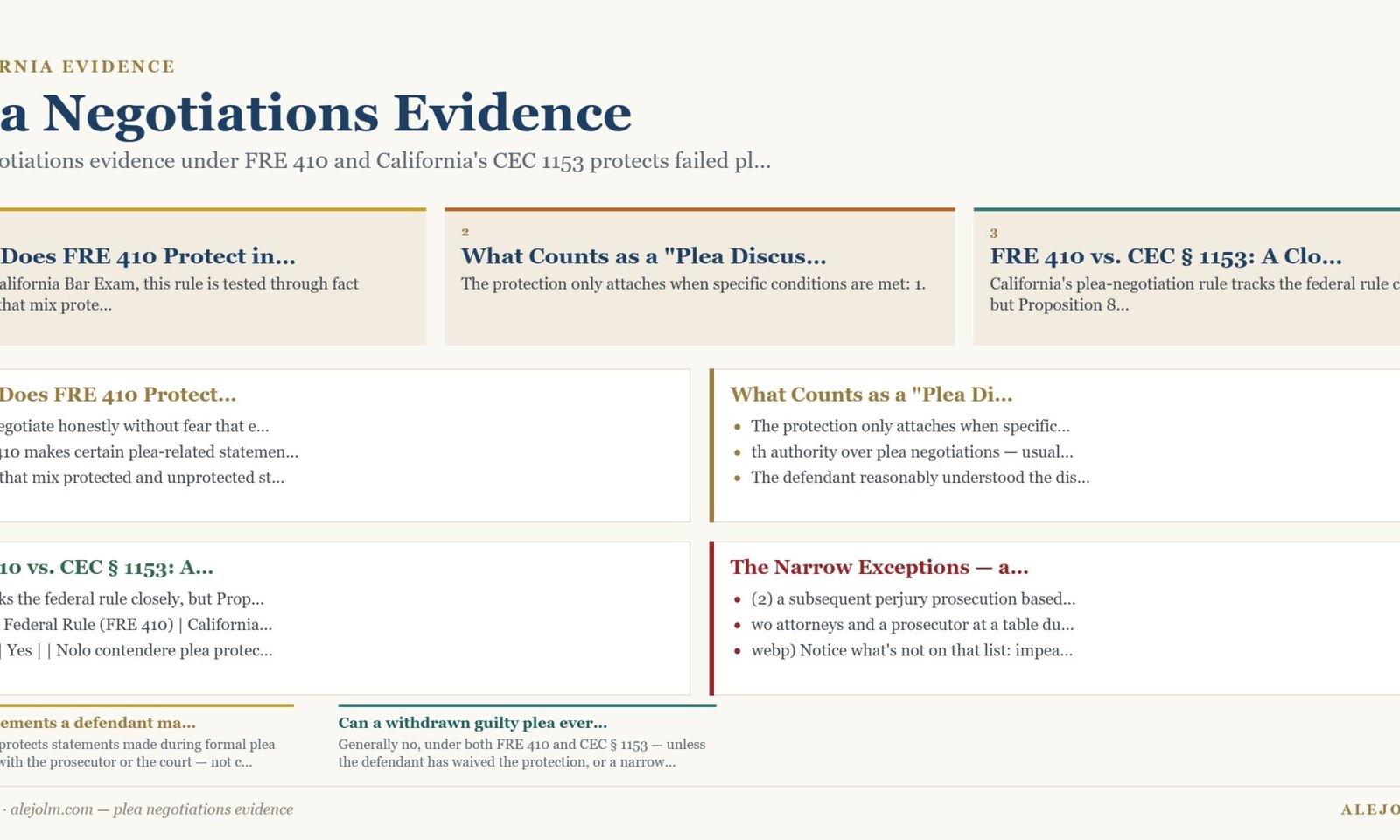
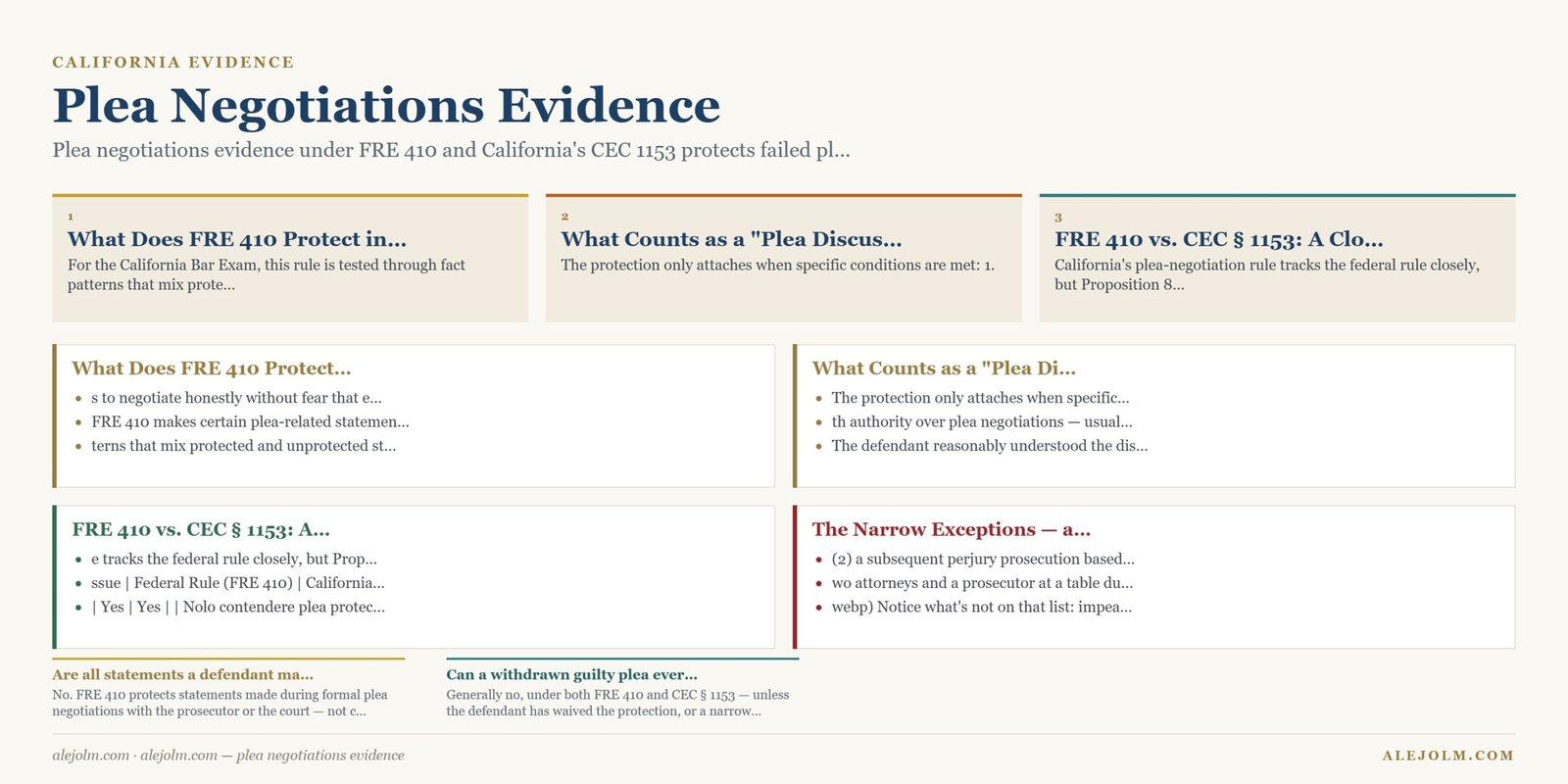
What Does FRE 410 Protect in Plea Negotiations?
Plea negotiations evidence rules exist because roughly 95% of criminal cases resolve through plea bargains, and prosecutors need defendants to negotiate honestly without fear that exploratory statements will be used against them if talks fall apart. FRE 410 makes certain plea-related statements inadmissible against the defendant in later proceedings.
For the California Bar Exam, this rule is tested through fact patterns that mix protected and unprotected statements in the same scenario — spotting the line is the whole game.
FRE 410 excludes withdrawn guilty pleas, nolo contendere pleas, statements made to a court in offering such a plea, and statements made during plea discussions with the prosecutor that didn’t result in an accepted plea. A firm, non-withdrawn guilty plea remains fully admissible.
What Counts as a “Plea Discussion”
The protection only attaches when specific conditions are met:
- The statement was made to someone with authority over plea negotiations — usually the prosecutor or the prosecutor’s agent, or to the court itself.
- The defendant reasonably understood the discussion as a plea negotiation, not a casual conversation.
- There was an actual or implied understanding that the statement was tied to reaching a plea agreement.
- No binding plea has been accepted and finalized.
A defendant who admits involvement to a prosecutor during formal plea talks is protected. A defendant who blurts out the same admission to a booking officer, with no prosecutor involved, is not — Rule 410 simply doesn’t reach that statement, even though other rules (like Miranda) might.
FRE 410 vs. CEC § 1153: A Close Match, With One Open Question
California’s plea-negotiation rule tracks the federal rule closely, but Proposition 8 injects genuine uncertainty that federal law doesn’t have.
| Issue | Federal Rule (FRE 410) | California Rule (CEC § 1153) |
|---|---|---|
| Withdrawn guilty plea protected? | Yes | Yes |
| Nolo contendere plea protected? | Yes | Yes |
| Statements during prosecutor plea talks protected? | Yes | Yes |
| Firm, non-withdrawn guilty plea admissible? | Yes | Yes |
| Effect of Proposition 8 on the exclusion | N/A | Open question whether Prop. 8 overrides CEC § 1153; even if it does, CEC § 352 balancing still lets the trial court exclude for unfair prejudice |
| Waivable by agreement? | Yes — United States v. Mezzanatto allows a defendant to waive protection, commonly for impeachment | Generally tracks federal analysis where applicable |
The practical exam point: don’t assume Prop. 8 automatically makes plea statements admissible in California. Courts have held that CEC § 352 balancing survives even if Prop. 8 technically applies, giving the trial judge real discretion to keep the exclusion in place.
The Narrow Exceptions — and the Mezzanatto Waiver
FRE 410(b) itself has only two textual exceptions: (1) fairness/completeness, where another statement from the same discussion is introduced to avoid a misleading partial picture, and (2) a subsequent perjury prosecution based on a statement made under oath, on the record, with counsel present.
Notice what’s not on that list: impeachment. FRE 410 does not contain a freestanding exception letting the government use excluded statements to impeach a testifying defendant. The only way around that is a waiver — under United States v. Mezzanatto, a defendant can prospectively agree, as part of a plea agreement, to let the government use plea-discussion statements for impeachment. That waiver clause is now standard in many federal plea agreements, but absent one, the impeachment door stays shut.
Worked Example: Two Statements, Two Outcomes
Marcus is arrested for robbery. At booking, he tells the arresting officer, “I took the car without permission.” Later, his attorney arranges a meeting with the prosecutor to discuss a plea; Marcus is present and says, “I did it, but I didn’t know the owner was home.” The parties can’t agree on a sentence, and the case goes to trial.
The booking statement is not protected by FRE 410 — there was no plea negotiation with the prosecutor, so the rule doesn’t reach it (though Miranda and other doctrines might still be in play). The prosecutor’s-office statement is protected — it was made during a formal plea discussion with the government’s own representative, and no agreement was ever accepted. Unless Marcus signed a Mezzanatto-style waiver, the prosecution cannot use that second statement at trial, even to impeach him if he testifies differently.
Common Mistakes on the Bar Exam
- Assuming every admission near an arrest is plea-protected. Only statements made during actual negotiations with the prosecutor qualify.
- Confusing FRE 410 with FRE 408. FRE 410 covers criminal plea talks; FRE 408 covers civil settlement offers — different scopes, different exceptions.
- Treating impeachment as an automatic FRE 410(b) exception. It isn’t. Impeachment use requires a Mezzanatto waiver, not a rule exception.
- Ignoring Proposition 8 in a California essay. Even if Prop. 8 arguably reaches plea statements, CEC § 352 balancing remains a live issue.
Frequently Asked Questions
Are all statements a defendant makes to police protected by FRE 410?
No. FRE 410 protects statements made during formal plea negotiations with the prosecutor or the court — not casual admissions to police outside that context.
Can a withdrawn guilty plea ever be used against the defendant?
Generally no, under both FRE 410 and CEC § 1153 — unless the defendant has waived the protection, or a narrow exception (completeness or perjury) applies.
Does Proposition 8 make California plea statements automatically admissible?
Not automatically. It’s an open question whether Prop. 8 overrides CEC § 1153, and even where it might apply, trial courts retain discretion under CEC § 352 to exclude the statement if its prejudicial impact outweighs its probative value.
Key Takeaways
- FRE 410 and CEC § 1153 exclude withdrawn pleas, nolo contendere pleas, and unaccepted plea-discussion statements made to the prosecutor.
- A firm, non-withdrawn guilty plea remains admissible under both federal and California law.
- FRE 410(b)’s only textual exceptions are completeness/fairness and a later perjury prosecution — not impeachment.
- A defendant can waive FRE 410 protection by agreement under United States v. Mezzanatto, commonly to permit impeachment use.
- In California, Proposition 8’s effect on CEC § 1153 remains unsettled, but CEC § 352 balancing still constrains admission either way.
This article is educational and is not legal advice. Consult a licensed California attorney about your situation.
Related guides
- Miranda rights and confession admissibility
- dead man’s statute and witness competency
- witness examination objections
- expressions of sympathy in California