
What Is California’s Expressions-of-Sympathy Rule?
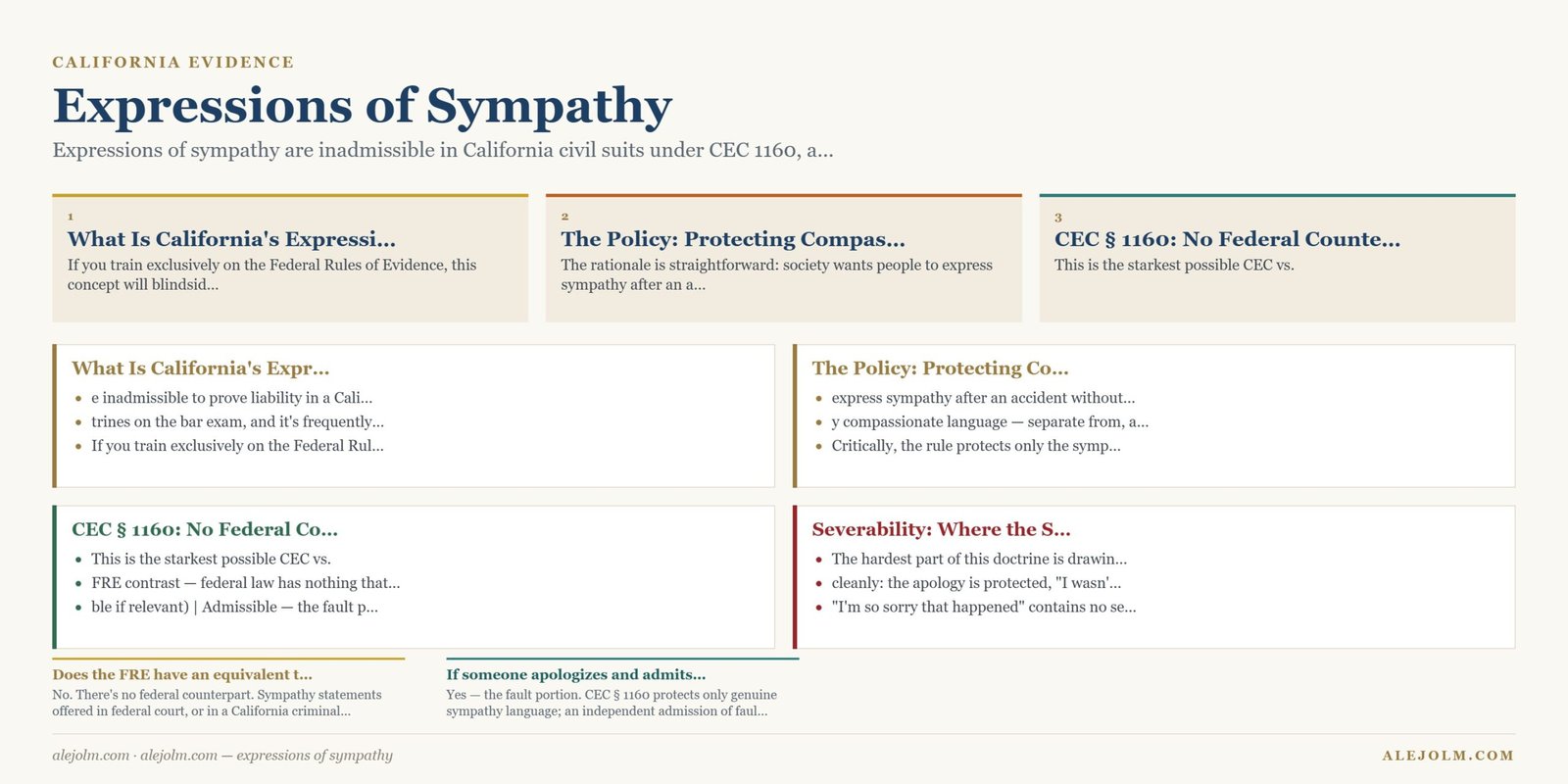
Expressions of sympathy relating to an accident victim’s pain, suffering, or death are inadmissible to prove liability in a California civil action — a rule the federal system simply doesn’t have. It’s one of the clearest CEC-only doctrines on the bar exam, and it’s frequently tested precisely because it has no FRE counterpart to fall back on.
If you train exclusively on the Federal Rules of Evidence, this concept will blindside you. California Evidence Code § 1160 protects compassion; it does not protect fault.
Under California Evidence Code § 1160, expressions of sympathy or benevolence relating to the pain, suffering, or death of an accident victim are inadmissible to prove liability in a civil action — but any accompanying admission of fault remains fully admissible. Severability is the whole doctrine.
The Policy: Protecting Compassion, Not Concealing Fault
The rationale is straightforward: society wants people to express sympathy after an accident without fear that “I’m so sorry” will be twisted into a courtroom admission. So California carved out a narrow, purpose-built exclusion for purely compassionate language — separate from, and different than, the negotiation-focused exclusions in CEC § 1152.
Critically, the rule protects only the sympathy itself. If a statement combines sympathy with an independent admission of fault, the fault language is severable and fully admissible as a party-opponent statement.
CEC § 1160: No Federal Counterpart
This is the starkest possible CEC vs. FRE contrast — federal law has nothing that resembles it.
| Issue | Federal Rule | California Rule (CEC § 1160) |
|---|---|---|
| Categorical exclusion for sympathy statements | None — FRE 401/403 relevance and prejudice balancing apply instead | Yes — categorical exclusion for the sympathy portion |
| Fault admission combined with sympathy | Governed entirely by FRE 401/403 (admissible if relevant) | Admissible — the fault portion is severable and not protected |
| Applies in criminal cases? | N/A | No — CEC § 1160 applies only in civil actions |
| Related neighboring exclusion | FRE 408/409 (settlement/medical-expense payments) | CEC § 1152 (compromise, including medical-expense payments under subdivision (b)) — a separate provision from § 1160 |
Under federal law (or in a California criminal case), a sympathy statement is analyzed the ordinary way: if it’s relevant to an element and its probative value isn’t substantially outweighed by unfair prejudice, it comes in. California civil courts skip that balancing entirely for the sympathy component — it’s excluded categorically.
Severability: Where the Statement Splits
The hardest part of this doctrine is drawing the line between sympathy and fault within a single statement. “I’m so sorry — I wasn’t paying attention” splits cleanly: the apology is protected, “I wasn’t paying attention” is an independent fault admission and comes in. “I’m so sorry that happened” contains no separable fault language at all, so the whole thing stays out.
California courts have also recognized that sympathy can be expressed through conduct — comforting a victim, rushing to help — not just words, though these conduct-based cases are rare.
Worked Example: The Warehouse Accident
Right after a forklift accident at a California warehouse, the site manager tells the injured worker: “I’m so sorry this happened — I feel terrible for you. I should have had that equipment inspected last week; that’s on me.”
The worker later sues. The employer moves to exclude the entire statement under CEC § 1160. The worker argues the last sentence is an independent fault admission.
Analysis: “I’m so sorry this happened” and “I feel terrible for you” are pure expressions of sympathy — inadmissible under § 1160. “I should have had that equipment inspected last week; that’s on me” is an unprotected admission of negligent maintenance — admissible as a party-opponent statement. The statement splits exactly the way the doctrine anticipates, and only the fault portion reaches the jury.
Common Mistakes on the Bar Exam
- Applying CEC § 1160 outside a California civil action. It doesn’t exist under the FRE and doesn’t apply in criminal cases at all.
- Assuming the whole statement is excluded because it opens with an apology. Only the genuinely sympathetic language is protected; independent fault language is severable.
- Confusing CEC § 1160 with CEC § 1152. Section 1152 covers compromise offers and medical-expense payments; § 1160 covers only sympathy/benevolent-gesture language.
- Overlooking conduct-based sympathy. Comforting gestures, not just words, can qualify — though courts apply this sparingly.
Frequently Asked Questions
Does the FRE have an equivalent to California’s sympathy rule?
No. There’s no federal counterpart. Sympathy statements offered in federal court, or in a California criminal case, are analyzed under ordinary FRE 401/403 relevance and prejudice balancing.
If someone apologizes and admits fault in the same breath, is any of it admissible?
Yes — the fault portion. CEC § 1160 protects only genuine sympathy language; an independent admission of fault within the same statement is severable and admissible.
Does California’s sympathy rule apply in criminal cases?
No. It applies only to civil actions. In a criminal proceeding, a defendant’s sympathetic-sounding statement is analyzed under the ordinary hearsay and relevance framework, not this exclusion.
Key Takeaways
- CEC § 1160 categorically excludes expressions of sympathy relating to an accident victim’s pain, suffering, or death in California civil actions.
- There is no federal counterpart — this is a purely California, purely civil-action doctrine.
- Statements combining sympathy and fault are severable: the sympathy is excluded, the fault admission is admissible.
- The rule is distinct from CEC § 1152 (compromise offers and medical-expense payments), a separate statute in the same public-policy cluster.
- On the exam, always parse a post-accident statement sentence by sentence before concluding it’s entirely excluded.
This article is educational and is not legal advice. Consult a licensed California attorney about your situation.
Related guides
- plea negotiations evidence in California
- presumptions and burdens in California evidence
- negligence and damages fundamentals