
What Is Rule 4.4(a) in California Legal Ethics?
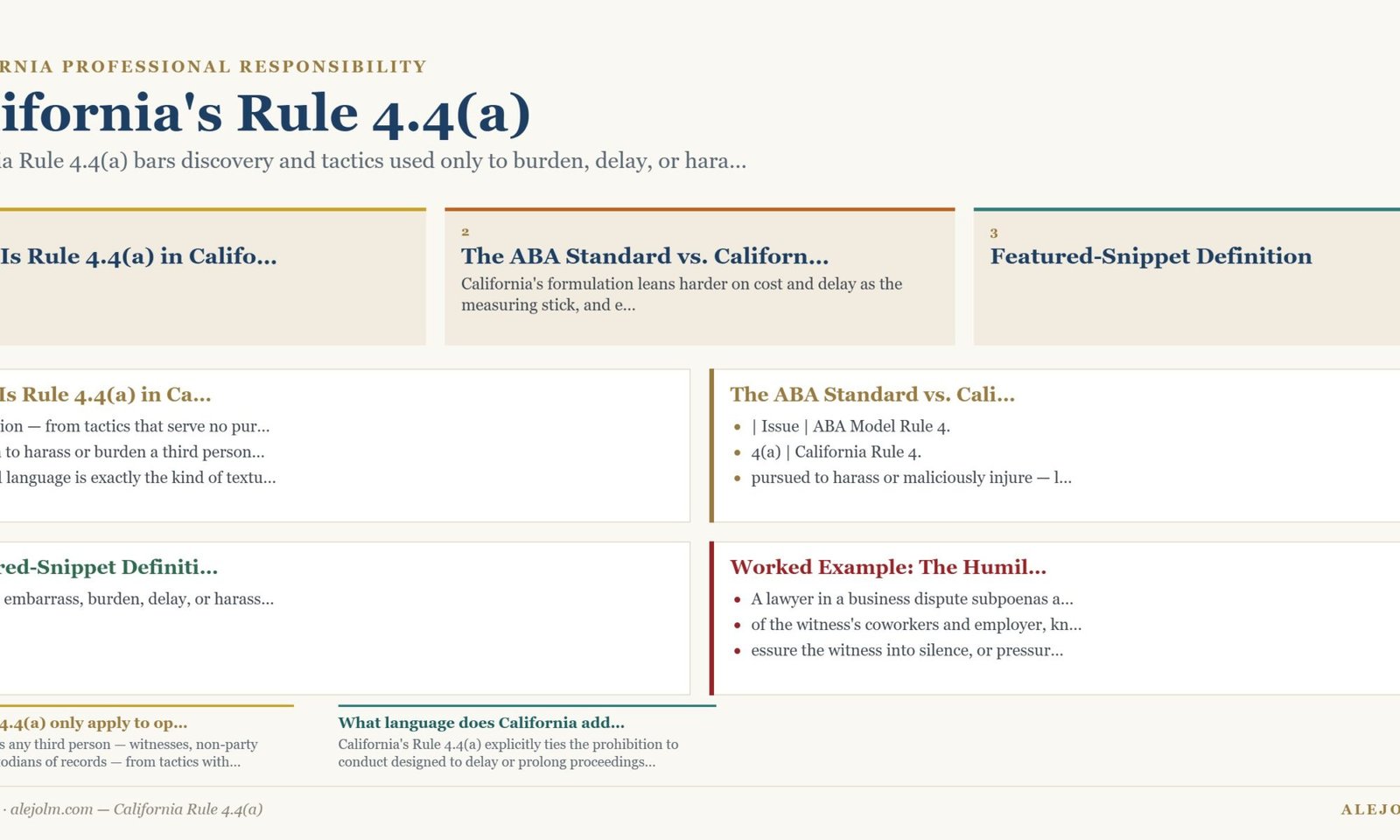
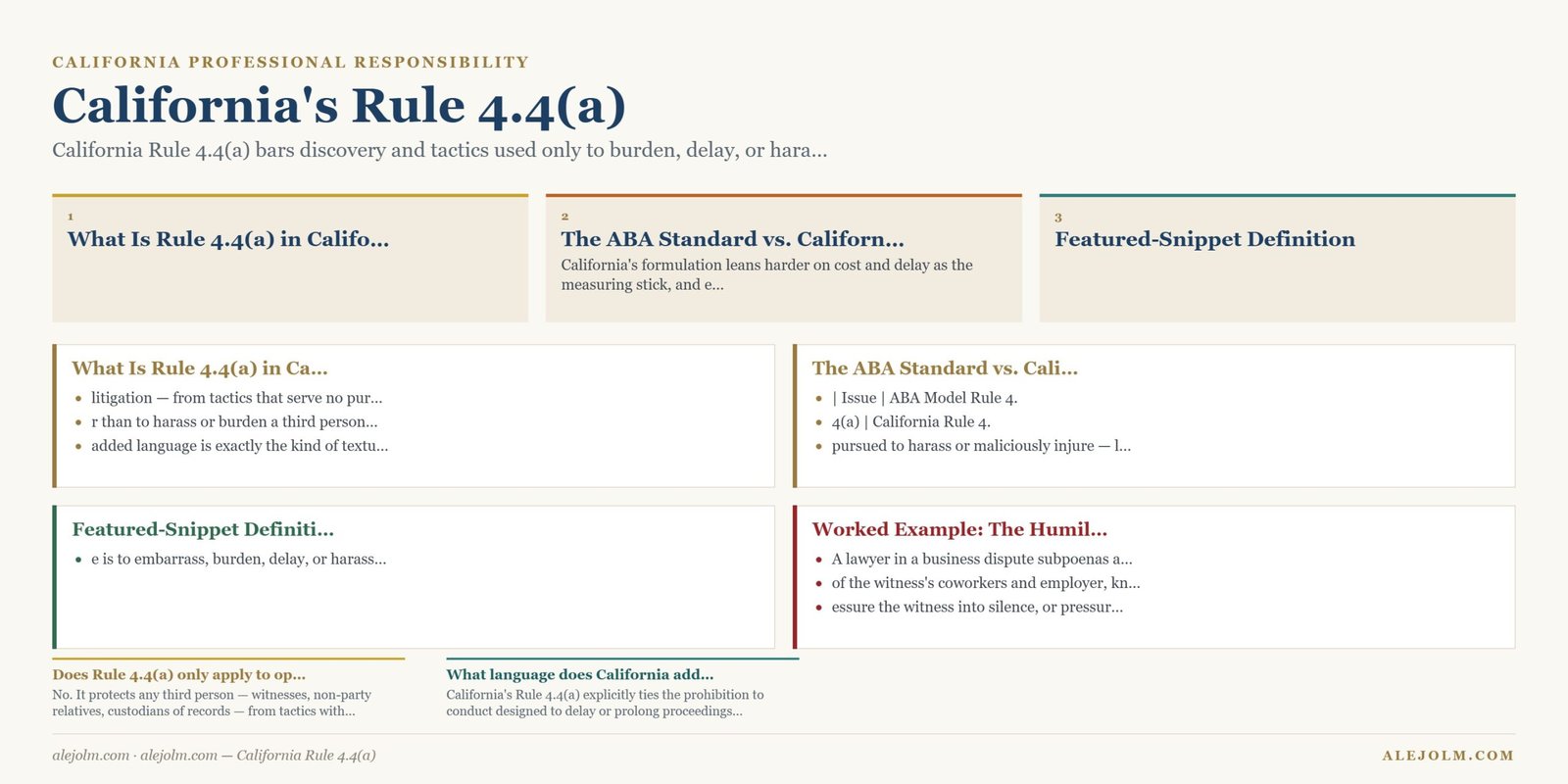
Rule 4.4(a) protects third persons — not clients, not the tribunal, but everyone else touched by litigation — from tactics that serve no purpose beyond embarrassment, burden, delay, or violating legal rights. In one sentence: a lawyer may not use methods that have no substantial purpose other than to harass or burden a third person, or gather evidence by means that violate that person’s legal rights. California’s version of this rule adds language the ABA doesn’t have, and that added language is exactly the kind of textual difference the California Bar Exam rewards you for catching.
The ABA Standard vs. California’s Added Language
| Issue | ABA Model Rule 4.4(a) | California Rule 4.4(a) |
|---|---|---|
| Core prohibition | No substantial purpose but to embarrass, burden, or delay a third person; no rights-violating evidence-gathering | No substantial purpose but to delay/prolong proceedings or cause needless expense |
| Explicit harassment language | Not separately called out | Explicitly ties the prohibition to pursuing claims to harass or maliciously injure |
| Evidence-access obstruction | Covered generally | Separately and heavily tested |
California’s formulation leans harder on cost and delay as the measuring stick, and explicitly links the rule to claims pursued to harass or maliciously injure — language that echoes California’s frivolous-claims rule (Rule 3.1) and reinforces how tightly these provisions overlap in California practice.
Featured-Snippet Definition
Rule 4.4(a) bars a lawyer from using discovery, depositions, or other litigation tools against a third person when the sole purpose is to embarrass, burden, delay, or harass that person — rather than to advance a legitimate need in the case.
Worked Example: The Humiliation Deposition
A lawyer in a business dispute subpoenas a key witness — an employee of the opposing party — for a deposition. The lawyer deliberately schedules it during the witness’s normal workday, at the opposing party’s own office, in front of the witness’s coworkers and employer, knowing the testimony will touch on an embarrassing business practice. The goal is to pressure the witness into silence, or pressure the opposing party into settling to spare the witness humiliation.
There may be a legitimate need for the testimony, but the manner and timing are chosen purely to embarrass. That’s a Rule 4.4(a) violation: the method of obtaining the evidence, separate from whether the evidence itself is relevant, serves no substantial purpose other than to embarrass a third person.
Worked Example: Burying a Non-Party
Frustrated that the opposing party won’t settle, a lawyer targets the opposing party’s elderly, uninvolved uncle — a total non-party — with 50 interrogatories, 100 requests for production, and a deposition subpoena covering matters barely connected to any disputed fact. The uncle is overwhelmed and begs the opposing party to settle just to spare him the ordeal.
This violates Rule 4.4(a), and in California, it also implicates the rule’s explicit prohibition on conduct designed to cause needless expense or delay. There is no substantial legitimate purpose to discovery this disproportionate against a bystander — only the purpose of pressure through burden.
Worked Example: Illegally Obtained Evidence
A lawyer needs a witness’s private medical records to attack credibility at trial. Rather than using a subpoena or a proper records authorization, the lawyer’s investigator poses as a hospital billing administrator and tricks the hospital into releasing the file. The lawyer then uses the records at trial.
This violates Rule 4.4(a)’s separate prong against obtaining evidence by methods that violate a third person’s legal rights. Impersonation and fraud violate the hospital’s and patient’s legal rights, even though the same records might have been lawfully obtainable through ordinary discovery. The rule polices how evidence is obtained, not just whether it’s ultimately admissible.
Why the Rule Exists
Litigation inevitably touches people who aren’t parties — witnesses, custodians of records, family members, bystanders. Rule 4.4(a) recognizes that hard-nosed advocacy is fine, but tactics that serve no purpose except to harm a third person cross an ethical line. It’s a check on lawyers using leverage over people outside the dispute as a substitute for actually litigating the merits.
Common Mistakes on Rule 4.4(a) Questions
- Assuming any burdensome discovery is fine as long as it’s technically relevant. If the manner — timing, location, scope — has no purpose other than embarrassment, it can still violate the rule.
- Missing California’s added “needless expense” and “harass or maliciously injure” language. These phrases mark the California-specific gloss on the ABA baseline.
- Overlooking non-party discovery abuse. Serving disproportionate discovery on an uninvolved third party to pressure the opposing party is a classic fact pattern.
- Focusing only on the evidence’s relevance and ignoring how it was obtained. Illegally or improperly obtained evidence can violate Rule 4.4(a) even if it would otherwise be admissible.
FAQ
Does Rule 4.4(a) only apply to opposing parties?
No. It protects any third person — witnesses, non-party relatives, custodians of records — from tactics with no substantial purpose other than to embarrass, burden, delay, or (under California’s language) cause needless expense.
What language does California add beyond the ABA Model Rule?
California’s Rule 4.4(a) explicitly ties the prohibition to conduct designed to delay or prolong proceedings, cause needless expense, or pursue claims to harass or maliciously injure a person, and it separately addresses unlawfully obstructing access to evidence.
Can a lawyer be disciplined for how evidence was obtained, even if it’s relevant?
Yes. Rule 4.4(a) bars obtaining evidence by methods that violate a third person’s legal rights, regardless of whether the underlying evidence would otherwise be admissible or relevant.
Key Takeaways
- Rule 4.4(a) bars litigation tactics against third persons with no substantial purpose beyond embarrassment, burden, delay, or rights violations.
- California adds explicit language on needless expense, harassment, and malicious injury not found verbatim in the ABA Model Rule.
- Excessive or misdirected discovery against non-parties is a recurring fact pattern.
- Improperly obtained evidence can violate the rule even when the underlying information is relevant.
- This is a favorite pairing with Rule 3.1’s frivolous-claims standard on the California Bar Exam.
This article is educational and is not legal advice. Consult a licensed California attorney about your situation.
Related guides
- truthfulness to third parties under Rule 4.1
- communicating with unrepresented persons
- California’s lawyer non-compete rule
- trial publicity rules for California lawyers