
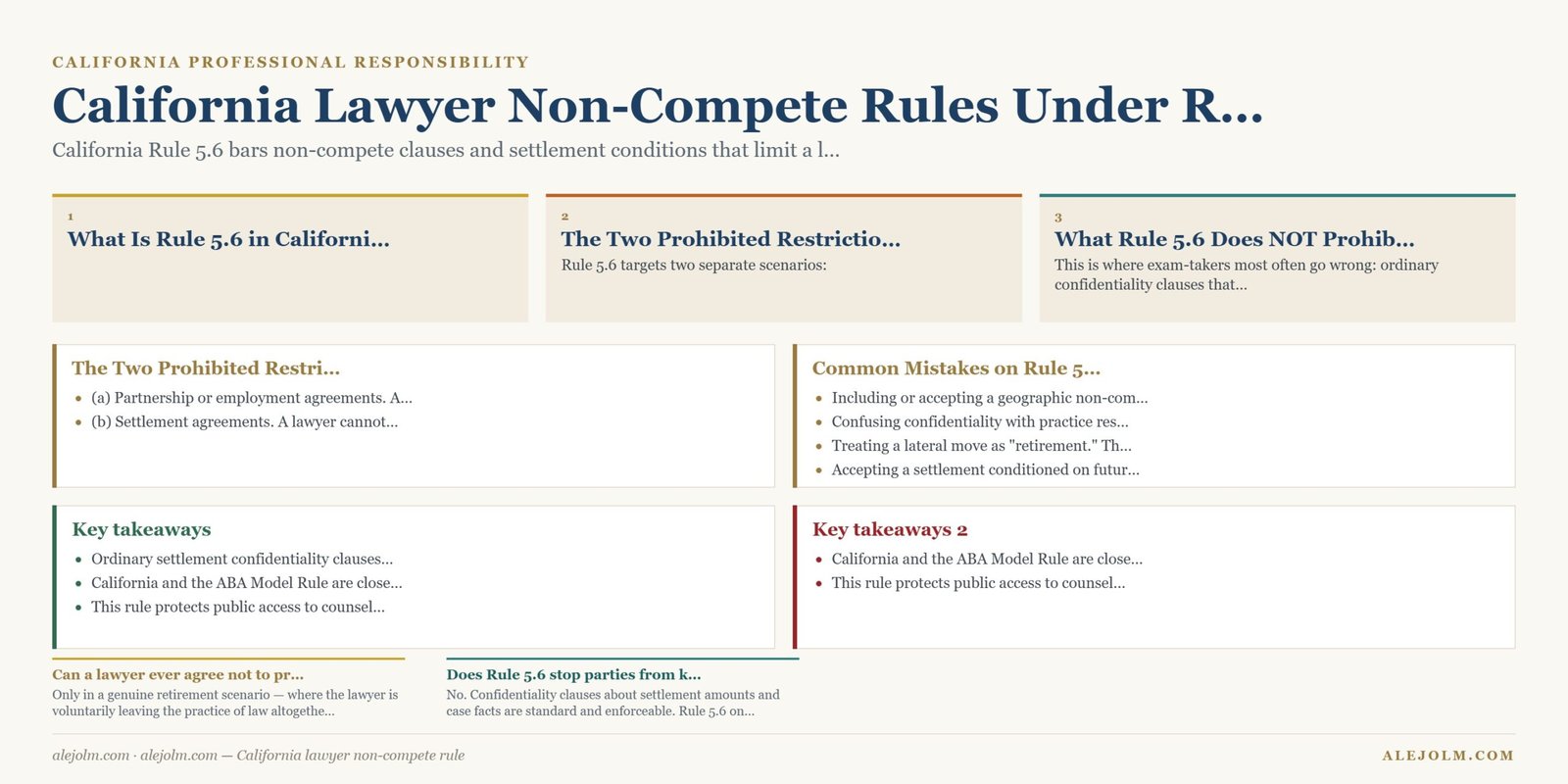
What Is Rule 5.6 in California Legal Ethics?
Rule 5.6 bars a lawyer from offering or making an agreement that restricts a lawyer’s right to practice law after leaving a firm, or as a condition of settling a case. In short: lawyers and clients cannot buy or bargain their way out of another lawyer’s future availability to the public. The ABA Model Rule and California Rule 5.6 are aligned on this core prohibition, which makes it a comparatively rare “no real difference” pairing worth knowing precisely because the exam sometimes tests whether you can spot when the rules do line up.
The Two Prohibited Restrictions
Rule 5.6 targets two separate scenarios:
- (a) Partnership or employment agreements. A firm cannot condition a departing lawyer’s compensation, benefits, or partnership status on the lawyer agreeing not to compete after leaving — with one narrow exception for a genuine retirement agreement.
- (b) Settlement agreements. A lawyer cannot accept a settlement offer that is conditioned on the lawyer agreeing never again to represent similar plaintiffs against that defendant, effectively letting a defendant buy the plaintiff’s lawyer out of the market.
| Agreement Type | Prohibited Restriction | Narrow Exception |
|---|---|---|
| Partnership/employment (5.6(a)) | Non-compete tied to leaving the firm | Genuine retirement from practice |
| Settlement (5.6(b)) | Bar on future representation of similar clients | None — this restriction is never permitted |
| Confidentiality clause (settlement terms) | Not a Rule 5.6 violation | Standard and enforceable |
What Rule 5.6 Does NOT Prohibit
This is where exam-takers most often go wrong: ordinary confidentiality clauses that bar disclosure of settlement amounts or case facts are perfectly fine. Rule 5.6 targets restrictions on a lawyer’s future practice — who the lawyer can represent, what cases the lawyer can take — not restrictions on discussing the deal itself. A settlement can keep the dollar figure and the underlying facts private without ever touching Rule 5.6.
Worked Example: The Deferred-Compensation Trap
Marcus is a partner at a mid-size California firm. The partnership agreement states that any partner who leaves — voluntarily or otherwise — forfeits all deferred compensation and retirement benefits if that partner practices law within 50 miles of the firm’s office for two years. Marcus leaves to open a solo practice three miles away, handling the same type of work. The firm threatens to withhold $300,000 in vested compensation.
This clause violates Rule 5.6(a). It restricts Marcus’s right to practice law by attaching a steep financial penalty to ordinary competition. The narrow exception — a genuine retirement agreement, where a lawyer voluntarily exits the profession entirely — doesn’t apply here, because Marcus isn’t retiring; he’s just changing firms. A clause that penalizes practicing law elsewhere, while the lawyer remains active in the profession, is an impermissible restriction regardless of how it’s dressed up as a “forfeiture” rather than an outright ban.
Worked Example: Buying Off the Plaintiff’s Lawyer
A products-liability defendant facing significant exposure offers the plaintiff’s lawyer a very favorable $5 million settlement — but only if the lawyer agrees never again to represent any plaintiff in a similar products-liability claim against that defendant. The defendant is trying to purchase the lawyer’s future unavailability along with the settlement.
This is a textbook Rule 5.6(b) violation. However attractive the settlement, the plaintiff’s lawyer cannot accept a condition restricting her future practice rights. She must either negotiate the restriction out of the deal or refuse the settlement altogether. The policy is blunt: a case cannot be settled by purchasing a lawyer’s silence toward future clients.
Worked Example: The Permissible Confidentiality Clause
A commercial settlement between two companies includes a clause requiring both parties and their counsel to keep the settlement amount and underlying facts confidential, disclosed only to accountants and immediate family. The agreement says nothing about the plaintiff’s lawyer’s ability to take similar cases in the future.
This clause is permitted. It restricts disclosure of the deal’s terms, not the lawyer’s freedom to represent future clients — exactly the line Rule 5.6 draws between acceptable confidentiality and prohibited practice restrictions.
Why the Rule Exists
Rule 5.6 protects the public’s access to counsel of choice and the profession’s independence from being bought out of the market. A lawyer who leaves a firm should be free to keep practicing; a lawyer who wins a great settlement for one client shouldn’t be barred from helping the next one against the same defendant. These restrictions hurt not just the individual lawyer but the broader public, which benefits from having competent, available counsel.
Common Mistakes on Rule 5.6 Questions
- Including or accepting a geographic non-compete tied to departure. Financial penalties for post-departure competition violate Rule 5.6(a), even if structured as a “forfeiture” rather than a ban.
- Confusing confidentiality with practice restriction. A clause barring disclosure of settlement terms is not the same as, and does not violate, Rule 5.6.
- Treating a lateral move as “retirement.” The retirement exception applies only when a lawyer genuinely exits the practice of law entirely.
- Accepting a settlement conditioned on future non-representation. No amount of client benefit justifies the lawyer accepting a Rule 5.6(b) restriction.
FAQ
Can a lawyer ever agree not to practice law as part of leaving a firm?
Only in a genuine retirement scenario — where the lawyer is voluntarily leaving the practice of law altogether. A lawyer who simply moves to another firm or opens a competing practice cannot lawfully agree to (or be penalized for not agreeing to) a non-compete.
Does Rule 5.6 stop parties from keeping a settlement confidential?
No. Confidentiality clauses about settlement amounts and case facts are standard and enforceable. Rule 5.6 only bars restrictions on a lawyer’s future ability to practice or represent other clients.
Is Rule 5.6 different between California and the ABA Model Rules?
Not substantively — both prohibit the same partnership/employment and settlement restrictions, with the same narrow retirement exception. It’s one of the few provisions in this area where California and the ABA align closely.
Key Takeaways
- Rule 5.6 bars agreements restricting a lawyer’s future right to practice, whether in a partnership/employment agreement or a settlement.
- The only exception is a genuine retirement agreement.
- Ordinary settlement confidentiality clauses are permitted and are not Rule 5.6 violations.
- California and the ABA Model Rule are closely aligned here, unlike many other California professional-responsibility provisions.
- This rule protects public access to counsel and is a recurring topic on the California Bar Exam.
This article is educational and is not legal advice. Consult a licensed California attorney about your situation.
Related guides
- selling a law practice under Rule 1.17
- law-related services under Rule 5.7
- abuse of the legal system under Rule 4.4(a)
- trial publicity rules for California lawyers