
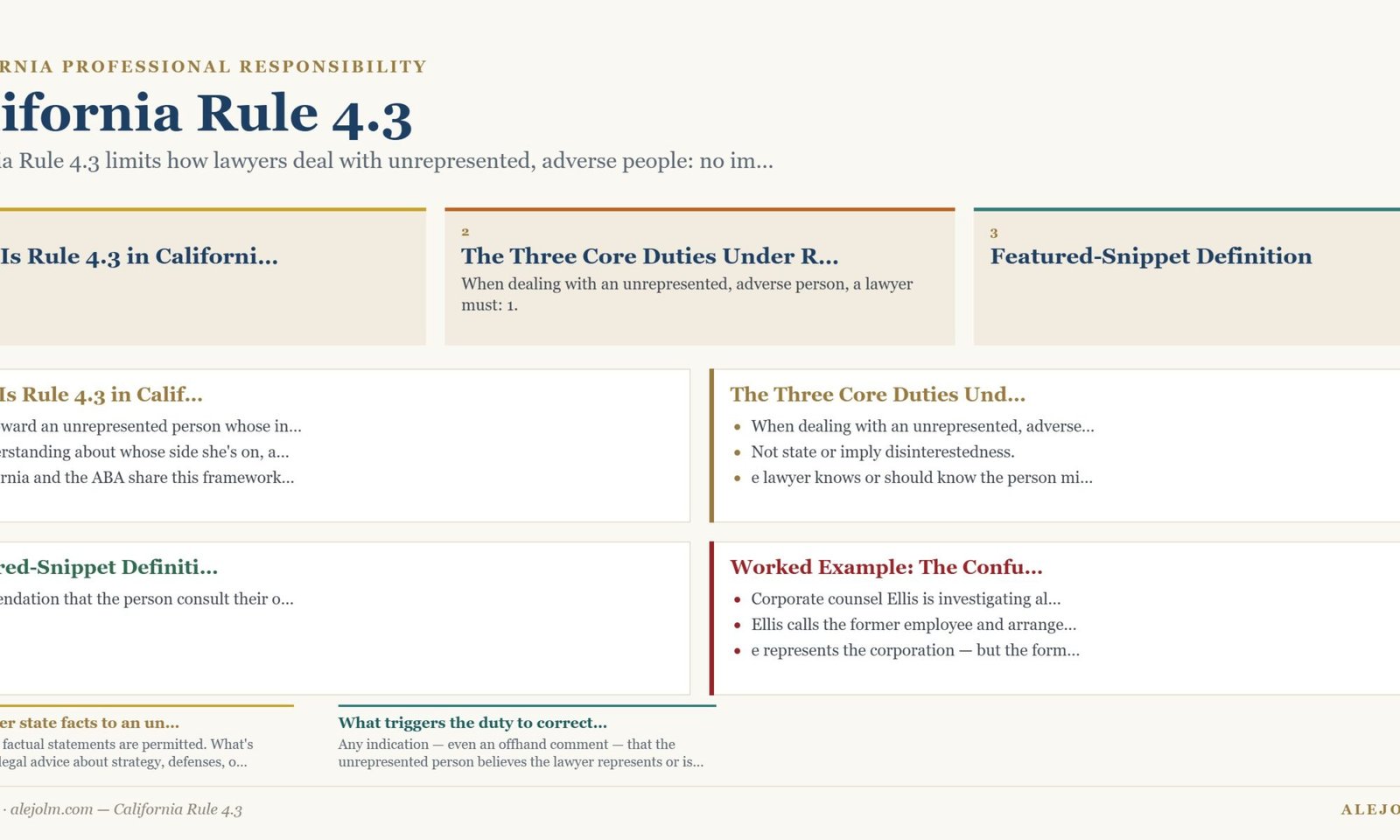
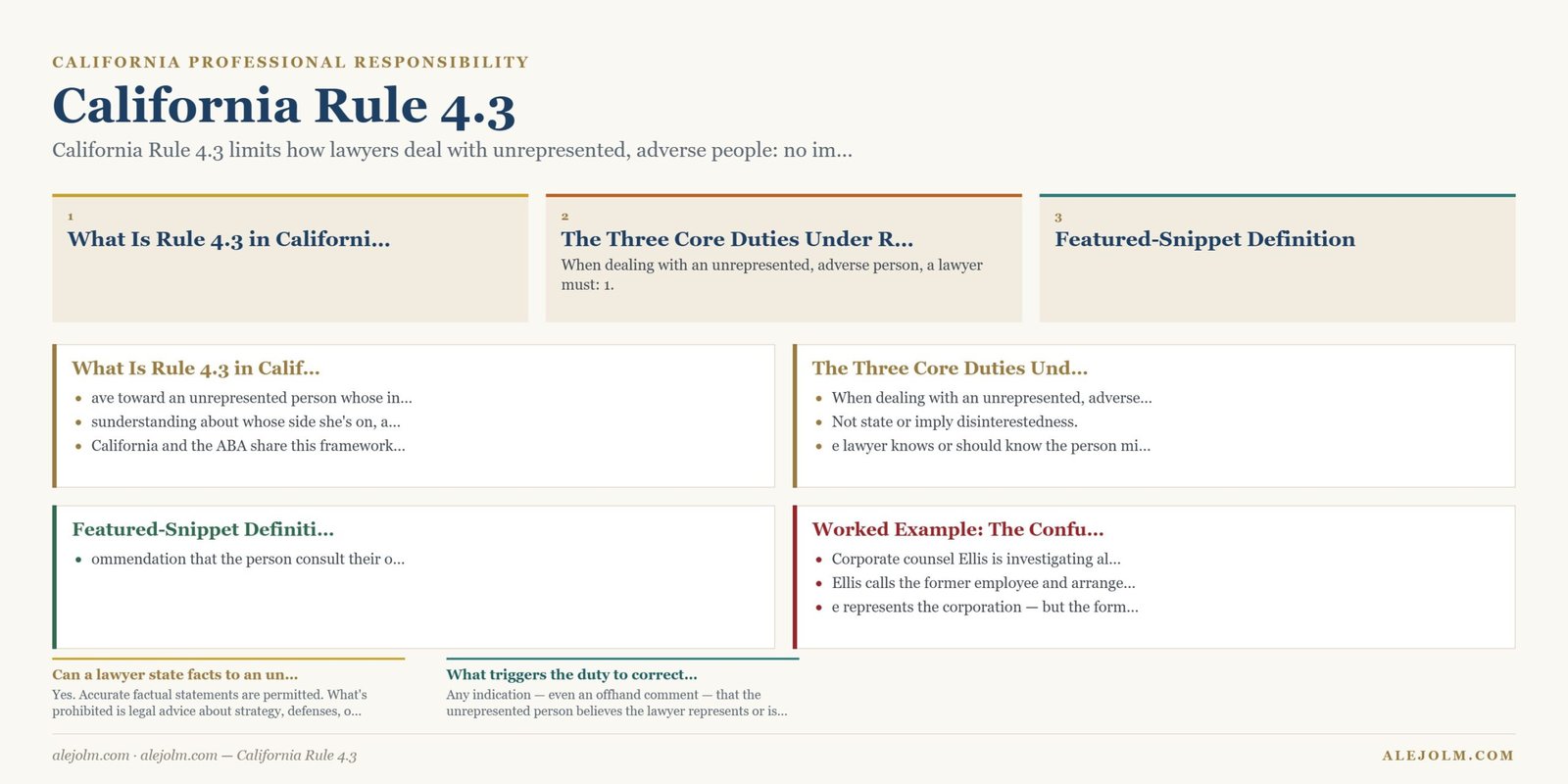
What Is Rule 4.3 in California Legal Ethics?
Rule 4.3 governs how a lawyer must behave toward an unrepresented person whose interests are adverse, or potentially adverse, to the lawyer’s client. In short: a lawyer dealing with an unrepresented, adverse party may not claim or imply neutrality, must correct any misunderstanding about whose side she’s on, and may give no legal advice beyond recommending independent counsel. California and the ABA share this framework, making Rule 4.3 another rule where the exam payoff comes from fact-pattern precision rather than jurisdictional conflict.
The Three Core Duties Under Rule 4.3
When dealing with an unrepresented, adverse person, a lawyer must:
- Not state or imply disinterestedness. If the lawyer knows or should know the person misunderstands her role, she must take reasonable steps to correct it.
- Not seek privileged or confidential information from the unrepresented person.
- Not give legal advice, other than advising the person to get independent counsel.
| Permitted | Prohibited |
|---|---|
| Stating accurate facts about the matter | Advising on strategy, defenses, or settlement decisions |
| Recommending the person consult independent counsel | Implying the lawyer represents or is neutral toward the person |
| Correcting a misunderstanding about the lawyer’s role | Seeking confidential or privileged information from the person |
Featured-Snippet Definition
Rule 4.3 requires a lawyer to clarify her role to an unrepresented, adverse person, correct any misunderstanding about that role, and limit any “advice” to the single recommendation that the person consult their own lawyer — nothing about strategy, defenses, or settlement value.
Worked Example: The Confused Former Employee
Corporate counsel Ellis is investigating alleged wrongdoing by a former employee, now unrepresented. Ellis calls the former employee and arranges a meeting. Ellis explains she represents the corporation — but the former employee responds, “Okay, but you’re going to help me too, right? Since I did nothing wrong?”
This statement signals the former employee has misunderstood Ellis’s role, believing Ellis is also acting as her advocate. Once that confusion surfaces, Ellis must take reasonable steps to correct it: “No, I represent only the corporation, not you. If you’d like to discuss this further, I recommend you consult your own lawyer.” Continuing the interview without correcting the misimpression — and using any candid admissions obtained while the person believed Ellis was on her side — violates Rule 4.3.
Worked Example: Crossing Into Legal Advice
Landlord’s counsel meets directly with an unrepresented tenant who has a potential habitability defense (no heat all winter). Wanting a fast settlement, counsel says: “Look, you don’t really have any defenses here. The habitability claim is a long shot. You should just sign this stipulated judgment and move out. The judge won’t help you anyway.”
This crosses from permitted fact statements into prohibited legal advice. Counsel may accurately state facts (“we believe the heat was repaired within 24 hours”), but cannot advise the tenant on strategy, whether to sign, or whether to pursue a defense. The only permissible advice is to recommend the tenant consult independent counsel.
Worked Example: Doing It Right
Attorney Cho represents Spouse A in an informal, amicable division of marital property. Spouse A wants to meet with unrepresented Spouse B to finalize the split, and Cho will attend. Before any substantive discussion, Cho states clearly: “I want to be clear that I represent only Spouse A. I do not represent you. Before you agree to anything, I strongly recommend you consult your own lawyer to review whatever we agree to.”
Spouse B acknowledges this and the meeting proceeds. Cho has satisfied Rule 4.3’s role-clarification duty by being transparent up front, before any pressure or persuasion enters the conversation.
Why the Rule Exists
Unrepresented people are more vulnerable to confusion and overreach, especially when a lawyer’s language sounds helpful or the setting feels informal (a friendly meeting between spouses, a casual phone call). Rule 4.3 forces the lawyer to be transparent about role, so the unrepresented person can make decisions with clear eyes about whose interests are actually being served.
Common Mistakes on Rule 4.3 Questions
- Assuming role clarification is unnecessary in friendly settings. Confusion can arise even in informal, cordial conversations.
- Failing to correct a stated misunderstanding. Once the unrepresented person signals confusion about the lawyer’s role, silence is a violation.
- Giving advice beyond “get your own lawyer.” Any commentary on strategy, defenses, or settlement value crosses the line.
- Seeking confidential information the person would have protected with counsel. Rule 4.3 also bars exploiting the lack of representation to extract sensitive admissions.
FAQ
Can a lawyer state facts to an unrepresented adverse person?
Yes. Accurate factual statements are permitted. What’s prohibited is legal advice about strategy, defenses, or whether to settle — the only advice allowed is to recommend independent counsel.
What triggers the duty to correct a misunderstanding under Rule 4.3?
Any indication — even an offhand comment — that the unrepresented person believes the lawyer represents or is neutral toward them. Once the lawyer knows or reasonably should know of the confusion, she must correct it.
Does Rule 4.3 apply in informal, non-litigation settings?
Yes. The rule applies whenever a lawyer deals with an unrepresented, adverse or potentially adverse person — including informal negotiations like dividing property between separating spouses, not just formal litigation.
Key Takeaways
- Rule 4.3 requires a lawyer to avoid implying neutrality toward an unrepresented, adverse person and to correct any misunderstanding about her role.
- The only permissible “legal advice” is to recommend the person consult independent counsel.
- Seeking privileged or confidential information from an unrepresented person is prohibited.
- California and the ABA Model Rule align on Rule 4.3’s core requirements.
- Fact patterns testing this rule on the California Bar Exam hinge on precisely where accurate factual statements end and prohibited advice begins.
This article is educational and is not legal advice. Consult a licensed California attorney about your situation.
Related guides
- truthfulness to third parties under Rule 4.1
- abuse of the legal system under Rule 4.4(a)
- law-related services under Rule 5.7
- bar admission honesty rules