

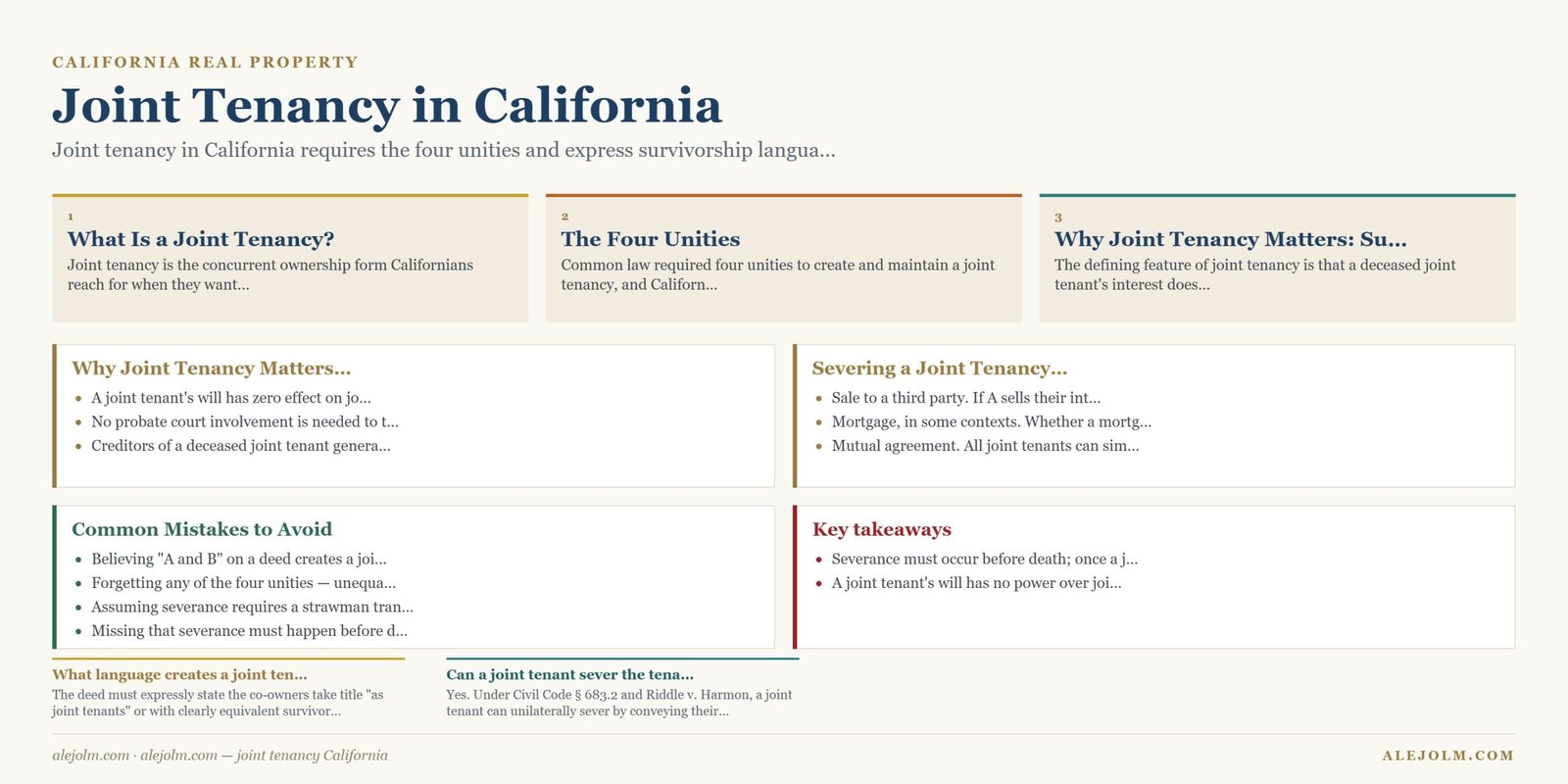
What Is a Joint Tenancy?
Joint tenancy is the concurrent ownership form Californians reach for when they want property to skip probate entirely. It’s common between spouses, siblings, and business partners who trust each other enough to let survivorship — not a will — decide who ends up owning the whole thing.
Joint tenancy, in one sentence: it is a form of concurrent ownership in which each co-owner holds an equal, undivided interest, and when one joint tenant dies, their share vests automatically and immediately in the surviving joint tenant(s), completely outside probate.
Under Cal. Civil Code § 683, a joint tenancy must be created expressly — a deed to “A and B” alone is not enough. The instrument must state that the parties take title “as joint tenants” or with equivalent express survivorship language, or California defaults right back to tenancy in common.
The Four Unities
Common law required four unities to create and maintain a joint tenancy, and California still applies this framework:
| Unity | Requirement |
|---|---|
| Time | All joint tenants must acquire their interests at the same moment |
| Title | All must take by the same instrument (the same deed or will) |
| Interest | All must hold equal, identical shares (e.g., two tenants each hold 50%) |
| Possession | All must have an equal right to possess the whole property |
If any unity is missing — say, unequal shares, or one owner added to title a year after the others — the arrangement is a tenancy in common, regardless of what label the deed uses.
Why Joint Tenancy Matters: Survivorship Outside Probate
The defining feature of joint tenancy is that a deceased joint tenant’s interest does not pass through their will or through intestate succession. It simply evaporates, and the surviving joint tenant’s share expands to fill the gap — as if the deceased tenant had never owned anything at all. This means:
- A joint tenant’s will has zero effect on jointly held property. If Grandma leaves “everything to my daughter” in her will, but her house is in joint tenancy with her son, the son gets the house regardless of what the will says.
- No probate court involvement is needed to transfer title — in practice, the survivor typically records an affidavit of death of joint tenant to clear the record.
- Creditors of a deceased joint tenant generally cannot reach the property after death, because the deceased’s interest no longer exists to be attached.
Severing a Joint Tenancy in California
A joint tenant is never permanently locked in. Any joint tenant can unilaterally destroy the survivorship feature by severing the tenancy — converting it into a tenancy in common as to their share.
Historically, severance required an awkward “strawman” conveyance (transferring to a third party who immediately transferred back). California eliminated that formality in Riddle v. Harmon, 51 Cal. 3d 288 (1980), which held that a joint tenant may sever unilaterally by conveying their own interest directly to themselves. The California Legislature then codified this rule at Cal. Civil Code § 683.2, which also requires that certain unilateral severances be recorded (or otherwise evidenced) before the severing tenant’s death to be effective against the other joint tenants.
Severance can also happen through:
- Sale to a third party. If A sells their interest to C, the joint tenancy between A and B ends as to A’s share. C and B now hold as tenants in common.
- Mortgage, in some contexts. Whether a mortgage severs a joint tenancy depends on whether California treats the mortgage as a lien (it does, under the lien theory) — a lien alone does not automatically sever a joint tenancy the way an outright transfer does, though a completed foreclosure sale would.
- Mutual agreement. All joint tenants can simply agree to convert to tenancy in common.
Critical timing rule: severance must occur before death. Once a joint tenant dies, there is nothing left to sever — the interest has already vested in the survivor(s) by operation of law.
Worked Example
Wei and his sister Lin hold a Palo Alto condo as joint tenants with right of survivorship. Wei, without telling Lin, executes and records a deed transferring his interest to himself as a tenant in common. Three months later, Wei dies, and his will leaves “all my property” to his son.
Question: Who owns Wei’s share of the condo?
Analysis: Wei’s self-conveyance, executed and recorded during his lifetime, was a valid unilateral severance under Riddle v. Harmon and Civil Code § 683.2. That severance converted the joint tenancy into a tenancy in common as to Wei’s share before his death. Because the joint tenancy was already severed, Wei’s death did not trigger survivorship — Lin does not automatically take his share. Instead, Wei’s 50% tenancy-in-common interest passes under his will to his son, who becomes a tenant in common alongside Lin. Had Wei died without ever recording (or otherwise completing) the severance, Lin would have taken the entire condo by survivorship, and Wei’s will would have had no effect on it at all.
Common Mistakes to Avoid
- Believing “A and B” on a deed creates a joint tenancy in California — it does not; express survivorship language is required.
- Forgetting any of the four unities — unequal shares or staggered acquisition dates defeat joint tenancy even if the deed says “joint tenants.”
- Assuming severance requires a strawman transaction — California allows unilateral self-conveyance under Civil Code § 683.2.
- Missing that severance must happen before death — there’s no severing a joint tenancy retroactively after a co-tenant has already died.
FAQ
What language creates a joint tenancy in California?
The deed must expressly state the co-owners take title “as joint tenants” or with clearly equivalent survivorship language. A bare conveyance to two or more people, without more, creates a tenancy in common instead.
Can a joint tenant sever the tenancy without the other owner’s consent?
Yes. Under Civil Code § 683.2 and Riddle v. Harmon, a joint tenant can unilaterally sever by conveying their interest to themselves, converting their share into a tenancy in common interest.
Does a joint tenant’s will control what happens to jointly held property?
No. Property held in joint tenancy passes automatically to the surviving joint tenant(s) by operation of law, and a will has no effect on it unless the joint tenancy was severed before death.
Key Takeaways
- Joint tenancy requires the four unities (time, title, interest, possession) plus express survivorship language — Cal. Civil Code § 683.
- On a joint tenant’s death, their interest vests automatically in the survivors, bypassing probate entirely.
- California allows unilateral severance by self-conveyance under Civil Code § 683.2, following Riddle v. Harmon.
- Severance must occur before death; once a joint tenant dies, survivorship has already taken effect.
- A joint tenant’s will has no power over jointly held property unless the joint tenancy is severed first.
This article is educational and is not legal advice. Consult a licensed California attorney about your situation.
Related guides
- concurrent ownership and tenancy in common in California
- tenancy by the entirety and California community property
- recording acts and bona fide purchasers
- community property presumptions in California