
What Is Tenancy by the Entirety?
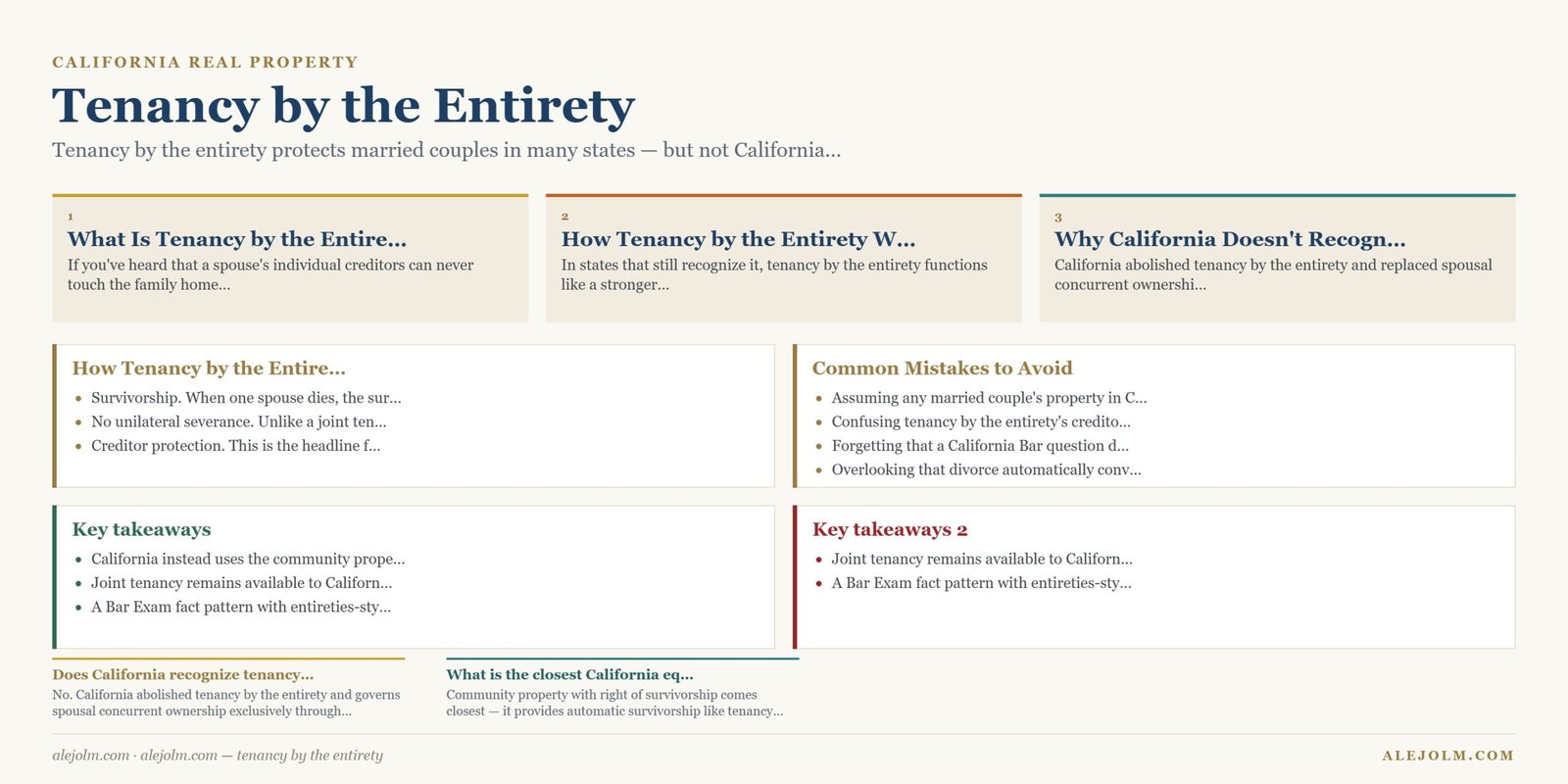
If you’ve heard that a spouse’s individual creditors can never touch the family home, you’re thinking of tenancy by the entirety — a form of concurrent ownership that exists in a number of states but has no application in California. Understanding why is as important as understanding what the doctrine does, especially for anyone advising clients who moved from a tenancy-by-the-entirety state.
Tenancy by the entirety, in one sentence: it is a form of concurrent ownership available only to married spouses in which each spouse is deemed to own the whole property (not a divided half), carries automatic right of survivorship, and cannot be unilaterally severed by either spouse acting alone.
How Tenancy by the Entirety Works Where It’s Recognized
In states that still recognize it, tenancy by the entirety functions like a stronger version of joint tenancy, reserved exclusively for married couples:
- Survivorship. When one spouse dies, the surviving spouse automatically owns the entire property — the deceased spouse’s will is irrelevant to this asset.
- No unilateral severance. Unlike a joint tenant, neither spouse can sever a tenancy by the entirety alone. Both spouses must act together to sell, mortgage, or convert the ownership form.
- Creditor protection. This is the headline feature. Because each spouse is deemed to own the whole property rather than a severable share, an individual creditor of only one spouse generally cannot force a sale or attach the property. Sawada v. Endo, 57 Haw. 608 (1977), is the leading case establishing that one spouse’s individual creditors cannot reach entireties property without both spouses’ consent. Only creditors of both spouses jointly — such as a joint mortgage lender — can reach it.
Why California Doesn’t Recognize It
California abolished tenancy by the entirety and replaced spousal concurrent ownership with the community property system. Under Cal. Family Code § 750, spouses may hold property as community property, separate property, or as community property with right of survivorship — but tenancy by the entirety is simply not one of the recognized categories.
This is a favorite California-specific trap on the Bar Exam: a question describing facts that sound like tenancy by the entirety (married couple, survivorship, creditor issue) is very often testing whether you know that California doesn’t use that doctrine at all, and instead routes the analysis through community property rules.
Tenancy by the Entirety vs. California’s Actual Options
| Feature | Tenancy by the Entirety (other states) | California Community Property | California Joint Tenancy |
|---|---|---|---|
| Available to | Married couples only | Married couples / registered domestic partners | Any co-owners |
| Survivorship | Automatic | Only if titled “with right of survivorship” | Automatic |
| Unilateral severance | Not permitted | Governed by community property / family law rules | Permitted (Civil Code § 683.2) |
| Individual creditor protection | Strong — creditor of one spouse alone usually cannot reach it | Limited — community property can be reached for community debts | None — a joint tenant’s individual creditor can reach that tenant’s share |
| Divorce effect | Converts to tenancy in common | Subject to division under community property rules | Unaffected by marital status |
Because California married couples cannot use tenancy by the entirety’s creditor shield, estate planning attorneys in the state instead lean on community property with right of survivorship (which combines survivorship with the community property step-up in basis at death) or on trusts, when creditor protection or probate avoidance is the goal.
Worked Example
Robert and Wendy marry in Ohio, where they buy a home titled as tenants by the entirety. Ohio law would protect that home from a creditor who sues only Robert individually. Five years later, they relocate to San Diego and purchase a new home, financed by both of their incomes, titled in both their names.
Question: Does the same creditor protection apply to their new California home?
Analysis: No. California does not recognize tenancy by the entirety at all — Robert and Wendy cannot hold their San Diego home that way no matter what they call it on the deed. If the deed says “as community property” or “as community property with right of survivorship,” Family Code § 750 governs, and the home is generally reachable by creditors of community debts, though separate creditors of only one spouse face real (but different and more limited) restrictions than the near-absolute protection tenancy by the entirety offered in Ohio. If Robert and Wendy instead take title “as joint tenants,” they get automatic survivorship, but with none of the entireties-style creditor protection — a joint tenant’s individual creditor can reach that tenant’s own share even while both spouses are alive.
Common Mistakes to Avoid
- Assuming any married couple’s property in California functions like tenancy by the entirety — it doesn’t; California has no such doctrine.
- Confusing tenancy by the entirety’s creditor protection with California community property’s more limited protections — they are not equivalent.
- Forgetting that a California Bar question describing entireties-sounding facts is likely testing whether you know to route the analysis through community property instead.
- Overlooking that divorce automatically converts a tenancy by the entirety into a tenancy in common in states that recognize it — a useful comparison point, but not California’s rule.
FAQ
Does California recognize tenancy by the entirety?
No. California abolished tenancy by the entirety and governs spousal concurrent ownership exclusively through the community property system under Family Code § 750.
What is the closest California equivalent to tenancy by the entirety?
Community property with right of survivorship comes closest — it provides automatic survivorship like tenancy by the entirety, though it does not carry the same strong individual-creditor protection.
Can one spouse in California sell community property without the other’s consent?
Generally no for real property — California law requires both spouses’ consent (often both signatures) to sell, convey, or encumber community real property, similar in spirit to the “no unilateral action” rule under tenancy by the entirety.
Key Takeaways
- Tenancy by the entirety is available only to married couples and combines automatic survivorship with strong protection from one spouse’s individual creditors.
- California does not recognize tenancy by the entirety at all — this is a frequently tested California-specific rule.
- California instead uses the community property system under Family Code § 750 for spousal ownership.
- Joint tenancy remains available to California spouses but lacks the entireties-style creditor shield.
- A Bar Exam fact pattern with entireties-style facts is usually testing whether you redirect the analysis to California community property.
This article is educational and is not legal advice. Consult a licensed California attorney about your situation.
Related guides
- joint tenancy with right of survivorship in California
- concurrent ownership and tenancy in common in California
- community property presumptions in California