
What Are Former Government Lawyer and Former Judge Conflicts?
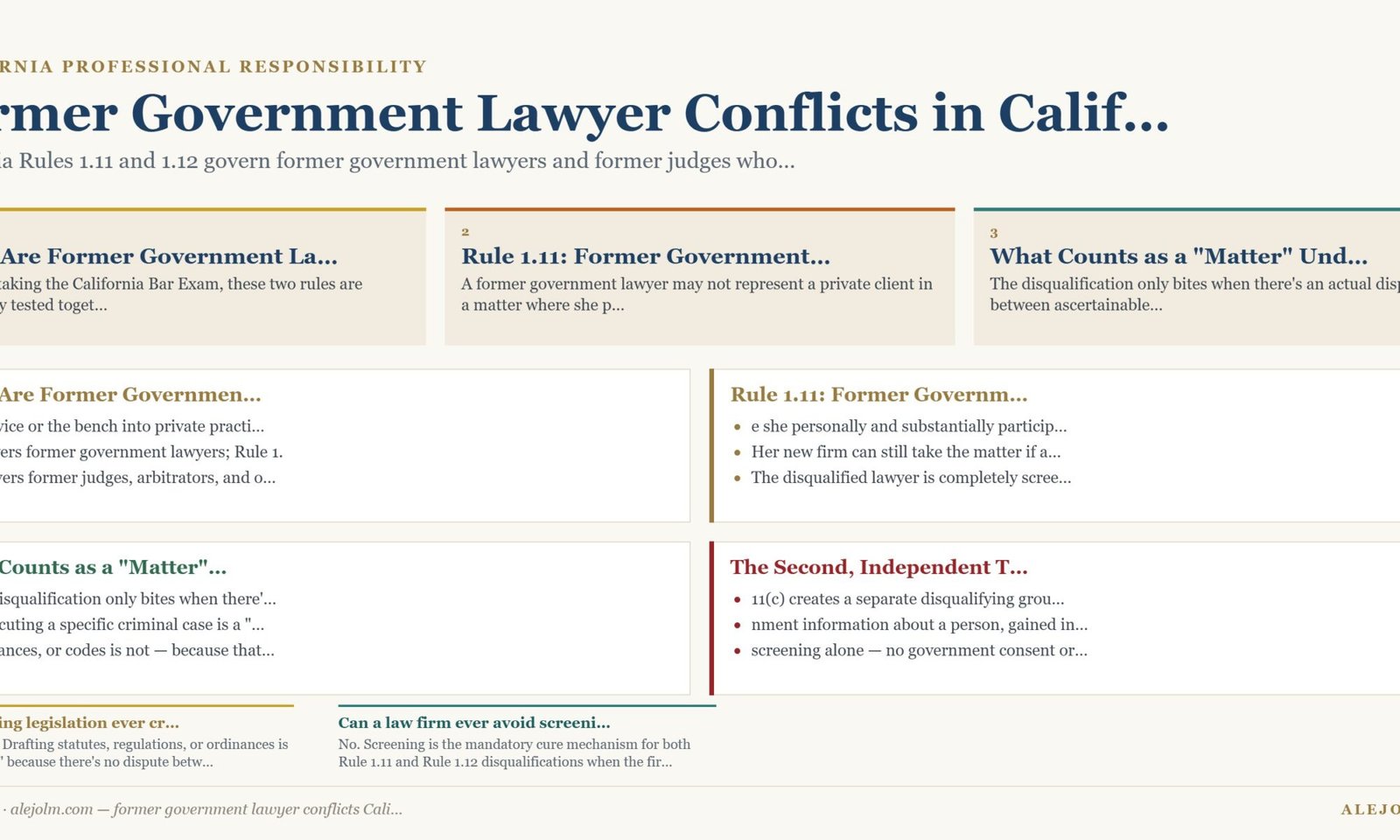
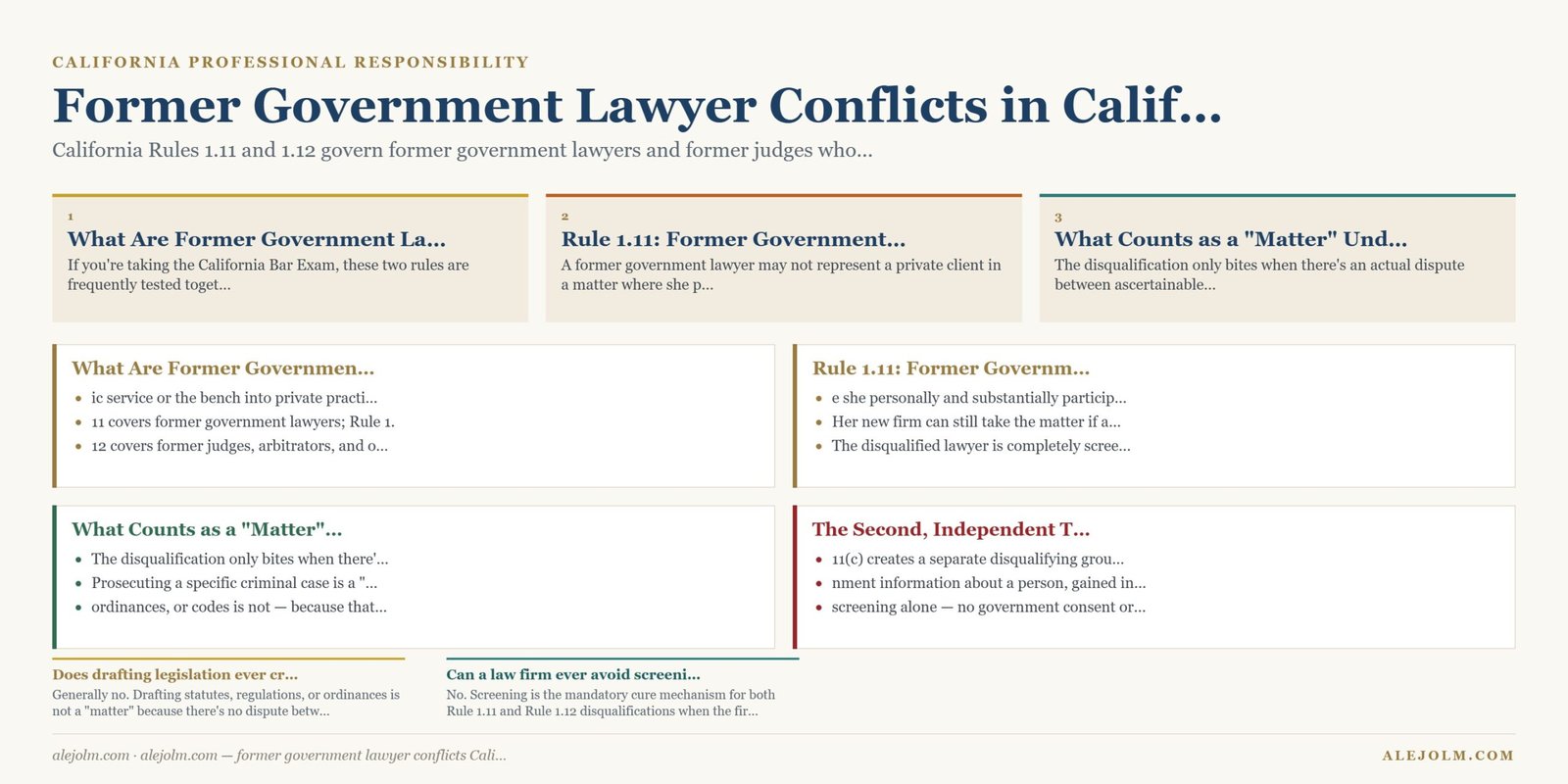
Former government lawyer and former judge conflicts are “revolving door” rules that restrict lawyers who move from public service or the bench into private practice from working on matters connected to their prior government role. Rule 1.11 covers former government lawyers; Rule 1.12 covers former judges, arbitrators, and other neutral adjudicators. Both let the lawyer’s new firm take the matter anyway, if it screens the disqualified lawyer properly.
If you’re taking the California Bar Exam, these two rules are frequently tested together because they share a screening-and-notice cure but differ in their triggers and requirements.
Rule 1.11: Former Government Lawyers
A former government lawyer may not represent a private client in a matter where she personally and substantially participated as a public officer, unless the government agency consents. Her new firm can still take the matter if all three conditions are met:
- The disqualified lawyer is completely screened from any part of the representation;
- She shares in no part of the fees earned on that matter; and
- The firm notifies the government agency, so it can evaluate the situation and object if it wants to.
What Counts as a “Matter” Under Rule 1.11
The disqualification only bites when there’s an actual dispute between ascertainable parties. Prosecuting a specific criminal case is a “matter.” Drafting general regulations, ordinances, or codes is not — because that work applies broadly to future situations, not a specific dispute.
This distinction is a favorite exam trap: a lawyer who spent years drafting environmental regulations, then joins private practice and challenges a permit decision under those same regulations, is usually not disqualified — as long as she picked up no confidential information about that specific dispute while in government.
The Second, Independent Trigger: Confidential Government Information
Rule 1.11(c) creates a separate disqualifying ground. Even if the lawyer never personally and substantially participated in a “matter,” she may not use confidential government information about a person, gained in government service, to that person’s material disadvantage later. This prong is cured by screening alone — no government consent or agency notice is required, unlike the matter-participation prong.
Rule 1.12: Former Judges and Neutrals
A former judge, arbitrator, or other adjudicative officer may not represent a client in a matter over which she presided. Her firm can still take the case with screening plus written notice — the same basic cure mechanism used for lateral-hire former-client conflicts, but without a government-consent requirement.
| Issue | Former Government Lawyer (Rule 1.11) | Former Judge/Neutral (Rule 1.12) |
|---|---|---|
| Trigger | Personal and substantial participation as a public officer | Presided over the matter |
| Cure for the firm | Screening + no fee share + notice to the government agency | Screening + written notice |
| Consent option | Government agency may waive | Not applicable |
Worked Example: The Prosecutor Who Switches Sides
A Deputy District Attorney personally and substantially prosecutes an embezzlement case; the defendant is convicted. Two years later, she joins a civil litigation firm. The same former defendant is now sued civilly by his ex-employer over related restitution, and he wants to hire her firm.
The lawyer herself is disqualified under Rule 1.11 — she personally and substantially prosecuted him. But her firm can still take the case if: it completely screens her (no access to the file, no role in strategy), she gets no share of the fees from the matter, and the firm sends written notice to the DA’s office.
Worked Example: The Former Family-Law Judge
A judge presides over a contentious divorce, issuing a custody and property decree for Spouse A and Spouse B. Three years later, now in private practice at a family-law firm, Spouse A wants the firm to handle a custody modification tied to the same original case.
The former judge personally cannot take the matter — she presided over it. Her firm can, if it screens her completely and gives written notice to both spouses about the conflict and the screen. Unlike Rule 1.11, there’s no government-agency notice requirement here — just screening and notice to the affected parties.
Why the Revolving Door Rules Exist
Lawyers moving between government and private practice may carry confidential information or relationships with officials still in government. Rules 1.11 and 1.12 let lawyers move freely between the public and private sectors — an important professional-mobility principle — while protecting against the risk that inside knowledge or lingering influence gets exploited in a later private matter.
Common Mistakes on the California Bar Exam
- Confusing “subject area” with “matter.” Working generally in environmental law isn’t disqualifying; personally handling the specific dispute is.
- Forgetting the confidential-information prong exists independently. A lawyer can clear the participation test and still be disqualified under Rule 1.11(c).
- Sharing fees with a “screened” lawyer. That destroys the cure — screening plus a fee cut is not screening.
- Skipping notice to the government agency. Screening alone isn’t enough for Rule 1.11’s matter-based prong; the agency must be told.
- Assuming Rule 1.12 requires government notice too. It doesn’t — former-judge conflicts require screening and notice to the parties, not the court system.
FAQ
Does drafting legislation ever create a Rule 1.11 conflict?
Generally no. Drafting statutes, regulations, or ordinances is not a “matter” because there’s no dispute between ascertainable parties — it’s prospective, general lawmaking, not adjudication of a specific case.
Can a law firm ever avoid screening entirely?
No. Screening is the mandatory cure mechanism for both Rule 1.11 and Rule 1.12 disqualifications when the firm wants to keep the engagement; there’s no version of the rule that skips it.
What happens if a screened lawyer accidentally sees the file?
The screen is destroyed. If a disqualified lawyer receives case documents, attends strategy meetings, or is copied on related emails, the firm loses the protection and risks imputed disqualification for the whole firm.
Key Takeaways
- Rule 1.11 disqualifies former government lawyers who personally and substantially participated in a specific matter as a public officer.
- Rule 1.11(c) independently bars use of confidential government information against a person, even without matter participation.
- Rule 1.12 disqualifies former judges and neutrals from matters over which they presided.
- Firms cure both types of disqualification with complete screening; Rule 1.11’s matter-based prong also requires no fee-sharing and government-agency notice.
- Drafting general regulations is usually not a disqualifying “matter” under Rule 1.11.
This article is educational and is not legal advice. Consult a licensed California attorney about your situation.
Related guides
- California’s hot-potato rule for dropping clients
- California fee splitting rules for lawyers
- Unauthorized practice of law in California