

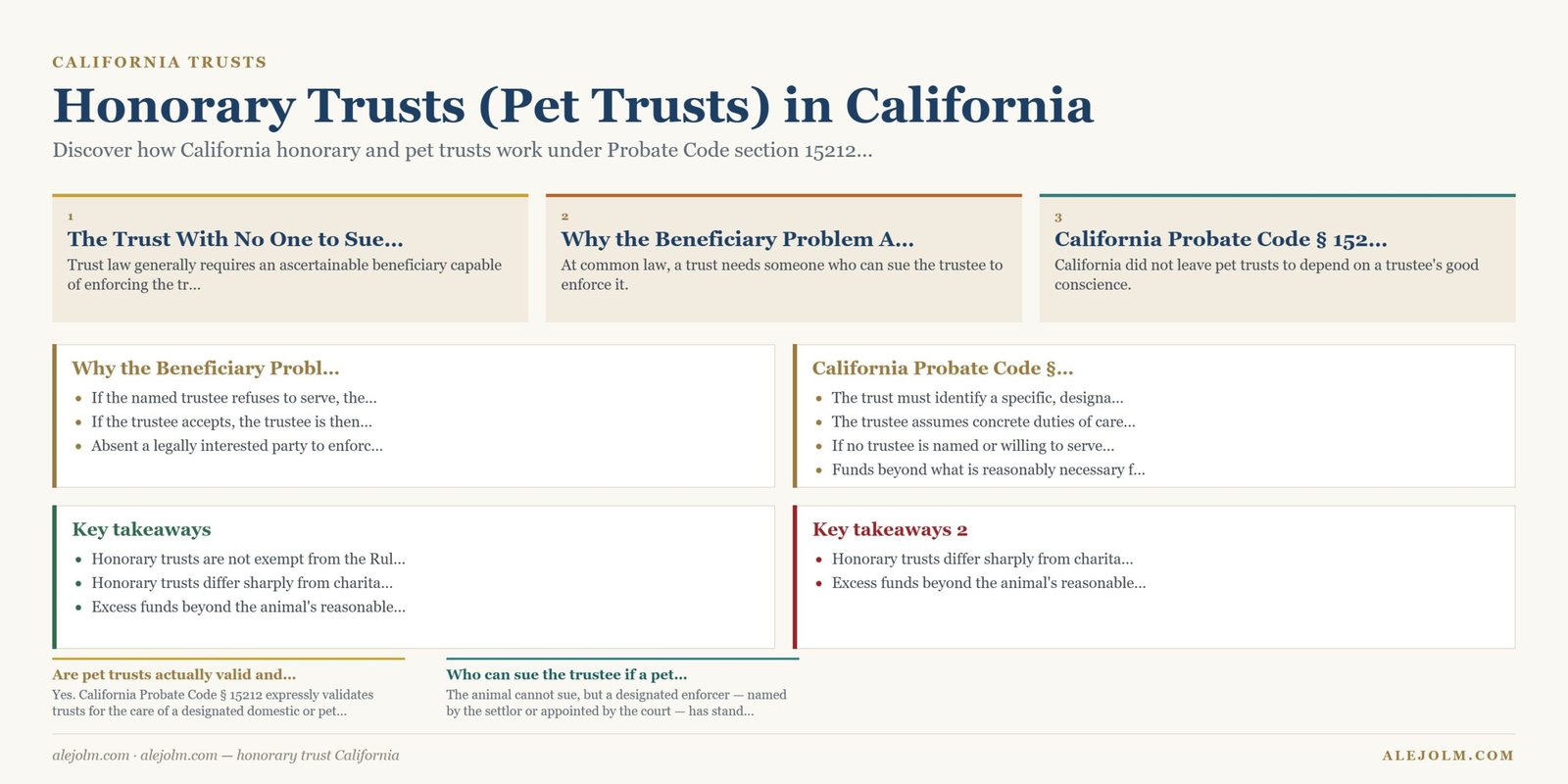
The Trust With No One to Sue Over It
Trust law generally requires an ascertainable beneficiary capable of enforcing the trust in court. So what happens when a settlor wants to leave money for a dog, a cemetery plot, or the upkeep of a family cabin — none of which can walk into a courtroom? California solved this puzzle with the honorary trust, and the pet-trust version of it is one of the most memorable, and testable, corners of trust law.
An honorary trust is a trust created for a specific non-charitable purpose that lacks an ascertainable human beneficiary. The classic example is a trust for the care of a designated pet or the maintenance of a cemetery plot. California expressly validates pet trusts by statute, sidestepping the usual beneficiary requirement.
Why the Beneficiary Problem Almost Killed This Trust
At common law, a trust needs someone who can sue the trustee to enforce it. A pet cannot be a plaintiff. Without an enforceable beneficiary, an ordinary honorary trust theoretically fails for lack of a legally cognizable party to hold the trustee accountable. Historically, courts patched this gap by treating honorary trusts as resting on the trustee’s honor rather than legal compulsion:
- If the named trustee refuses to serve, the “beneficiary” (the animal) cannot sue to force acceptance.
- If the trustee accepts, the trustee is then bound to perform according to the trust’s terms.
- Absent a legally interested party to enforce the trust, the trustee’s compliance was traditionally a matter of honor, not law.
California Probate Code § 15212 Fixes the Enforcement Gap
California did not leave pet trusts to depend on a trustee’s good conscience. Probate Code § 15212 expressly authorizes trusts for the care of a designated domestic or pet animal during that animal’s life, and it builds in a real enforcement mechanism. Key features of the California statute:
- The trust must identify a specific, designated animal — not a generic category like “any pet I may own.”
- The trustee assumes concrete duties of care and sustenance for that animal.
- If no trustee is named or willing to serve, a court may appoint one.
- Funds beyond what is reasonably necessary for the animal’s care can be reduced, with the excess passing by resulting trust back to the settlor or the settlor’s estate.
- A settlor or the court may designate an enforcer with standing to sue the trustee for breach — solving the “who can sue” problem directly.
The Rule Against Perpetuities Trap
Here is where honorary trusts get genuinely tricky on the bar exam. Unlike charitable trusts, honorary trusts are not exempt from the Rule Against Perpetuities. A trust that could theoretically last forever — with no fixed termination — risks invalidity under RAP.
California’s pet-trust statute solves this too, but through a specific design choice: the trust’s duration is limited to the life of the designated pet. Because the animal’s death is a certain, measurable event, the trust necessarily terminates well within any conceivable perpetuities period. This is a deliberate drafting fix, not an accident — and it is exactly the kind of connection between doctrines (RAP + honorary trusts) that shows up in integrated bar essays.
Honorary Trusts Are Not Charitable Trusts — Don’t Mix Them Up
A trust “for the care of my dog Fido” is specific and personal — it benefits one identifiable animal, not the public. A trust “for animal welfare generally” or “for the prevention of cruelty to animals” is a charitable trust, subject to an entirely different set of rules: it is exempt from RAP, enforced by the Attorney General, and eligible for cy pres if its purpose fails.
| Feature | Honorary Trust (e.g., pet trust) | Charitable Trust |
|---|---|---|
| Purpose | Specific, personal, non-charitable | Broad public benefit |
| Beneficiary | None ascertainable; enforced via statute/enforcer | Enforced by Attorney General |
| Rule Against Perpetuities | Must comply (life-of-pet limitation typically satisfies it) | Exempt — can last forever |
| Failed purpose remedy | Excess funds result back to settlor’s estate | Cy pres redirects to similar purpose |
A Worked Bar Exam Hypo
Priya’s will creates a trust: “I leave $150,000 to my trustee, to be used for the care of my cat, Biscuit, during Biscuit’s life. My friend Wendy shall serve as trustee. My brother Sam shall serve as enforcer of this trust.” Priya dies; Wendy accepts the role of trustee but two years later begins using trust funds to pay her own credit card bills instead of Biscuit’s food and veterinary care.
Walk through the analysis:
- Is this a valid trust despite Biscuit’s inability to sue? Yes — this is a valid California honorary (pet) trust under Probate Code § 15212, which expressly authorizes trusts for a designated animal’s care.
- Does it violate the Rule Against Perpetuities? No — the trust terminates at Biscuit’s death, a life clearly within the perpetuities period.
- Who can enforce the trust against Wendy’s misuse of funds? Sam, the designated enforcer, has standing to sue Wendy for breach even though Biscuit cannot.
- What happens to any money left after Biscuit dies? If $150,000 exceeds what is reasonably necessary for Biscuit’s care, the excess is subject to reduction and passes by resulting trust to Priya’s estate (or residuary beneficiaries), not to Wendy.
Practical Drafting Points Worth Remembering
Even outside the bar exam, honorary/pet trusts show up constantly in real estate planning practice. A well-drafted California pet trust should: name the specific animal, designate a willing trustee (with a court-appointment backup), define the scope of permitted expenses, name an enforcer, and specify what happens to leftover funds after the animal’s death.
FAQ
Are pet trusts actually valid and enforceable in California?
Yes. California Probate Code § 15212 expressly validates trusts for the care of a designated domestic or pet animal during its lifetime, and it allows a court-appointed trustee and a designated enforcer to ensure compliance.
Who can sue the trustee if a pet trust is breached?
The animal cannot sue, but a designated enforcer — named by the settlor or appointed by the court — has standing to sue the trustee for breach. The settlor may also retain enforcement rights.
Does a pet trust violate the Rule Against Perpetuities?
Not under California’s statute. Because the trust is limited to the life of the designated pet, its duration is measured by a certain, ascertainable life and satisfies the Rule Against Perpetuities.
Key Takeaways
- An honorary trust serves a specific non-charitable purpose without an ascertainable human beneficiary — most commonly, pet care.
- California Probate Code § 15212 validates pet trusts and allows an enforcer or court-appointed trustee to fill the enforcement gap.
- Honorary trusts are not exempt from the Rule Against Perpetuities; California’s “life of the pet” limitation is what keeps pet trusts valid.
- Honorary trusts differ sharply from charitable trusts in purpose, enforcement, RAP treatment, and failed-purpose remedies.
- Excess funds beyond the animal’s reasonable needs pass by resulting trust back to the settlor’s estate.
This article is educational and is not legal advice. Consult a licensed California attorney about your situation.
Related guides
- Cy Pres Doctrine in California
- Rule Against Perpetuities
- Charitable Bequests in California Wills
- Trustee Duties in California