
What Happens When a Charitable Trust’s Purpose Dies With It?
California courts see this fact pattern constantly: a donor funds a charity for a specific cause, decades pass, and the cause disappears. A hospital closes. A disease is cured. A college merges into another school. The cy pres doctrine is the equitable tool that keeps the money working for charity instead of falling apart. For California Bar Exam candidates, cy pres is a high-yield trusts topic that examiners love to pair with resulting trusts and equitable deviation.
Cy pres (French for “as near as possible”) lets a court redirect a charitable trust to the nearest similar purpose when the settlor’s original charitable purpose becomes impossible, impracticable, illegal, or wasteful. It applies only to charitable trusts, and only when the settlor held a general — not specific — charitable intent.
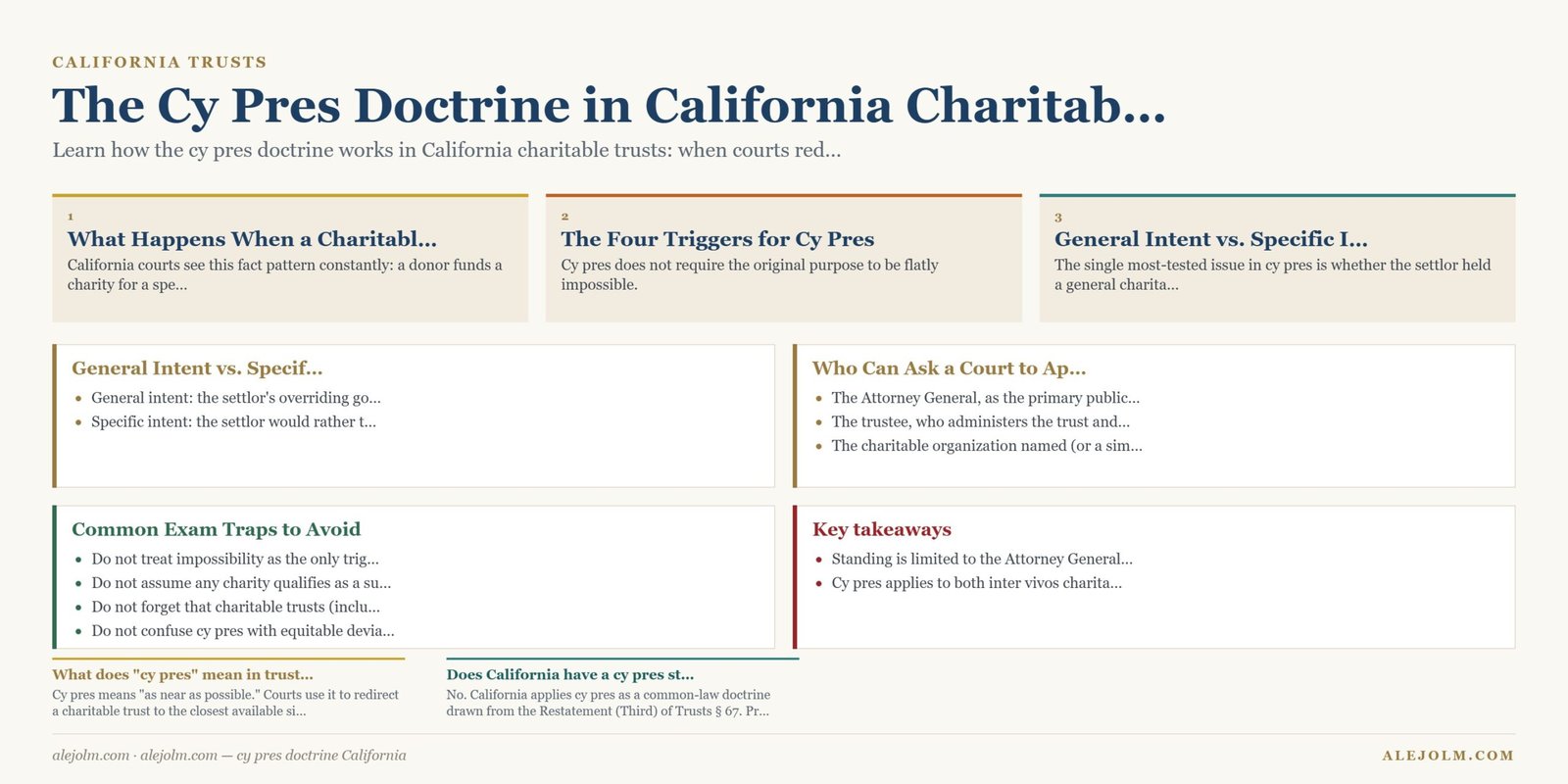
The Four Triggers for Cy Pres
Cy pres does not require the original purpose to be flatly impossible. California courts recognize four independent triggers, and the modern trend has expanded the doctrine well beyond its historical roots.
- Impossibility — the stated purpose literally cannot be carried out (the named college has closed).
- Impracticability — the purpose is technically possible but no longer efficient (the disease is now rare, or the institution merged).
- Illegality — the purpose has become unlawful (a trust that segregates by race is now unconstitutional).
- Waste — the modern Restatement addition: continuing the original purpose would squander trust assets or contradict the settlor’s broader charitable goal.
Bar candidates frequently miss the fourth trigger. Waste is not about the purpose being impossible — it is about the purpose becoming an inefficient use of money that a reasonable settlor would not have wanted.
General Intent vs. Specific Intent — The Real Battleground
The single most-tested issue in cy pres is whether the settlor held a general charitable intent or a specific charitable intent.
- General intent: the settlor’s overriding goal was to benefit a broad charitable category (education, medicine, religion), and the named institution was just the vehicle. Cy pres applies.
- Specific intent: the settlor would rather the gift fail entirely than be redirected — for example, “only this hospital, and if it closes, the money reverts to my family.” Cy pres does not apply, and the property passes by resulting trust back to the settlor or the settlor’s successors.
Modern law, including the California approach, presumes general charitable intent. The party opposing cy pres — usually an heir hoping for a reversion — bears the burden of proving the settlor’s intent was narrowly specific. This presumption is a favorite examiner trap: students assume the default rule favors the family, when it actually favors the charity.
No California Probate Code Section — And Why That Matters
Unlike many trust doctrines, cy pres has no dedicated California Probate Code section. It remains a common-law doctrine applied by California courts, drawing on the Restatement (Third) of Trusts § 67. Do not confuse it with California Probate Code § 15409, which codifies a related but distinct doctrine: equitable deviation. The two are easy to mix up on the exam, so keep the distinction sharp.
| Doctrine | Applies To | Focus | California Authority |
|---|---|---|---|
| Cy pres | Charitable trusts only | Substitutes a similar purpose | Common law (no Probate Code section) |
| Equitable deviation | Any trust | Modifies administrative terms due to changed circumstances | Cal. Prob. Code § 15409 |
Who Can Ask a Court to Apply Cy Pres
Standing is narrow. Only three parties can petition for cy pres:
- The Attorney General, as the primary public enforcer of charitable trusts in California.
- The trustee, who administers the trust and needs judicial guidance.
- The charitable organization named (or a similar one, if the original no longer exists).
Individual members of the public or incidental beneficiaries of the charitable purpose cannot invoke cy pres on their own. This is consistent with the broader rule that charitable trusts, unlike private trusts, are enforced by the state rather than by identified beneficiaries.
A Worked Example for Exam Practice
Assume Eleanor creates an irrevocable trust in 1985: “$500,000 in trust, income to be used exclusively to fund research into polio at Fairview Children’s Hospital.” By 2026, polio is essentially eradicated in the United States, and Fairview Children’s Hospital has merged into a larger regional medical center.
Walk through the analysis:
- Is this a charitable trust? Yes — medical research is a recognized charitable purpose.
- Has the purpose become impossible or impracticable? Yes — the disease is effectively eradicated, and the named hospital no longer exists as an independent entity.
- Did Eleanor have general or specific charitable intent? Nothing in the facts suggests Eleanor wanted the money to revert to her heirs if polio were cured; her intent appears broadly medical/charitable. Under the modern presumption, general intent controls absent contrary proof.
- Result: A California court applies cy pres and redirects the trust to the nearest similar purpose — likely general pediatric medical research at the successor medical center, or a comparable children’s health charity.
If the facts instead said, “and if Fairview Children’s Hospital ever closes, this money reverts to my nephew,” that specific language rebuts the presumption, and the trust fails in favor of a resulting trust to the nephew.
Cy Pres Also Reaches Failed Charitable Bequests in Wills
Cy pres is not limited to trusts created during life. It applies equally to charitable bequests in wills when the named charity or purpose has ceased to exist by the time of the testator’s death. This cross-over is a common source of exam questions that blend trusts and wills, so remember that a failed charitable gift in a will is analyzed the same way as a failed charitable trust.
Common Exam Traps to Avoid
- Do not treat impossibility as the only trigger — impracticability, illegality, and waste count too.
- Do not assume any charity qualifies as a substitute; the court must pick the nearest purpose consistent with the settlor’s intent, not just any worthy cause.
- Do not forget that charitable trusts (including ones reformed under cy pres) are exempt from the Rule Against Perpetuities and can run forever.
- Do not confuse cy pres with equitable deviation — one is purpose-focused, the other is administration-focused.
FAQ
What does “cy pres” mean in trust law?
Cy pres means “as near as possible.” Courts use it to redirect a charitable trust to the closest available similar purpose when the original purpose becomes impossible, impracticable, illegal, or wasteful, so long as the settlor had a general (not specific) charitable intent.
Does California have a cy pres statute?
No. California applies cy pres as a common-law doctrine drawn from the Restatement (Third) of Trusts § 67. Probate Code § 15409 codifies the separate doctrine of equitable deviation, which is often confused with cy pres on the bar exam.
What happens if the settlor had a specific charitable intent instead of general intent?
Cy pres does not apply. The trust fails as to its stated purpose, and the property passes by resulting trust back to the settlor or the settlor’s successors in interest.
Key Takeaways
- Cy pres applies only to charitable trusts and only when the purpose becomes impossible, impracticable, illegal, or wasteful.
- General charitable intent is presumed in California; the party opposing cy pres must prove specific intent.
- California has no Probate Code section for cy pres — it is common law, distinct from equitable deviation under § 15409.
- Standing is limited to the Attorney General, the trustee, and the named (or similar) charitable organization.
- Cy pres applies to both inter vivos charitable trusts and failed charitable bequests in wills.
This article is educational and is not legal advice. Consult a licensed California attorney about your situation.
Related guides
- Charitable Bequests in California Wills
- Rule Against Perpetuities
- Trustee Duties in California
- Honorary Trusts (Pet Trusts) in California