
What Is the Trustee’s Duty to Inform and Account?
The trustee duty to inform and account is one of the few trustee obligations with a hard statutory backbone in California, and that makes it a favorite for bar examiners: unlike duties of loyalty or prudence, which turn on judgment calls, this duty has specific triggering events and specific timelines you can cite chapter and verse.
For practicing trustees, this duty is also the one most likely to generate a lawsuit — not because a trustee necessarily mismanaged the trust, but because beneficiaries who feel kept in the dark sue reflexively. Understanding exactly what disclosure is legally required (and when) heads off both problems.
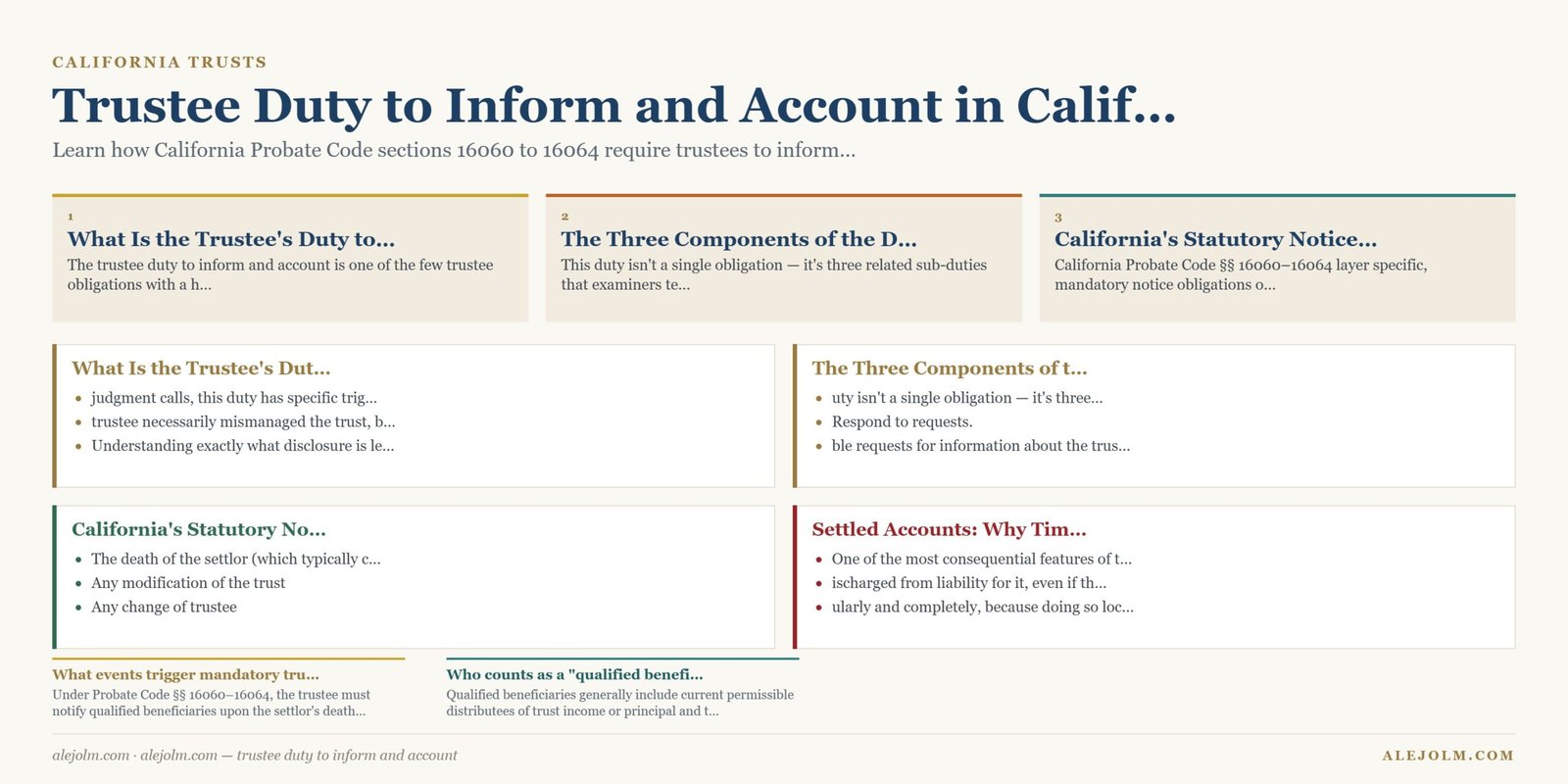
What is the duty to inform and account? The trustee owes beneficiaries a continuing duty to keep them reasonably informed, covering three components: responding to reasonable information requests, affirmatively disclosing significant events, and providing periodic accountings. California Probate Code §§ 16060–16064 impose specific statutory notice triggers on top of these general obligations.
The Three Components of the Duty
This duty isn’t a single obligation — it’s three related sub-duties that examiners test both together and separately.
- Respond to requests. The trustee must promptly and accurately answer a beneficiary’s reasonable requests for information about the trust’s investments, distributions, fees, and any conflicts of interest.
- Affirmative disclosure. The trustee cannot simply wait to be asked. Significant or unusual events — a major breach, a self-dealing transaction, an unusual investment — must be proactively disclosed.
- Periodic accounting. The trustee must render regular accountings (typically annual) showing all receipts, disbursements, and current holdings.
California’s Statutory Notice Triggers
California Probate Code §§ 16060–16064 layer specific, mandatory notice obligations on top of the general duty. Three events trigger the trustee’s obligation to notify qualified beneficiaries:
- The death of the settlor (which typically converts a revocable trust to irrevocable status)
- Any modification of the trust
- Any change of trustee
“Qualified beneficiaries” is a defined, narrower class than “all conceivable beneficiaries” — it generally includes current permissible distributees and the first-line remaindermen, not every remote contingent beneficiary who might someday take under the trust.
| Trigger event | Who must be notified | Statutory basis |
|---|---|---|
| Settlor’s death | Qualified beneficiaries | §§ 16060-16064 |
| Trust modification | Qualified beneficiaries | §§ 16060-16064 |
| Change of trustee | Qualified beneficiaries | §§ 16060-16064 |
Settled Accounts: Why Timely Objection Matters
One of the most consequential features of this duty is the settled account doctrine. If a trustee renders a proper accounting that fully and fairly discloses a transaction, and the beneficiary fails to object within the applicable time period, that transaction becomes settled — the trustee is discharged from liability for it, even if the transaction turns out, in hindsight, to have been a poor decision.
This creates strong mutual incentives: trustees benefit from accounting regularly and completely, because doing so locks in protection against future claims over fully disclosed matters. Beneficiaries, correspondingly, need to review every accounting promptly, because silence functions as a waiver. Many California trusts default to annual court-supervised accountings, though this requirement is commonly waived — particularly for revocable trusts during the settlor’s lifetime, or by express trust terms or beneficiary agreement.
Disclosure Is Independent of Investment Performance
A subtlety worth internalizing: the duty to inform and account is entirely separate from the duty of prudent investment or loyalty. A trustee who makes an objectively poor investment decision but fully and promptly discloses it has satisfied the accounting duty even though the trustee may still face surcharge liability for the imprudent decision itself. Conversely, a trustee who makes a perfectly reasonable investment decision but conceals it, or fails to account for it, breaches the duty to inform independently — even absent any underlying investment failure. These are two separate lines of potential liability, and a bar essay can raise either, both, or neither.
Worked Example: Bar Exam Fact Pattern
Grandmother Sylvia dies, and her revocable trust becomes irrevocable at her death, naming her son Marcus as successor trustee for the benefit of Sylvia’s three grandchildren. Marcus takes over administration but never sends any notice to the grandchildren about Sylvia’s death or his new role as trustee. A year later, Marcus sends an annual accounting disclosing a $10,000 investment loss with full transaction details; none of the grandchildren object within the statutory window.
Analysis: Marcus breached the statutory notice requirement under §§ 16060–16064 by failing to notify the qualified beneficiaries — the three grandchildren — of Sylvia’s death and his assumption of the trustee role, both independently triggering events. Separately, because Marcus later gave a full and fair accounting of the $10,000 loss and none of the grandchildren timely objected, that specific loss is now a settled matter — the grandchildren cannot later sue over that particular transaction, even though the earlier notice failure remains a live, independent breach.
Common Mistakes to Avoid
Students commonly forget that the statutory notice triggers under §§ 16060–16064 are separate from the general common-law duty to inform, and that missing either one is its own breach. A second frequent error is assuming all beneficiaries must receive notice — only qualified beneficiaries do. A third is overlooking the settled-account defense entirely, forgetting that a properly disclosed, un-objected-to transaction can shield a trustee from an otherwise valid claim.
FAQ
What events trigger mandatory trustee notice under California law?
Under Probate Code §§ 16060–16064, the trustee must notify qualified beneficiaries upon the settlor’s death, any modification of the trust, or any change of trustee.
Who counts as a “qualified beneficiary” entitled to notice?
Qualified beneficiaries generally include current permissible distributees of trust income or principal and the first-line remainder beneficiaries — not every remote, contingent beneficiary who might theoretically take under the trust someday.
Can a beneficiary sue over a transaction disclosed in a past accounting?
Usually not, if the accounting fully and fairly disclosed the transaction and the beneficiary failed to object within the statutory window. That transaction becomes a “settled account,” discharging the trustee from further liability on that specific matter.
Key Takeaways
- The duty to inform and account has three components: responding to requests, affirmative disclosure of significant events, and periodic accounting.
- California Probate Code §§ 16060–16064 impose mandatory notice on settlor death, trust modification, and trustee change — to qualified beneficiaries specifically.
- A full and fair accounting that goes unobjected-to becomes a settled account, discharging the trustee from liability for that matter.
- This duty is independent of investment performance — good disclosure of a bad decision satisfies the duty; concealment of a good decision breaches it.
- Watch for settlor death, trust amendments, or new trustees in bar essays — each triggers an independent statutory notice check.
This article is educational and is not legal advice. Consult a licensed California attorney about your situation.
Related guides
- trustee duty to segregate and earmark trust property
- trustee powers and co-trustee rules in California
- probate process in California
- trustee duties