
What Powers Does a California Trustee Have?
Trustee powers in California come from three sources, and understanding all three — plus how they interact with fiduciary duties — is essential groundwork before tackling any trust-administration essay on the California Bar Exam. Just as important, and just as heavily tested, is what happens when more than one trustee is serving and they can’t agree.
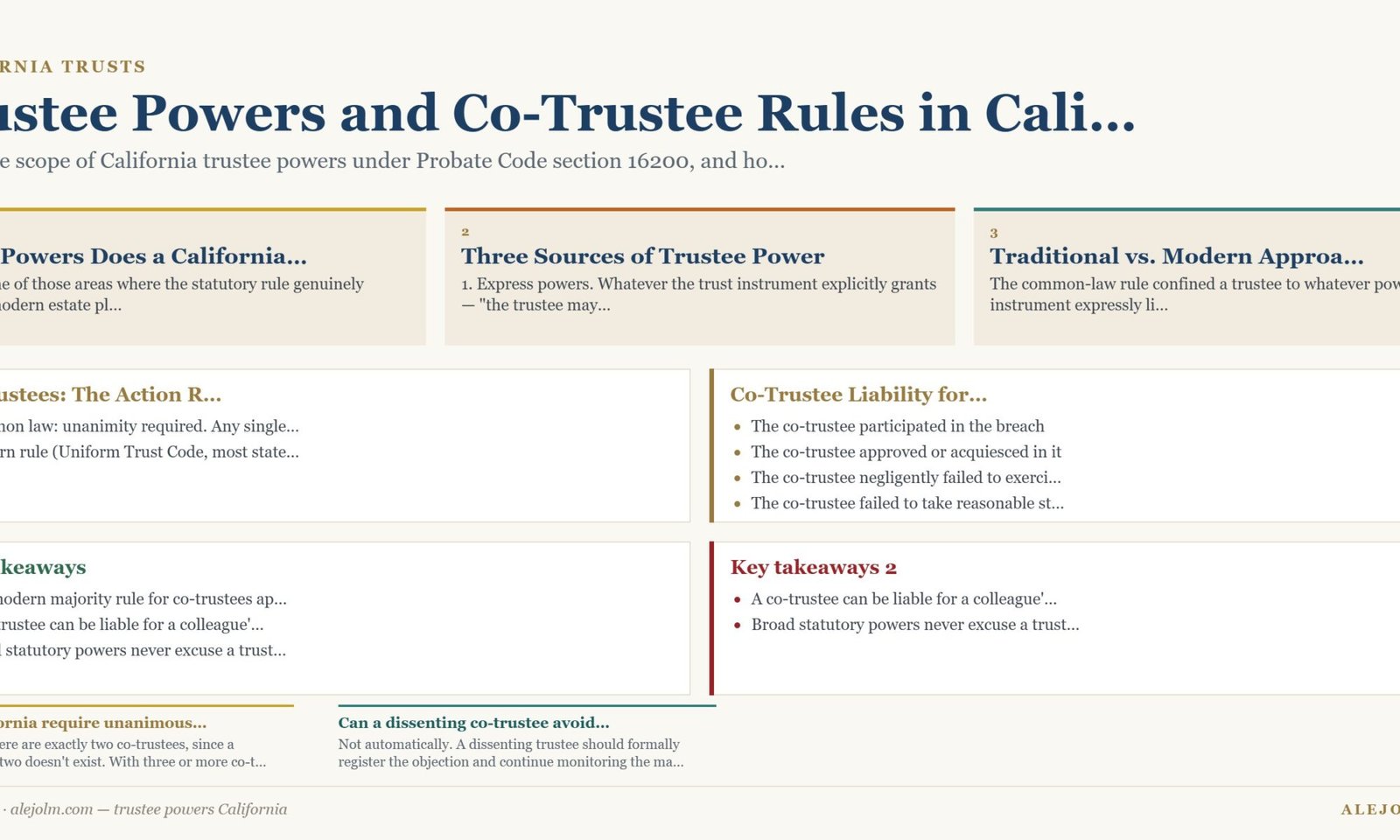
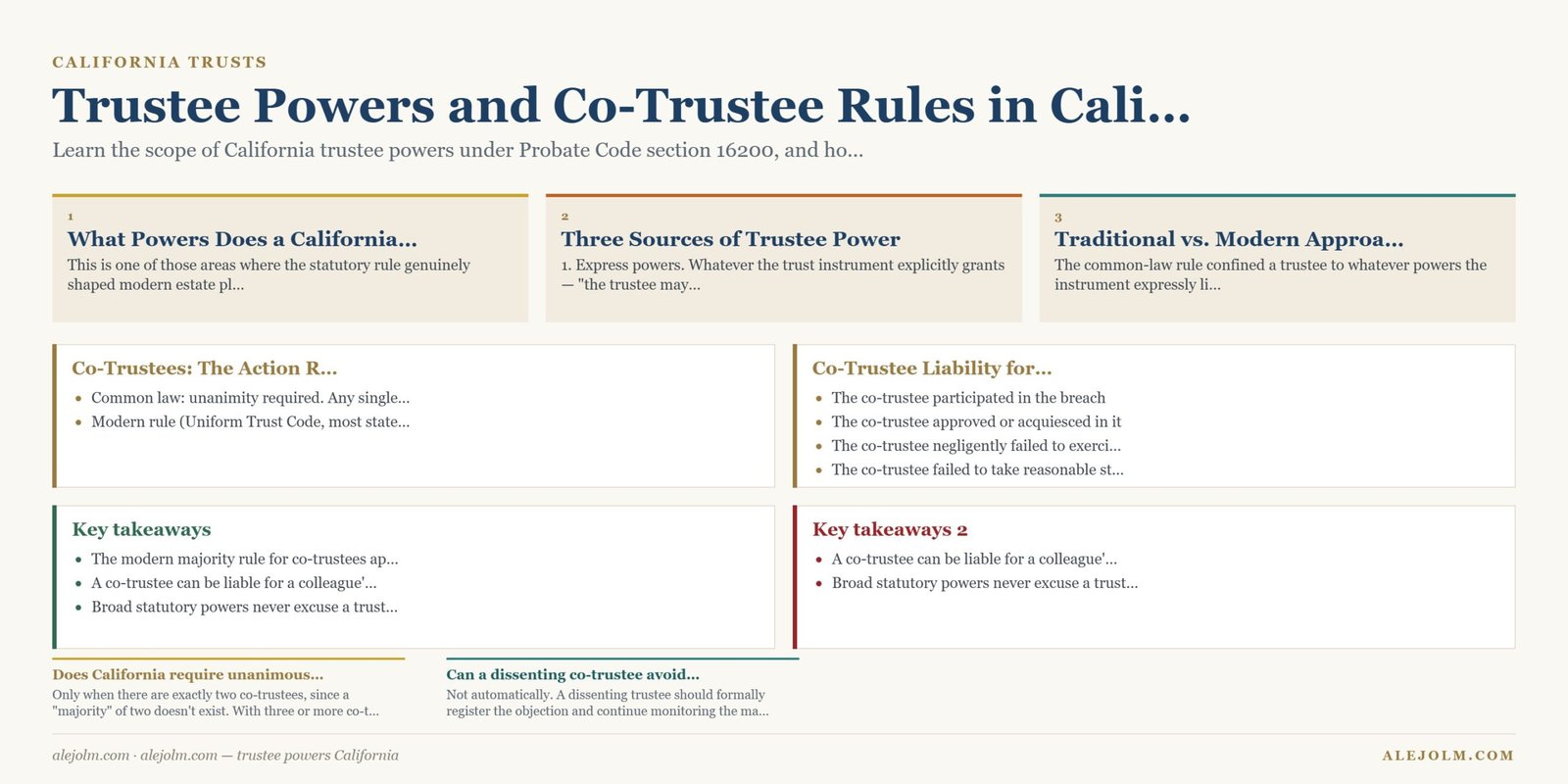
This is one of those areas where the statutory rule genuinely shaped modern estate planning practice: California trustees today hold powers close to those of an absolute owner, a significant departure from the restrictive common-law approach.
What are trustee powers? Trustee powers are the actions a trustee is authorized to take with trust property — drawn from express grants in the trust instrument, powers implied as necessary to the trust’s purposes, and statutory powers under California Probate Code §§ 16200 et seq., which grants owner-equivalent authority to sell, lease, mortgage, invest, and manage trust assets.
Three Sources of Trustee Power
- Express powers. Whatever the trust instrument explicitly grants — “the trustee may sell real property,” “the trustee may make investments.”
- Implied powers. Authority necessary or appropriate to carry out the trust’s purposes, even without an explicit grant — for instance, defending trust property from a third-party claim.
- Statutory powers. California Probate Code §§ 16200 et seq. grants trustees broad, owner-like powers: buying and selling trust property, borrowing and lending, voting shares and proxies, paying expenses, initiating and defending litigation, and a residual catch-all covering any power an absolute owner would have.
Traditional vs. Modern Approach
The common-law rule confined a trustee to whatever powers the instrument expressly listed — anything beyond that list required either a formal trust modification or a judicial petition. California’s modern statutory approach flips that default: express powers are supplemented by the full statutory list, plus the residual owner-equivalent grant. This shift reflects a deliberate policy choice favoring administrative flexibility over rigid textualism.
Mandatory vs. Discretionary Powers
This distinction controls how courts review a trustee’s exercise of power, and it’s a frequent source of confusion.
| Power type | Trustee’s obligation | Standard of judicial review |
|---|---|---|
| Mandatory | Must exercise it as directed | Abuse of discretion — was the manner of exercise reasonable? |
| Discretionary | May exercise it or not | Bad faith, improper motive, or unreasonableness only — courts won’t substitute their own judgment |
A trust directing the trustee to “distribute all net income to A” creates a mandatory power: the trustee must calculate and distribute income, though the trustee retains judgment over the manner of doing so. A trust granting the trustee discretion to “distribute principal as the trustee deems appropriate” creates a discretionary power: the trustee decides whether, when, and how much to distribute, and courts will not second-guess a reasonable exercise of that discretion.
Co-Trustees: The Action Rule
When more than one trustee serves, a separate set of rules governs how they must act together — and this is where the exam traps tend to concentrate.
- Common law: unanimity required. Any single co-trustee can veto a joint decision, regardless of how many trustees are serving.
- Modern rule (Uniform Trust Code, most states): where there are three or more co-trustees, a majority can act. Where there are only two co-trustees, both must still agree — a “majority” of two is mathematically meaningless, so unanimity persists for two-trustee arrangements even under modern statutes.
Every co-trustee — including a dissenter who gets outvoted — retains an ongoing duty to stay engaged in administration. A co-trustee cannot simply abstain and disclaim responsibility for what the majority does.
Co-Trustee Liability for a Colleague’s Breach
A co-trustee can be personally liable for a fellow trustee’s breach in any of these situations:
- The co-trustee participated in the breach
- The co-trustee approved or acquiesced in it
- The co-trustee negligently failed to exercise reasonable care to prevent it
- The co-trustee failed to take reasonable steps to compel redress once aware of it
Being outvoted is not, by itself, a defense. A dissenting trustee needs to register the dissent formally and continue actively monitoring the majority’s conduct to avoid exposure.
Powers Are Not a Shield From Fiduciary Duties
Broad statutory power never relaxes fiduciary obligation. A California trustee has the powers of an absolute owner but the duties of a fiduciary, and every exercise of a power — no matter how clearly authorized — remains subject to review under the duties of loyalty, prudence, and impartiality. Statutory authority to invest in any asset doesn’t excuse an imprudent investment; statutory authority to distribute doesn’t excuse a distribution that violates the trust’s terms or an impartiality obligation between beneficiaries.
Worked Example: Bar Exam Fact Pattern
A trust names three co-trustees — Amir, Beatriz, and Carlos — and is silent about how they must act on administrative decisions. Amir and Beatriz vote to sell a piece of trust real estate at fair market value to fund a required distribution; Carlos objects, believing the property should be held longer.
Analysis: Under the modern majority rule, which applies because there are three co-trustees, Amir and Beatriz’s two-vote majority can proceed with the sale over Carlos’s objection. Carlos cannot block the transaction merely by dissenting. However, Carlos retains a duty to stay engaged — monitoring the sale’s execution and the proceeds’ handling — and to raise formal objection if he believes the majority is acting improperly, in order to protect himself from potential co-trustee liability.
Change the facts: Suppose the trust names only Amir and Beatriz as co-trustees, with Carlos removed from the picture. Now, even under the modern rule, both co-trustees must agree — there’s no majority possible with only two trustees. If Beatriz objects to the sale, it cannot proceed without her consent, exactly as under the old common-law unanimity rule.
Common Mistakes to Avoid
The single most common exam error is applying majority rule to a two-trustee arrangement — modern majority rule only kicks in at three or more co-trustees. A second mistake is assuming broad statutory powers eliminate the underlying fiduciary duties; they never do. A third is forgetting that a dissenting, outvoted co-trustee still has an active monitoring duty and isn’t automatically shielded from liability just by losing the vote.
FAQ
Does California require unanimous agreement among co-trustees?
Only when there are exactly two co-trustees, since a “majority” of two doesn’t exist. With three or more co-trustees, the modern majority rule generally allows a majority to act, unless the trust instrument specifies otherwise.
Can a dissenting co-trustee avoid liability just by voting no?
Not automatically. A dissenting trustee should formally register the objection and continue monitoring the majority’s conduct. Merely being outvoted, without further action, does not by itself protect the dissenter from liability for a resulting breach.
Do California’s broad statutory trustee powers reduce fiduciary duties?
No. A trustee’s statutory powers under Probate Code §§ 16200 et seq. give the trustee the practical authority of an absolute owner, but every exercise of that power remains subject to the duties of loyalty, prudence, and impartiality.
Key Takeaways
- Trustee powers come from three sources: express grants, implied authority, and California’s broad statutory grant under Probate Code §§ 16200 et seq.
- Mandatory powers obligate the trustee to act (reviewed for abuse of discretion); discretionary powers permit but don’t require action (reviewed only for bad faith or unreasonableness).
- The modern majority rule for co-trustees applies only with three or more trustees — two-trustee panels still require unanimity.
- A co-trustee can be liable for a colleague’s breach through participation, acquiescence, negligent failure to prevent it, or failure to seek redress.
- Broad statutory powers never excuse a trustee from the underlying duties of loyalty, prudence, and impartiality — powers and duties are analyzed separately.
This article is educational and is not legal advice. Consult a licensed California attorney about your situation.
Related guides
- passive trusts in California: the active duties rule
- trustee delegation rules under California Probate Code
- trustee duty to inform and account in California trusts
- trustee duties