
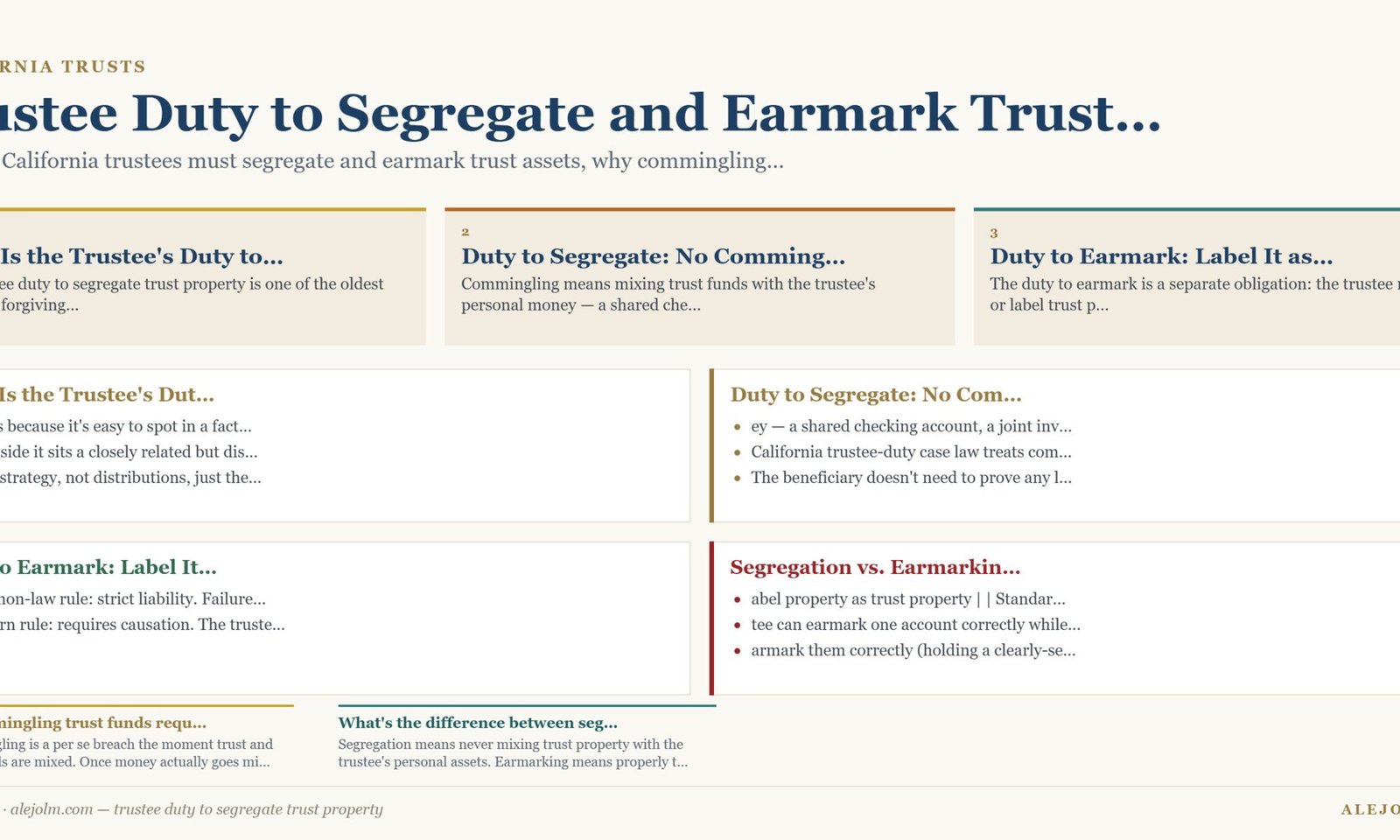

What Is the Trustee’s Duty to Segregate Trust Property?
The trustee duty to segregate trust property is one of the oldest and least forgiving rules in trust law, and it’s a frequent guest on California Bar Exam essays because it’s easy to spot in a fact pattern and easy to lose points on if you don’t flag it separately. Alongside it sits a closely related but distinct rule: the duty to earmark.
Both duties govern the physical and administrative handling of trust assets — not investment strategy, not distributions, just the basic mechanics of keeping trust property identifiable and separate. Get this wrong as a trustee, and you can end up personally absorbing losses that were never really your fault, simply because you can’t prove which dollars were whose.
What is the duty to segregate? The duty to segregate forbids a trustee from mixing trust property with the trustee’s own personal assets. Commingling trust and personal funds is a breach the moment it happens, regardless of whether it causes any actual loss, and it shifts the burden of proof onto the trustee for anything that goes missing afterward.
Duty to Segregate: No Commingling, Ever
Commingling means mixing trust funds with the trustee’s personal money — a shared checking account, a joint investment account, property held without any trust designation at all. California trustee-duty case law treats commingling as a per se breach. The beneficiary doesn’t need to prove any loss resulted; the mixing itself violates the duty.
The real bite of the rule shows up when money later goes missing from a commingled account. Once funds are mixed, the burden of proof shifts to the trustee to show which portion of the account was trust money and which was personal. Any doubt about what happened to lost or dissipated funds is resolved against the trustee. A trustee who can’t untangle the mix bears the resulting loss personally.
There’s a flip side that favors beneficiaries: any gains traceable to commingled funds belong to the trust, not the trustee. A trustee cannot commingle funds, make a profitable investment, and then keep the upside while leaving the beneficiaries to absorb any downside elsewhere.
Commingling also triggers the lowest intermediate balance rule for tracing purposes — a doctrine that assumes withdrawals from a mixed account come out of the trustee’s personal funds first, so the trust’s claim is capped at the lowest balance the account ever reached after the commingling occurred.
Duty to Earmark: Label It as Trust Property
The duty to earmark is a separate obligation: the trustee must title or label trust property so it’s identifiable as trust property, not the trustee’s own. A brokerage account should read “Jane Smith, Trustee of the Smith Family Trust,” not simply “Jane Smith.” Real property deeds, bank accounts, and investment accounts should all carry a trust designation.
The purpose is protective: proper earmarking shields trust assets from the trustee’s personal creditors and from the trustee’s own estate at death, and it creates a clean record of exactly what the trust owns.
The standard for earmarking violations has evolved:
- Common-law rule: strict liability. Failure to earmark was a breach regardless of whether it caused any harm.
- Modern rule: requires causation. The trustee is liable only for damages actually caused by the failure to earmark — for example, a personal creditor seizing an unearmarked trust asset because it looked like the trustee’s own property.
Segregation vs. Earmarking: Two Different Duties
| Duty to segregate | Duty to earmark | |
|---|---|---|
| What it prohibits | Mixing trust and personal property | Failing to title/label property as trust property |
| Standard | Strict liability (per se breach) | Common law: strict liability. Modern: requires causation |
| Burden after breach | Shifts to trustee to prove which funds are which | Trustee liable for damages the failure actually caused |
| Can be breached independently | Yes | Yes — a trustee can earmark one account correctly while commingling funds in another |
These are genuinely separate duties. A trustee can properly segregate funds (never mixing them with personal money) while still failing to earmark them correctly (holding a clearly-separate account in the trustee’s own name with no trust designation). Bar essays that raise one issue often raise the other too, and each should be flagged as its own distinct breach.
Worked Example: Bar Exam Fact Pattern
Trustee Oscar deposits $50,000 of trust funds into his personal checking account, which already holds $20,000 of his own money. He never retitles the account or gives it any trust designation. Six months later, one of Oscar’s personal creditors obtains a judgment and garnishes the account, seizing $40,000 before Oscar can intervene.
Analysis: Oscar has committed two separate breaches. First, the duty to segregate — he commingled $50,000 of trust funds with his own $20,000 the moment he deposited them into a shared account, regardless of what happened afterward. Second, the duty to earmark — he never titled the account as trust property, and under the modern causation-based rule, that failure directly caused the garnishment, since the creditor could seize the funds only because the account looked like Oscar’s own money. Oscar is personally liable for the resulting loss to the trust, and because the account was commingled, any doubt about which dollars the creditor actually seized is resolved against Oscar.
Why This Matters Beyond the Exam
For a practicing trustee — a family member serving informally, or a professional fiduciary — these rules aren’t academic. A trustee who uses one bank account “to keep things simple” is taking on serious personal exposure. Titling every trust asset correctly from day one, and never letting trust money touch a personal account even temporarily, is the cheapest insurance a trustee can buy against a beneficiary’s breach claim.
Common Mistakes to Avoid
Students frequently think commingling requires proof of actual harm before it counts as a breach — it doesn’t; the mixing itself is the violation, though the burden-shifting rule for losses only kicks in once something goes missing. A second mistake is confusing the two duties entirely, treating segregation and earmarking as the same rule with the same standard. A third is assuming any gains from a commingled account belong to the trustee who made the investment decision — they don’t; gains follow the trust.
FAQ
Does commingling trust funds require proof of loss to be a breach?
No. Commingling is a per se breach the moment trust and personal funds are mixed. Once money actually goes missing from the commingled account, the burden shifts to the trustee to prove which funds were trust funds — and any doubt is resolved against the trustee.
What’s the difference between segregation and earmarking?
Segregation means never mixing trust property with the trustee’s personal assets. Earmarking means properly titling or labeling trust property as belonging to the trust, even if it was never mixed with anything else. A trustee can breach either one independently.
Who keeps the gains if a trustee commingles funds and the investment performs well?
The trust does. A trustee cannot commingle funds and then keep any resulting profit personally — gains traceable to commingled money are attributed to the trust, not the trustee.
Key Takeaways
- The duty to segregate forbids mixing trust and personal property; commingling is a breach the instant it happens, no loss required.
- Once funds are commingled, the burden of proof shifts to the trustee, and doubts about lost money are resolved against the trustee.
- Gains from commingled funds belong to the trust, never to the trustee.
- The duty to earmark requires proper titling of trust property; modern law requires the beneficiary to show the failure actually caused a loss.
- Always flag segregation and earmarking as two separate, additional breaches on the bar exam — don’t fold them silently into a self-dealing analysis.
This article is educational and is not legal advice. Consult a licensed California attorney about your situation.
Related guides
- bona fide purchaser defense in California trust law
- trustee delegation rules under California Probate Code
- trustee duty to inform and account in California trusts
- trustee duties