
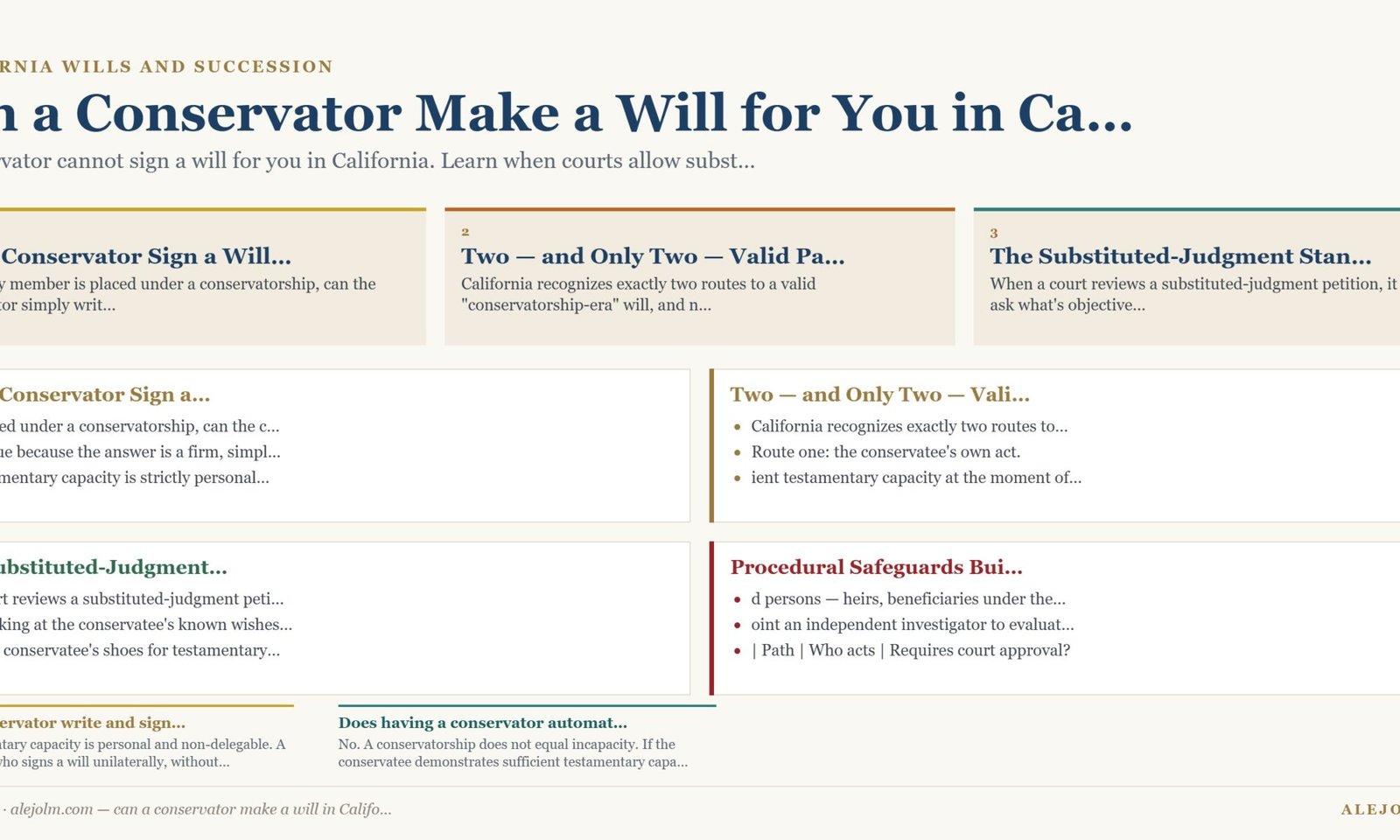
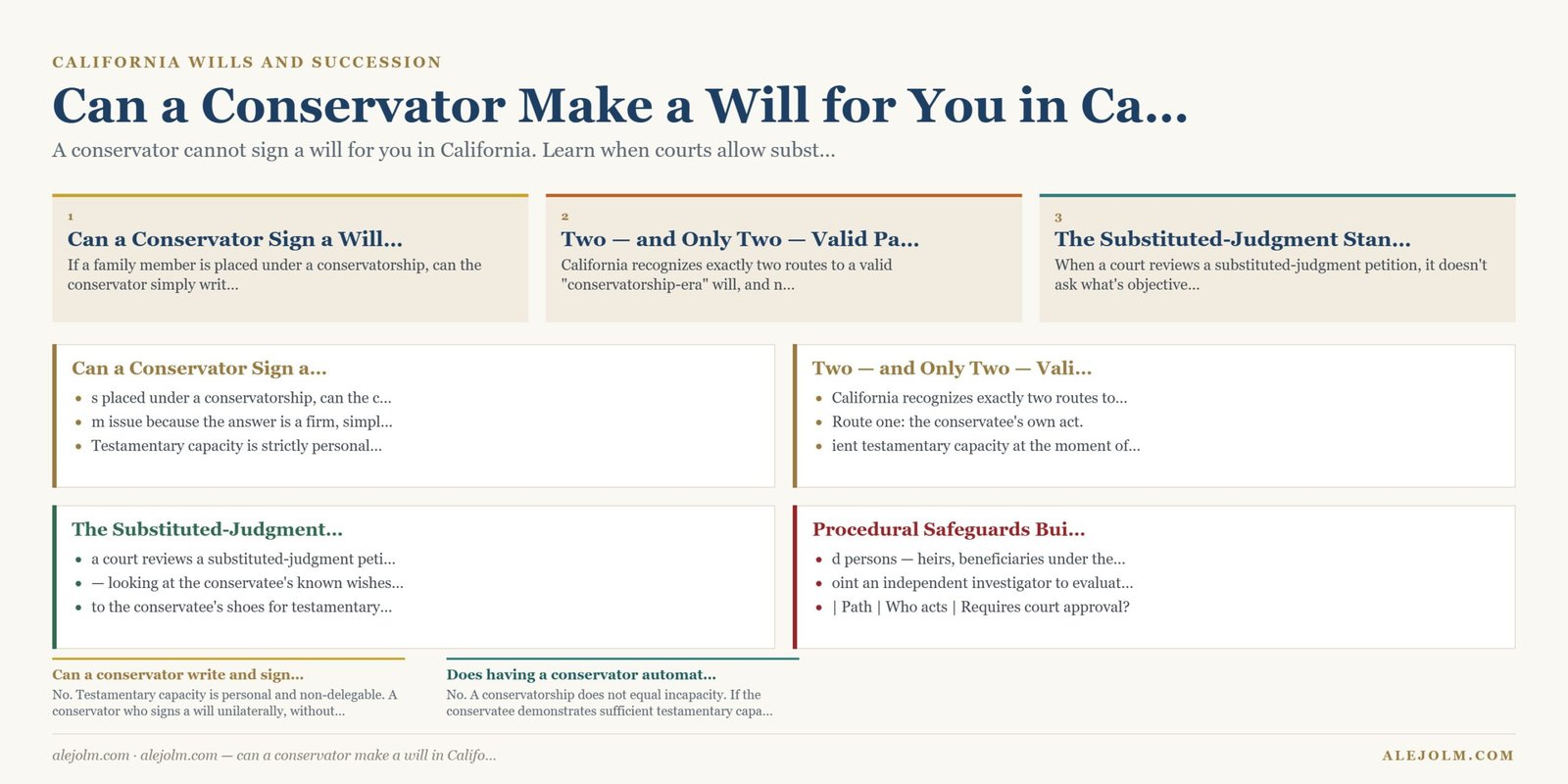
Can a Conservator Sign a Will for You in California?
If a family member is placed under a conservatorship, can the conservator simply write and sign a new will on that person’s behalf? This question comes up constantly for families navigating a loved one’s declining capacity, and it’s also a favorite California Bar Exam issue because the answer is a firm, simple no — with one narrow exception that gets frequently misunderstood.
Testamentary capacity is strictly personal and cannot be delegated. A conservator has no authority, acting alone, to make, amend, or revoke a will or codicil for the conservatee. A will signed by the conservator in the conservatee’s place, without the conservatee’s own participation, is void.
Two — and Only Two — Valid Paths to a Will During a Conservatorship
California recognizes exactly two routes to a valid “conservatorship-era” will, and nothing else works.
Route one: the conservatee’s own act. If the conservatee personally executes the will and has sufficient testamentary capacity at the moment of signing, the will is valid — even a brief lucid interval is enough. A conservatorship, on its own, does not strip someone of testamentary capacity.
Route two: substituted judgment under Probate Code §§ 2580–2586. The conservator can petition the probate court for prior approval to take estate-planning action on the conservatee’s behalf. Importantly, this doesn’t let the conservator simply sign a traditional will. Instead, it lets the court authorize a broader set of tools in place of a will — creating, amending, revoking, or funding a revocable trust; modifying a trust-based disposition of assets; changing beneficiary designations on life insurance, retirement accounts, or payable-on-death arrangements; exercising or releasing a power of appointment; or making gifts consistent with the conservatee’s existing estate plan.
The Substituted-Judgment Standard: What Would They Have Wanted?
When a court reviews a substituted-judgment petition, it doesn’t ask what’s objectively “best” for the conservatee. It asks what the conservatee would have done if competent — looking at the conservatee’s known wishes, any prior estate plan, personal values, and family relationships. This standard exists precisely because the court is stepping into the conservatee’s shoes for testamentary purposes, and that substitution demands real procedural protection.
Procedural Safeguards Built Into the Process
Because the court is substituting its judgment for the conservatee’s own autonomy, the process comes with real guardrails: the conservator must file a petition, give notice to interested persons — heirs, beneficiaries under the existing estate plan, and others as required — and obtain a hearing. Courts frequently appoint an independent investigator to evaluate the conservatee’s circumstances and report back before any ruling.
| Path | Who acts | Requires court approval? | Result |
|---|---|---|---|
| Conservatee’s own act (lucid interval) | Conservatee, personally | No | Valid traditional will |
| Substituted judgment (§§ 2580–2586) | Court, on conservator’s petition | Yes — with notice, hearing, investigator | Court-authorized trust/beneficiary changes, not a signed will |
| Conservator acting unilaterally | Conservator, without court approval | N/A | Void instrument |
Conservatorship Doesn’t Equal Incapacity
A common misconception — among families and law students alike — is that a conservatorship automatically means the person can’t make decisions about their estate. That’s false. If the conservatee, at the moment of execution, describes their property in detail and understands what they’re doing, their own personally executed will can be valid despite the ongoing conservatorship. Capacity is measured at the exact moment of execution, not by the mere existence of a conservatorship.
The Self-Dealing Trap
If a conservator unilaterally signs a will “for” the conservatee — for the conservator’s own benefit, no less — two problems stack on top of each other. First, the instrument is void outright because testamentary capacity is non-delegable. Second, because the conservator is a fiduciary, that self-benefiting transfer triggers the statutory presumption of undue influence under Cal. Probate Code § 21380. The conservator is fighting a losing battle on two independent fronts.
Worked Example: The Well-Meaning Conservator
A court-appointed conservator believes her mother’s old will is outdated. Without ever consulting her mother, the conservator drafts and signs a new will “on her mother’s behalf.” The mother later dies, and the new document is offered for probate.
Analysis: The new will is void. Testamentary capacity belongs solely to the testator and cannot be delegated. The only valid paths were the mother personally executing a new will during a period of sufficient capacity, or the conservator obtaining prior court approval through substituted judgment under §§ 2580 et seq. Neither happened here — the conservator simply acted unilaterally — so the instrument fails and the prior valid will, or intestate succession if none exists, governs instead.
California Bar Exam Angle
This topic has appeared repeatedly on past exams and rewards a two-step framework. First, ask whether the conservatee retained testamentary capacity at the moment of execution — a conservatorship alone does not negate it, so look for evidence of a lucid interval. Second, if the conservator acted instead of the conservatee, ask whether the conservator obtained court-approved substituted judgment beforehand. If not, the instrument is void — and if the conservator also stood to benefit personally, layer on the § 21380 undue-influence presumption.
FAQ
Can a conservator write and sign a will for someone under conservatorship in California?
No. Testamentary capacity is personal and non-delegable. A conservator who signs a will unilaterally, without the conservatee’s participation or prior court approval, creates a void instrument.
Does having a conservator automatically mean someone can’t make a valid will?
No. A conservatorship does not equal incapacity. If the conservatee demonstrates sufficient testamentary capacity at the exact moment of execution — even a brief lucid interval — their personally signed will can be valid.
What is substituted judgment, and does it let a conservator sign a will?
Substituted judgment (Cal. Probate Code §§ 2580–2586) lets a conservator petition the probate court for approval to take estate-planning actions on the conservatee’s behalf, such as modifying a trust or changing beneficiary designations. It does not let the conservator sign a traditional will for the conservatee.
Key Takeaways
- Testamentary capacity is strictly personal in California; a conservator cannot make, amend, or revoke a will unilaterally on a conservatee’s behalf.
- A will signed by a conservator without the conservatee’s participation is void.
- The only two valid paths are the conservatee’s own act during a lucid interval, or court-approved substituted judgment under §§ 2580–2586.
- Substituted judgment authorizes trust and beneficiary-designation changes through the court — not a conservator simply signing a will.
- A self-benefiting will signed unilaterally by a conservator is both void and triggers the § 21380 presumption of undue influence.
This article is educational and is not legal advice. Consult a licensed California attorney about your situation.
Mostrando SEO-03-wills-succession.md.