
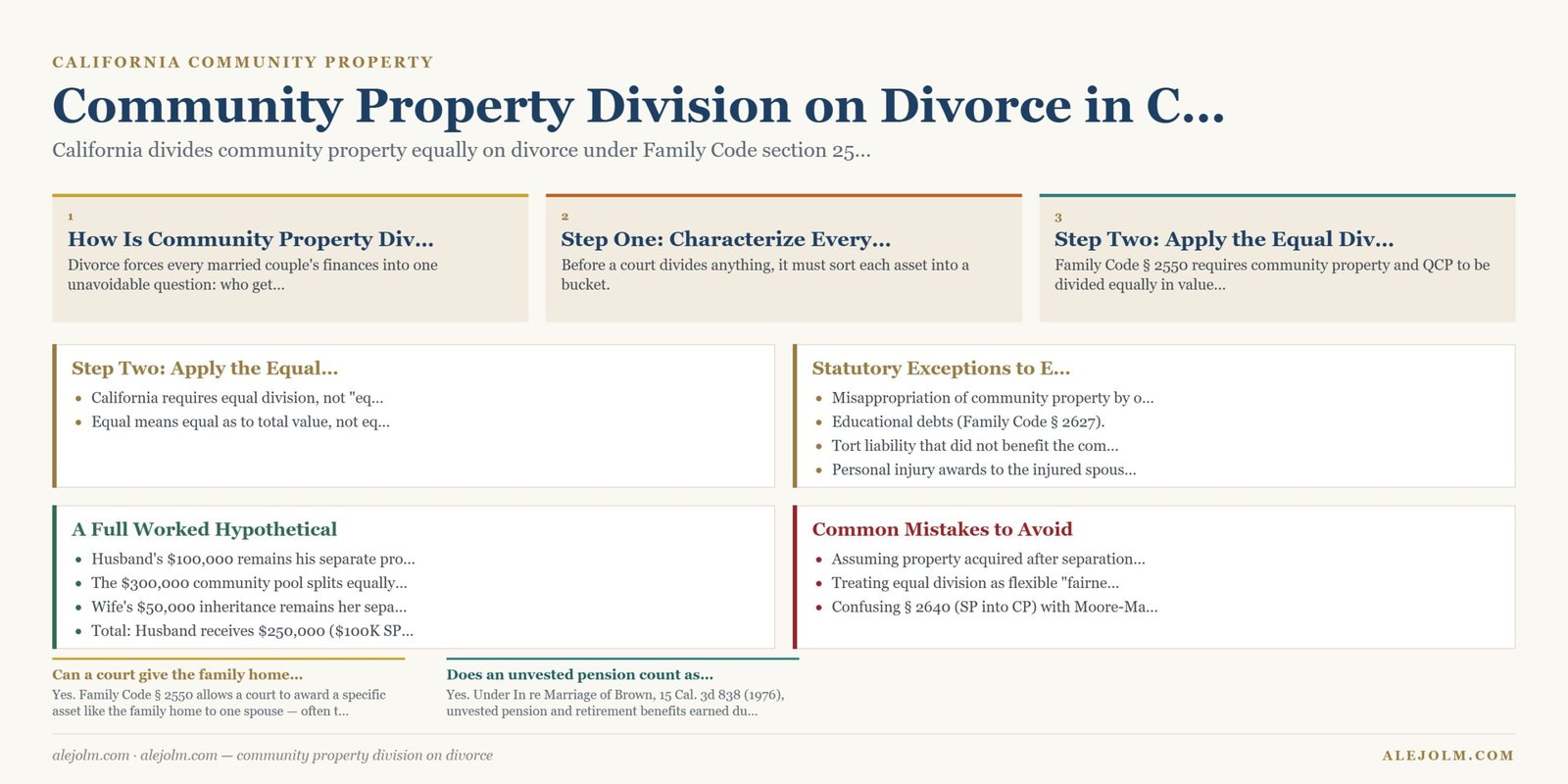
How Is Community Property Divided When a California Couple Divorces?
Divorce forces every married couple’s finances into one unavoidable question: who gets what? California answers with one of the most rigid rules in family law. Unlike most states, which apply a flexible “equitable distribution” standard, California requires equal division — and knowing exactly what “equal” means, and where it doesn’t apply, is essential for the Bar Exam.
Community property division on divorce means California courts must split the total value of the community estate 50-50 between the spouses under Family Code § 2550, while each spouse simply keeps their own separate property. Getting there requires three steps: characterization, tracing, and valuation.
Step One: Characterize Every Asset
Before a court divides anything, it must sort each asset into a bucket.
- Community property — presumptively everything acquired during the marriage, plus quasi-community property (QCP), which is treated as CP and divided 50/50 on divorce.
- Separate property — anything owned before marriage, or received during marriage by gift, inheritance, or acquired after the date of separation.
- Mixed or commingled assets — require tracing community contributions to separate property (or vice versa) to determine reimbursement rights.
Title is not the test. Property titled in only one spouse’s name can still be community property; characterization turns on how and when the asset was acquired, not whose name is on the deed.
Step Two: Apply the Equal Division Rule (Family Code § 2550)
Family Code § 2550 requires community property and QCP to be divided equally in value, absent the parties’ written agreement or stipulation otherwise. Two nuances matter a lot on the exam:
- California requires equal division, not “equitable” division — courts don’t weigh fairness factors the way many other states do.
- Equal means equal as to total value, not equal asset-by-asset. Section 2550 does not require in-kind division of every item.
That flexibility lets a court award an entire asset — the family home, a closely held business, a pension — to one spouse, offset by cash or other assets to the other spouse, so long as each side nets 50% of the total value.
| Rule | Applies To | Standard |
|---|---|---|
| Equal division (FC § 2550) | Community property, QCP | Exactly 50-50 by value |
| Separate property retention | Separate property | Owning spouse keeps 100% |
| Support (spousal/child) | Post-divorce income | Equitable factors, including earning disparity |
Note the last row: earning-power disparity between spouses is relevant to spousal and child support, but it is never a basis for unequal CP division. Equal division is mandatory regardless of who earns more after the divorce.
Step Three: Valuation Timing and Business Growth
Community property is valued as close as practicable to the date of trial, not the date of separation, unless a party shows good cause otherwise. This matters most with a growing business: if a CP business grows in value between separation and trial because of the managing spouse’s separate-property labor, courts apportion the increase using reverse Pereira or reverse Van Camp formulas — the standard formulas run in reverse because separate labor, not community labor, is now driving the growth.
Tracing and the Moore-Marsden Formula
When community funds pay down a mortgage on a spouse’s separate-property house, the house doesn’t become community property — but the community earns a pro rata interest in the appreciation.
Worked example: Husband owns a house before marriage worth $200,000. During the marriage, the couple uses $50,000 of community funds to pay down the mortgage principal. On divorce, the house remains Husband’s separate property, but the community is entitled to a Moore-Marsden interest calculated as [($50,000 ÷ purchase price) × appreciation] + $50,000. This is the reverse of the Family Code § 2640 reimbursement rule, which instead covers separate property contributions into community property — don’t cite § 2640 for a Moore-Marsden fact pattern.
Degrees and Professional Licenses Are Not Divisible
One of the most tested traps in this area: a professional degree or license earned during the marriage is not community property and is never divided (In re Marriage of Sullivan; Family Code § 2641). If Wife earns a medical license during the marriage, the community’s only remedy is reimbursement, with interest, of the community funds spent on her education — subject to statutory offsets, such as if the community already substantially benefited from the increased earnings, or if more than 10 years have passed. The earning capacity itself is never valued or divided as an asset.
Statutory Exceptions to Equal Division
A short, closed list of exceptions lets a court deviate from strict 50-50 division:
- Misappropriation of community property by one spouse.
- Educational debts (Family Code § 2627).
- Tort liability that did not benefit the community (Family Code § 1000).
- Personal injury awards to the injured spouse (Family Code § 2603).
- Negative community — where liabilities exceed assets — allocated according to each spouse’s ability to pay.
Outside these narrow categories, courts have no general “fairness” discretion to depart from equal division.
Practical Rules That Round Out the Framework
A few doctrines pair with the equal-division rule: courts may bifurcate, granting the divorce status immediately while deferring complex valuation; the § 721 fiduciary duty to disclose continues until the estate is fully distributed, not just until judgment; the court’s jurisdiction is limited to dividing CP/QCP and confirming (not reassigning) separate property; and post-judgment debt liability attaches only to the spouse who incurred it or was assigned it by the court.
A Full Worked Hypothetical
Husband and Wife marry. Husband brings $100,000 in savings earned before marriage (separate property). During the marriage, both spouses earn income totaling $300,000 in community savings. Wife later inherits $50,000 (separate property). On divorce, how is the $450,000 divided?
- Husband’s $100,000 remains his separate property.
- The $300,000 community pool splits equally: $150,000 to Husband, $150,000 to Wife.
- Wife’s $50,000 inheritance remains her separate property.
- Total: Husband receives $250,000 ($100K SP + $150K CP); Wife receives $200,000 ($50K SP + $150K CP).
The totals aren’t equal — and that’s exactly correct. Equal division applies only to the $300,000 community pool, never to separate property.
Common Mistakes to Avoid
- Assuming property acquired after separation is community. It’s presumed separate property of the acquiring spouse once the date of separation is established, rebuttable only by tracing to community sources.
- Treating equal division as flexible “fairness.” Outside the narrow statutory exceptions, courts must divide the community pool exactly 50-50 by value.
- Confusing § 2640 (SP into CP) with Moore-Marsden (CP into SP). These formulas run in opposite directions and are not interchangeable.
Frequently Asked Questions
Can a court give the family home entirely to one spouse?
Yes. Family Code § 2550 allows a court to award a specific asset like the family home to one spouse — often to avoid disrupting minor children — as long as the other spouse receives an equalizing cash payment or offsetting assets so total value stays 50-50.
Does an unvested pension count as community property?
Yes. Under In re Marriage of Brown, 15 Cal. 3d 838 (1976), unvested pension and retirement benefits earned during the marriage are a divisible community property interest, typically valued and divided using a time-rule formula.
Is spousal earning capacity ever divided like an asset?
No. Earning capacity and professional licenses are excluded from the divisible community estate under In re Marriage of Sullivan and Family Code § 2641; only reimbursement of community education expenses is available, and even that is subject to statutory offsets.
Key Takeaways
- California requires equal division of community property and QCP by total value under Family Code § 2550 — not asset-by-asset, and not merely “equitable.”
- Characterization comes first: sort assets into community, separate, or mixed/commingled before dividing anything.
- Valuation runs to the date of trial, not separation, absent good cause.
- Moore-Marsden apportions a community interest when community funds pay down a separate-property mortgage; don’t confuse it with § 2640.
- Professional degrees and licenses are never divided — only community education expenses are reimbursable.
- A short, closed list of statutory exceptions is the only way to deviate from strict equal division.
This article is educational and is not legal advice. Consult a licensed California attorney about your situation.
5. Siguientes bloques
Este documento agota Community Property. Los 580 conceptos restantes se entregarán en documentos equivalentes, uno por materia, en este orden (de mayor a menor oportunidad SEO):
professional_responsibility(59) — las reglas de California difieren de las ABA Model Rules: nicho puro.wills_succession(55) — alta intención de búsqueda comercial (“California will requirements”).real_property(77) — el temario más grande y el que conecta con tu perfil de real estate.trusts(51) · 5.evidence(49) · 6.crimes(68) · 7.contracts(48)remedies(40) · 9.corporations(31) · 10.constitutional(29) · 11.torts(28)civil-procedure(21) · 13.agency_partnership(23)
Related guides
- community property presumptions
- testamentary power over community property
- widow’s election
- intestate succession and community property