
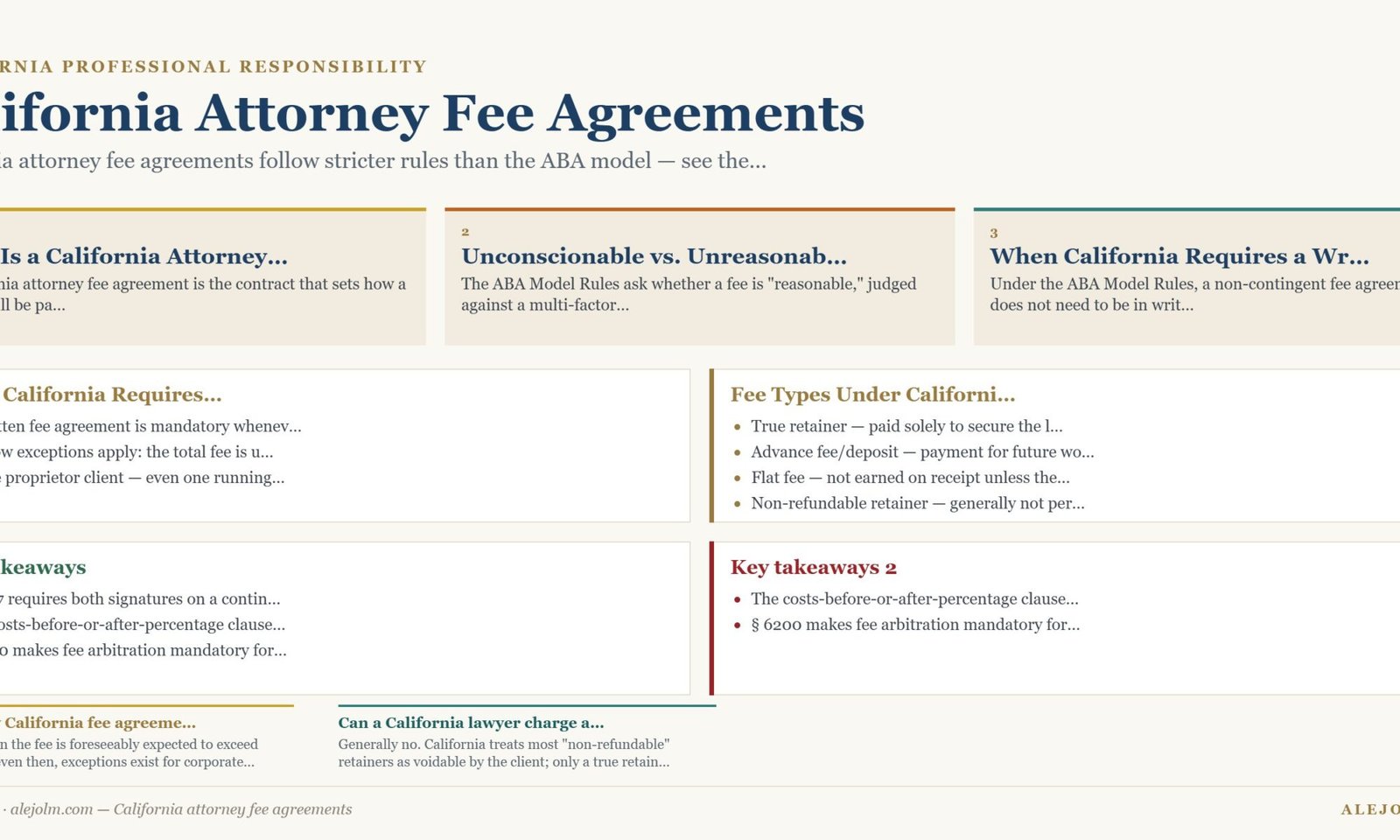
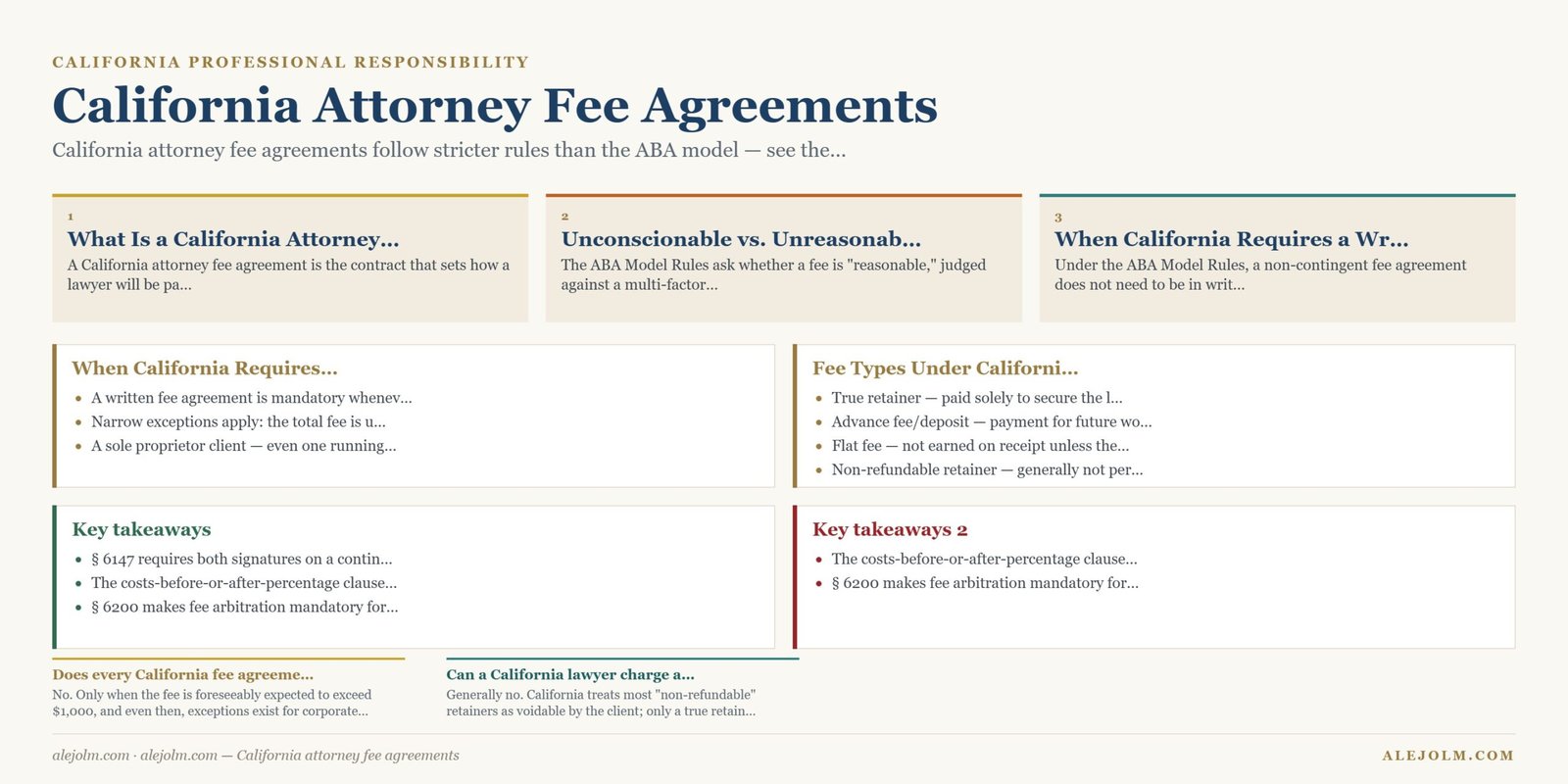
What Is a California Attorney Fee Agreement?
A California attorney fee agreement is the contract that sets how a lawyer will be paid, and it is regulated far more tightly than a typical business contract. Under the California Rules of Professional Conduct and the Business and Professions Code, a fee must not be unconscionable, and many agreements must be in writing, signed, and worded in specific ways before the lawyer can collect a dime.
If you’re studying for the California Bar Exam, this is one of the highest-yield professional responsibility topics because California diverges from the ABA Model Rules in at least four separate, testable ways. Each divergence is a trap for students who assume the Model Rules apply everywhere.
Unconscionable vs. Unreasonable: The First Big Split
The ABA Model Rules ask whether a fee is “reasonable,” judged against a multi-factor balancing test (time and labor required, customary fees in the locality, the result obtained, and so on). That is a relatively easy standard for a client to invoke.
California Rule of Professional Conduct 1.5 sets a tougher bar for challengers: the fee must be unconscionable, not merely unreasonable. A client attacking a California fee typically has to show something closer to bad faith or overreaching by the lawyer, not just that a fee seems high in hindsight. This makes California fee agreements harder to unwind than a straightforward “reasonableness” challenge would suggest.
When California Requires a Written Fee Agreement
Under the ABA Model Rules, a non-contingent fee agreement does not need to be in writing at all — a writing is encouraged, not mandatory. California takes a much stricter position under Business and Professions Code § 6148.
- A written fee agreement is mandatory whenever the fee is foreseeably expected to exceed $1,000.
- Narrow exceptions apply: the total fee is under $1,000, the client is a corporation, the services are routine, there’s an emergency, or the client knowingly waives the writing in writing.
- A sole proprietor client — even one running a real business — does not count as a “corporation” for this exception.
This is a favorite bar exam trap: a lawyer and a sole-proprietor client shake hands on a $2,000 flat fee for contract litigation. Under the ABA rule, that’s fine. Under California § 6148, the lawyer has violated the statute, even if the $2,000 fee is entirely reasonable.
Contingency Fees: California’s Extra Signature Rule
Both regimes require contingent-fee agreements to be in writing. California’s § 6147 goes further than the ABA in three ways the ABA does not require:
- Both the lawyer and the client must sign — the ABA requires only the client’s signature.
- The writing must state that the contingency rate is negotiable and not fixed by law.
- The writing must separately address any additional compensation owed for related work outside the core contingency matter.
Miss any of these three, and a California court may let the client void the agreement and force the lawyer into a quantum meruit recovery instead of the contracted percentage.
Costs Before or After the Percentage? The Order That Changes Everything
Every contingent-fee agreement has to specify whether litigation costs are deducted from the recovery before or after the lawyer’s percentage is applied. The order isn’t cosmetic — it changes real dollars.
| Scenario | Recovery | Costs | Lawyer’s Cut (1/3 contingency) | Client’s Cut |
|---|---|---|---|---|
| Costs deducted first | $1,000,000 | $100,000 | $300,000 (1/3 of $900,000) | $600,000 |
| Fee applied to gross, costs after | $1,000,000 | $100,000 | $333,333 (1/3 of $1,000,000) | $566,667 |
That $33,333 swing is exactly why California requires the agreement to spell out the order explicitly. Ambiguity on this point is one of the most common triggers for a fee-arbitration claim.
Fee Types Under California Law
California treats different payment structures differently for trust-account purposes:
- True retainer — paid solely to secure the lawyer’s availability; earned immediately upon receipt. This is a narrow category.
- Advance fee/deposit — payment for future work; not earned on receipt and must sit in the client trust account until earned.
- Flat fee — not earned on receipt unless the agreement clearly says so and the fee is actually earned through performance.
- Non-refundable retainer — generally not permitted in California and voidable by the client.
Contingency Fees That Are Always Off the Table
Both California and the ABA categorically bar contingency fees in two areas:
- Family law matters — a fee cannot be contingent on obtaining a divorce or on the amount of child support or alimony awarded.
- Criminal defense — a contingency creates a perverse incentive to rush a plea rather than serve the client’s real interests.
Mandatory Fee Arbitration Under § 6200
If a fee dispute arises, California Business and Professions Code § 6200 forces the lawyer to arbitrate if the client requests it — the lawyer has no right to refuse. The result doesn’t bind the client unless both sides later agree to binding arbitration, but the lawyer is stuck either way. The ABA Model Rules merely encourage fee arbitration; they never require it.
Worked Example: The $3,000 Handshake Deal
Lawyer and Client, a sole proprietor running a landscaping business, shake hands on a flat fee of $3,000 to handle a contract dispute. No writing is signed. Lawyer does the work and bills $3,000. Client refuses to pay, arguing the fee is unconscionable.
Analysis: Lawyer violated § 6148 because the fee — foreseeably over $1,000 — was never put in writing, and Client’s status as a sole proprietor (not a corporation) doesn’t trigger an exception. That violation exposes Lawyer to discipline independent of whether the $3,000 fee was actually reasonable. Many courts would still let Lawyer recover in quantum meruit for the value of work performed, but the § 6148 writing violation stands on its own.
FAQ
Does every California fee agreement have to be in writing?
No. Only when the fee is foreseeably expected to exceed $1,000, and even then, exceptions exist for corporate clients, routine services, emergencies, and knowing written waivers.
Can a California lawyer charge a non-refundable retainer?
Generally no. California treats most “non-refundable” retainers as voidable by the client; only a true retainer paid solely for availability is earned immediately.
What happens if a California contingency agreement is silent on cost deductions?
The agreement should specify whether costs come out before or after the percentage. Silence invites a fee dispute, and ambiguity is typically resolved against the drafter — usually the lawyer.
Key Takeaways
- California’s “unconscionable” fee standard is harder for clients to prove than the ABA’s “reasonable” standard.
- § 6148 mandates a written fee agreement above $1,000, with narrow exceptions — the ABA has no such rule for non-contingent fees.
- § 6147 requires both signatures on a contingency agreement and a disclosure that the rate is negotiable.
- The costs-before-or-after-percentage clause can shift tens of thousands of dollars and must be explicit.
- § 6200 makes fee arbitration mandatory for the lawyer if the client requests it.
This article is educational and is not legal advice. Consult a licensed California attorney about your situation.
Related guides
- Attorney Withdrawal Rules in California
- Attorney Supervisory Liability in California
- Frivolous Claims in California