
What Rule 1.8(a) Requires Before a Lawyer Does Business With a Client
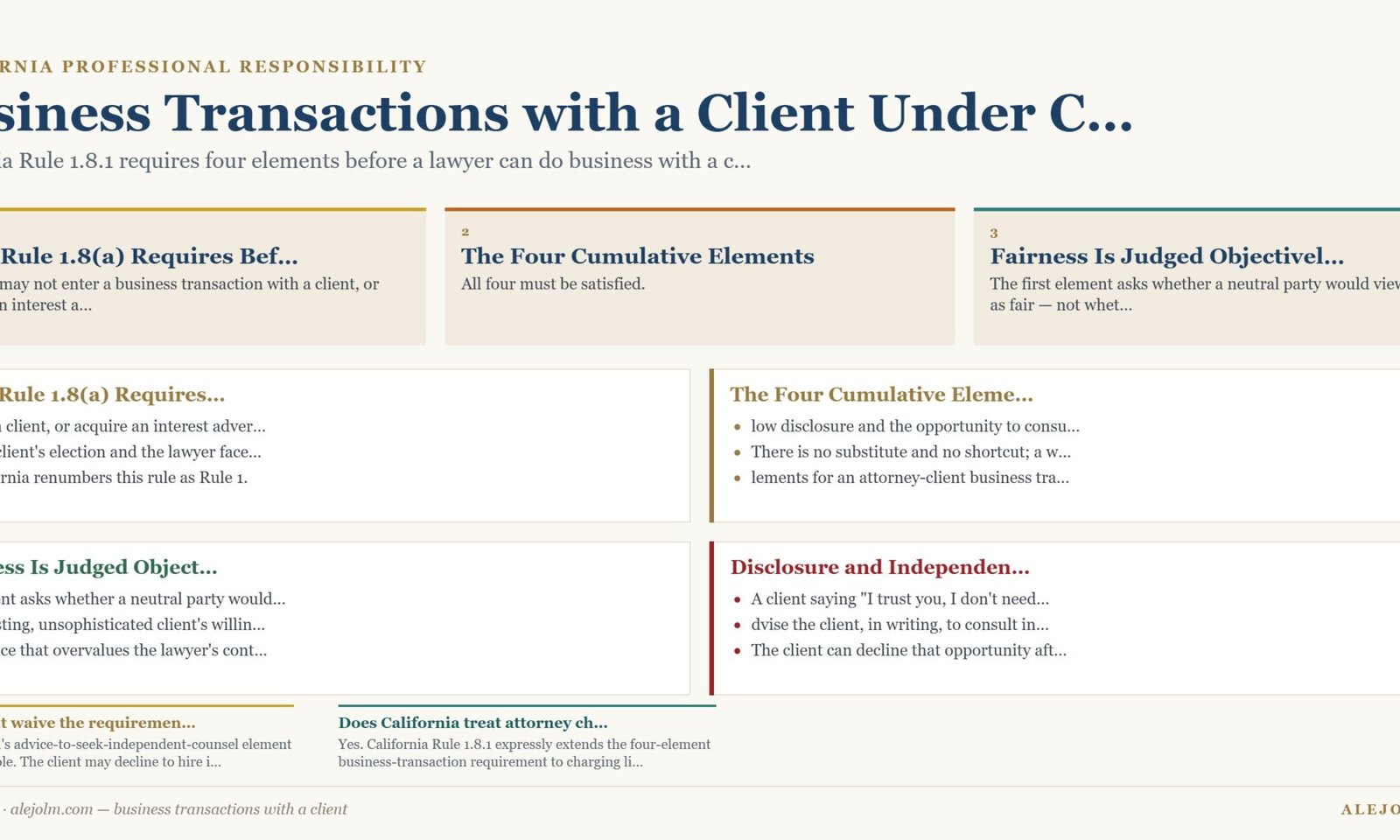
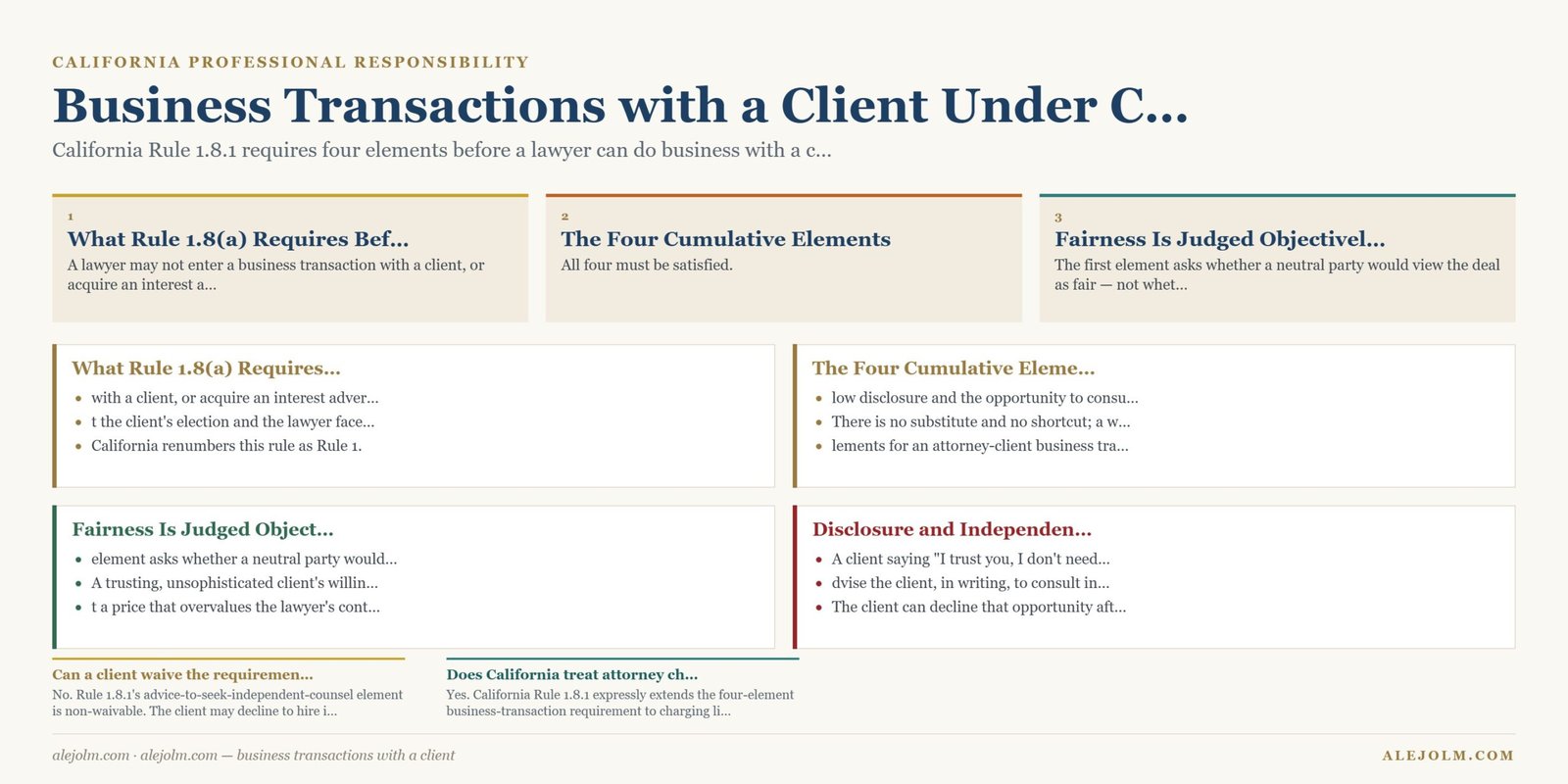
A lawyer may not enter a business transaction with a client, or acquire an interest adverse to the client, unless four cumulative requirements are satisfied. Miss even one, and the transaction is voidable at the client’s election and the lawyer faces discipline — regardless of how enthusiastically the client agreed.
California renumbers this rule as Rule 1.8.1 and extends it further than the ABA version, making it a distinctly California-flavored exam topic.
The Four Cumulative Elements
| # | Requirement | Why it matters |
|---|---|---|
| 1 | Terms are objectively fair and reasonable to the client | Client’s subjective agreement does not cure unfairness |
| 2 | All terms fully disclosed in writing | A handshake or verbal discussion is not enough |
| 3 | Client advised in writing to seek independent counsel, with a reasonable opportunity to do so | Non-waivable, even if the client says it’s unnecessary |
| 4 | Client gives informed written consent | Must follow disclosure and the opportunity to consult independent counsel — order matters |
All four must be satisfied. There is no substitute and no shortcut; a warm relationship between lawyer and client changes nothing.
Fairness Is Judged Objectively, Not by the Client’s Comfort Level
The first element asks whether a neutral party would view the deal as fair — not whether the client was happy to sign it. A trusting, unsophisticated client’s willingness to accept lopsided terms does not cure unfairness. If a lawyer proposes to co-purchase property with a client at a price that overvalues the lawyer’s contribution, that unfairness survives even enthusiastic client consent. Lawyers relying on this element should be able to point to appraisals, market comparables, or independent valuation — not just the client’s signature.
Disclosure and Independent Counsel Cannot Be Waived by Client Reassurance
A client saying “I trust you, I don’t need my own lawyer” does not satisfy elements 2 and 3. The lawyer must still put every material term in writing and must still advise the client, in writing, to consult independent counsel — and give the client a real opportunity to do so. The client can decline that opportunity after being properly advised, but the lawyer cannot skip offering it.
California’s Extension: Charging Liens Are Business Transactions Too
This is the standout California-specific wrinkle. Under Cal. Rule of Professional Conduct 1.8.1, a negotiated charging lien — a security interest a lawyer takes against a client’s case proceeds to secure payment of fees — is itself treated as a Rule 1.8.1 business transaction, requiring all four elements. The ABA’s version of the rule does not spell out this application. A California lawyer who wants to secure a lien against a client’s eventual recovery cannot simply insert boilerplate language into a fee agreement; the lawyer must independently satisfy fairness, written disclosure, written advice to seek independent counsel, and informed written consent — exactly as if negotiating any other business deal with the client.
The Equity-for-Fees Scenario
A frequently tested fact pattern: a startup client offers to pay legal fees in equity rather than cash. Every element of Rule 1.8(a) applies in full. The lawyer needs an independent valuation of the equity (accounting for dilution risk, vesting schedule, and voting rights), written disclosure of every material term, written advice to consult independent counsel, and informed written consent — obtained only after the client has had a genuine chance to get outside advice. A handshake deal on equity-for-fees fails on at least three of the four elements.
How This Interacts With Broader Conflicts Rules
A business transaction with a client necessarily creates a financial stake that can materially limit the lawyer’s loyalty — implicating Rule 1.7 as well. Satisfying Rule 1.8.1 does not automatically cure an independent Rule 1.7 conflict, and a Rule 1.7 conflict waiver does not substitute for Rule 1.8.1’s specific four-element compliance. The two analyses run in parallel, not as substitutes for each other.
Worked Example: Fees for Equity, No Paper Trail
Facts: Attorney Delgado and his longtime friend and client, a startup founder, agree over a handshake that Delgado’s $50,000 fee will be paid as a 10% equity stake in the company. There is no written disclosure. The founder says, “We trust each other — no need for a separate lawyer.”
Analysis: Delgado has violated Rule 1.8.1 on at least three grounds. Fairness (element 1) is unverifiable without a valuation of the business and Delgado’s services. There is no full written disclosure (element 2) — a handshake does not satisfy the writing requirement. There is no written advice to seek independent counsel (element 3), and the founder’s verbal reassurance does not waive that non-waivable requirement. And there is no informed written consent (element 4). The 10% interest is voidable at the founder’s election, and Delgado is subject to discipline, regardless of the founder’s subjective comfort with the deal.
FAQ
Can a client waive the requirement to be advised to seek independent counsel?
No. Rule 1.8.1’s advice-to-seek-independent-counsel element is non-waivable. The client may decline to hire independent counsel after being advised, but the lawyer must still give that advice in writing.
Does California treat attorney charging liens differently from the ABA?
Yes. California Rule 1.8.1 expressly extends the four-element business-transaction requirement to charging liens against case proceeds — an application the ABA’s Rule 1.8(a) does not spell out.
If a client is happy with the deal, does that satisfy the fairness requirement?
No. Fairness under Rule 1.8.1 is judged objectively. A client’s subjective satisfaction does not cure objectively unfair terms.
Key Takeaways
- All four Rule 1.8.1 elements — fairness, written disclosure, written advice to seek independent counsel, and informed written consent — must be satisfied cumulatively.
- Fairness is judged objectively, independent of how willing the client was to agree.
- The advice to seek independent counsel cannot be waived by the client’s reassurance.
- California explicitly extends Rule 1.8.1 to charging liens against case proceeds, unlike the ABA’s version of the rule.
- Satisfying Rule 1.8.1 does not automatically resolve an independent Rule 1.7 conflict of interest.
- Equity-for-fees arrangements are a classic California Bar Exam fact pattern testing all four elements at once.
Related guides
Sources and further reading
- California Rule of Professional Conduct 1.8.1
- ABA Model Rule 1.8: Conflict of Interest — Current Clients: Specific Rules
This article is educational and is not legal advice. Consult a licensed California attorney about your situation.