
What Counts as a Frivolous Claim in California?
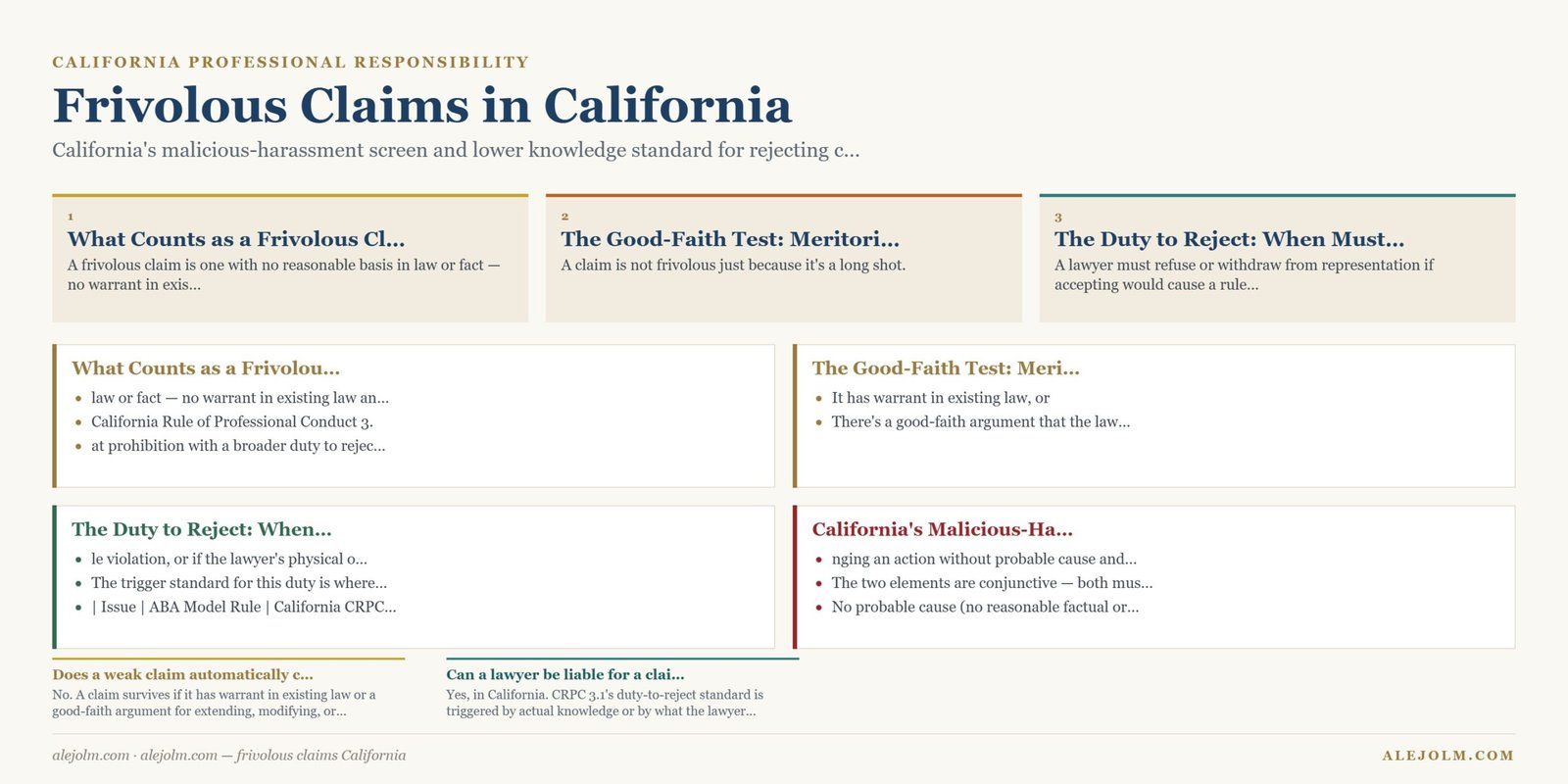
A frivolous claim is one with no reasonable basis in law or fact — no warrant in existing law and no good-faith argument for extending, modifying, or reversing it. California Rule of Professional Conduct 3.1 bars lawyers from bringing, defending, or continuing frivolous claims, and pairs that prohibition with a broader duty to reject or withdraw from representation that would force a rule violation.
California adds a layer the ABA doesn’t separately codify: a malicious-harassment screen that asks not just whether a claim has legal merit, but why the client wants to bring it.
The Good-Faith Test: Meritorious vs. Frivolous
A claim is not frivolous just because it’s a long shot. It survives if either:
- It has warrant in existing law, or
- There’s a good-faith argument that the law should be extended, modified, or reversed.
Even a lawyer who personally doubts a claim will win can ethically pursue it — the standard is objective, not a referendum on the lawyer’s private confidence level. Challenging a statute the Supreme Court recently upheld isn’t automatically frivolous if the legal landscape has shifted since — new scholarly criticism, a changed Court composition, or evolving doctrine can support a good-faith reversal argument.
The Duty to Reject: When Must a Lawyer Decline?
A lawyer must refuse or withdraw from representation if accepting would cause a rule violation, or if the lawyer’s physical or mental condition would make representation unreasonably difficult. The trigger standard for this duty is where California and the ABA split.
| Issue | ABA Model Rule | California CRPC 3.1 |
|---|---|---|
| Knowledge standard for duty to reject | Actual knowledge of a rule violation | Actual knowledge or reasonably should know |
| Frivolous-claim definition | No warrant in law + no good-faith argument | Same, plus the malicious-harassment screen |
| Malicious harassment | Handled generally under frivolous/fairness rules | Separately codified, conjunctive two-part test |
| Quasi-criminal backstop | None | Cal. Bus. & Prof. Code § 6128 makes willful bad-faith litigation a misdemeanor |
California’s “reasonably should know” standard is more protective of the public than the ABA’s actual-knowledge floor — a California lawyer can’t avoid the duty to reject simply by not asking follow-up questions that would have revealed the problem.
California’s Malicious-Harassment Screen
CRPC 3.1 independently bars asserting a position, taking an appeal, or bringing an action without probable cause and for the purpose of harassing or maliciously injuring any person. The two elements are conjunctive — both must be present:
- No probable cause (no reasonable factual or legal basis), and
- Purpose is harassment or malicious injury.
That means a claim with genuine probable cause doesn’t violate this prong even if the client’s underlying motive is petty or vindictive. And a claim asserted without probable cause but with no harassing purpose is analyzed under the ordinary frivolous-claim rule, not this heightened screen. Business and Professions Code § 6128 backs this up with a quasi-criminal misdemeanor for a lawyer who willfully brings or defends an action without just cause and with intent to injure — a sanction with no ABA counterpart.
Partial Representation: Accepting Some Claims, Rejecting Others
A lawyer doesn’t have to accept or reject a client’s entire case as a package. If a client proposes one meritorious claim and one frivolous claim, the lawyer can take the meritorious one and decline the frivolous one — as long as the lawyer doesn’t quietly smuggle the frivolous theory back in as a “supporting” argument. If the client insists the frivolous claim is non-negotiable, the lawyer may need to withdraw from the whole matter.
Worked Example: The Two-Foot Fence
Landowner asks Lawyer to sue Neighbor over a two-foot fence encroachment. A licensed surveyor’s report genuinely confirms the fence sits two feet onto Landowner’s property, supporting a modest but legally recognized trespass claim. Landowner admits: “Honestly, I don’t care about the two feet — I want to bury him in litigation costs because he called animal control on my dog.”
Analysis: Lawyer may file the suit. CRPC 3.1’s malicious-harassment prong requires the absence of probable cause and a harassing purpose — conjunctive, not either/or. Here, probable cause exists because the survey supports a good-faith legal and factual basis for trespass, regardless of how modest the damages are. Because probable cause is present, Landowner’s admitted harassment motive doesn’t, by itself, make filing improper. Lawyer should still counsel Landowner on proportionality and avoid tactics — like padding discovery just to run up costs — that would independently violate Rules 3.2 or 4.4.
FAQ
Does a weak claim automatically count as frivolous in California?
No. A claim survives if it has warrant in existing law or a good-faith argument for extending, modifying, or reversing the law — regardless of the lawyer’s personal odds-of-winning assessment.
Can a lawyer be liable for a claim they “should have known” was improper, even without actual knowledge?
Yes, in California. CRPC 3.1’s duty-to-reject standard is triggered by actual knowledge or by what the lawyer reasonably should have known — broader than the ABA’s actual-knowledge test.
Does a harassing motive alone make a California claim improper?
No. The malicious-harassment screen requires both the absence of probable cause and a harassing purpose. A claim with genuine probable cause isn’t barred just because the client’s motives are petty.
Key Takeaways
- Frivolousness is judged objectively — a lawyer’s personal doubt about winning doesn’t make a claim frivolous.
- California’s duty-to-reject standard covers what a lawyer “reasonably should know,” not just actual knowledge.
- CRPC 3.1’s malicious-harassment screen is conjunctive: no probable cause and a harassing purpose, both required.
- Business and Professions Code § 6128 backs the rule with a quasi-criminal misdemeanor the ABA has no equivalent for.
- A lawyer can accept meritorious claims while declining frivolous ones within the same representation.
This article is educational and is not legal advice. Consult a licensed California attorney about your situation.
Related guides
- Candor and Fairness in Litigation Rules
- Attorney Withdrawal Rules in California
- Attorney Supervisory Liability in California Firms