
What Is the Duty to Communicate With a Client?
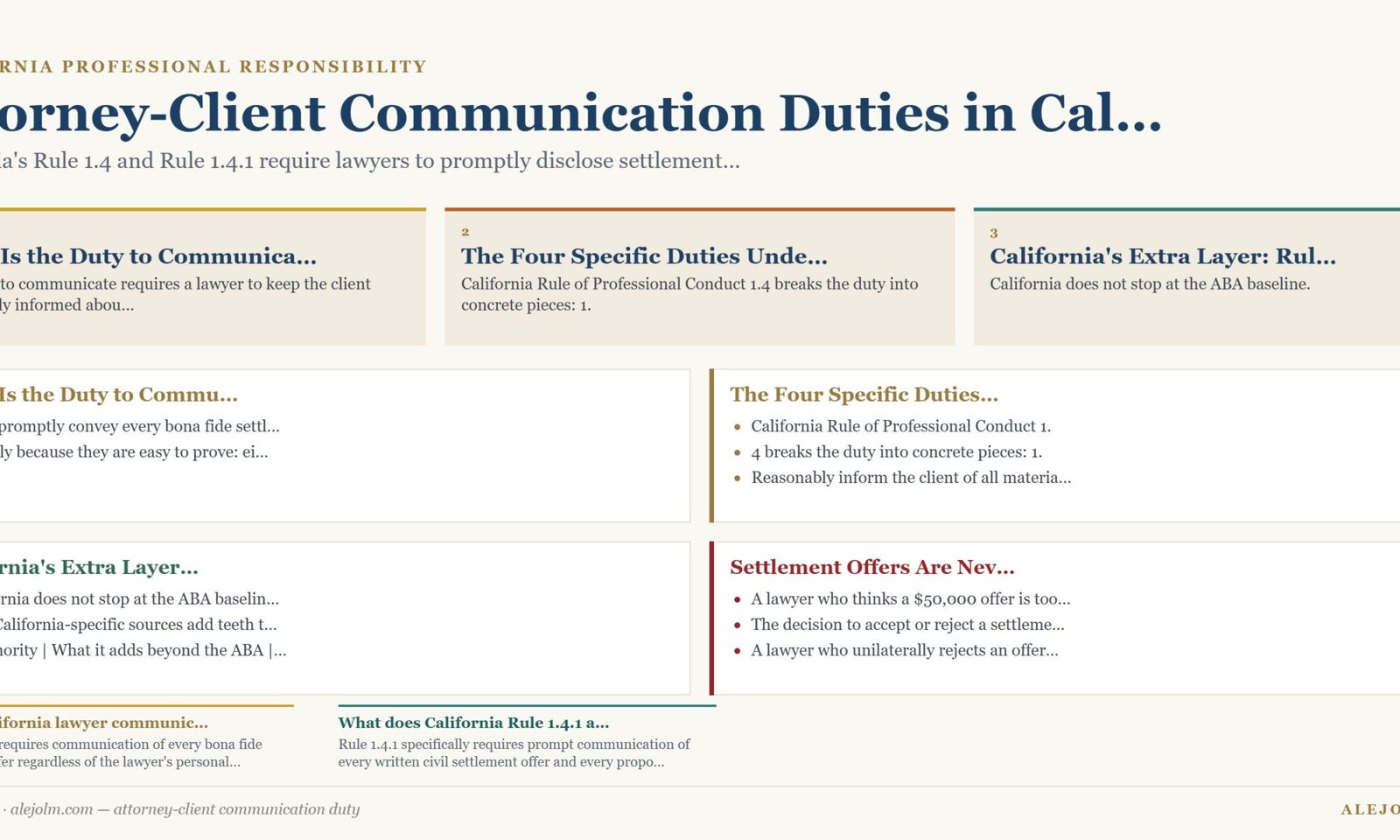
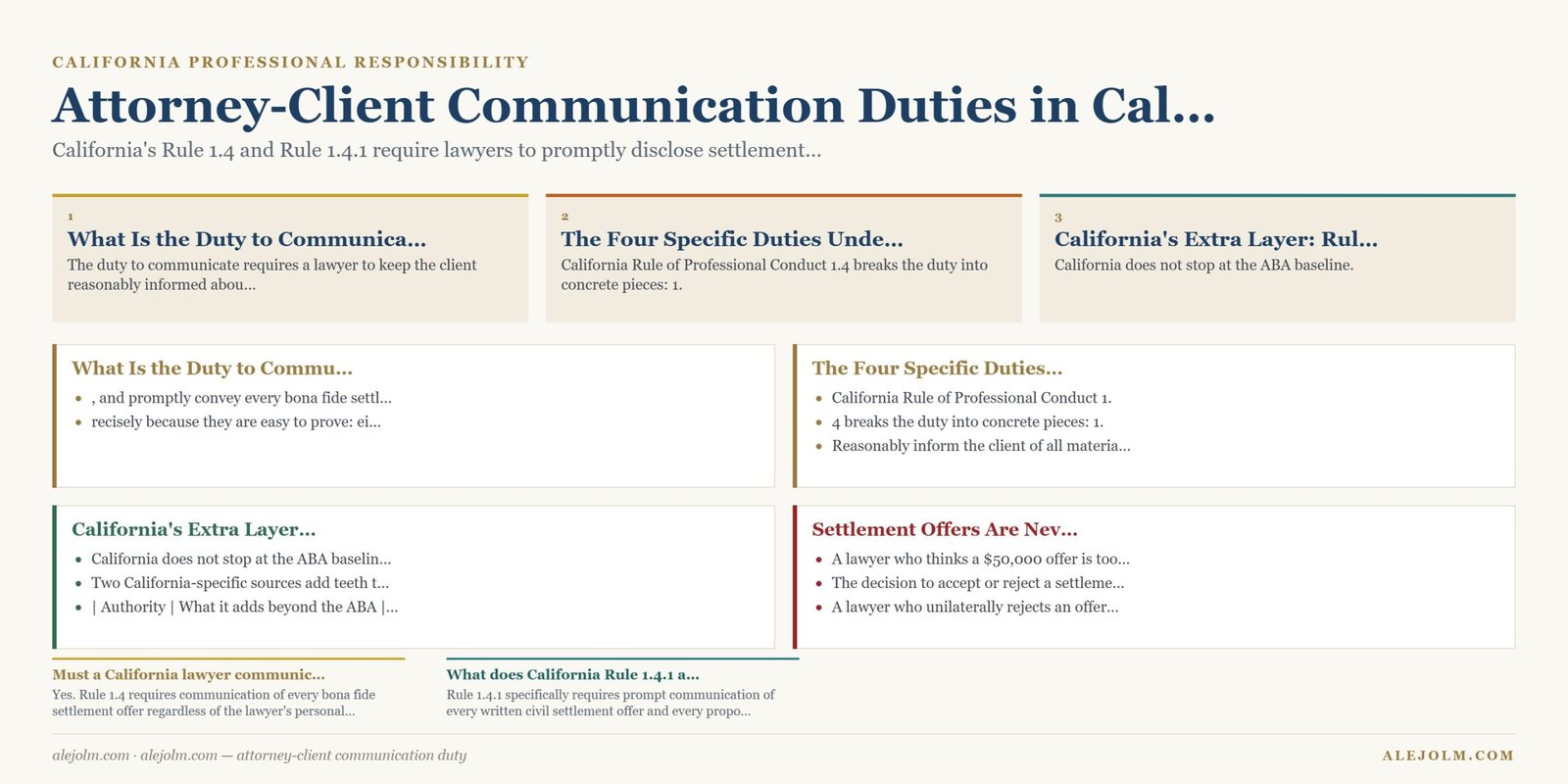
The duty to communicate requires a lawyer to keep the client reasonably informed about the matter, explain issues enough for the client to make informed decisions, and promptly convey every bona fide settlement offer — regardless of what the lawyer personally thinks of it.
Communication failures are among the most common sources of State Bar complaints, precisely because they are easy to prove: either the lawyer told the client, or the client can show they didn’t.
The Four Specific Duties Under Rule 1.4
California Rule of Professional Conduct 1.4 breaks the duty into concrete pieces:
- Reasonably inform the client of all material developments
- Explain legal matters to the extent reasonably necessary for informed decisions
- Communicate every bona fide settlement offer, no matter the lawyer’s opinion of it
- Advise the client promptly of significant developments
A failure to communicate is rarely an isolated violation — it typically also breaches the duty of competence (a client cannot decide anything without information) and the duty of loyalty (the lawyer effectively substitutes her judgment for the client’s).
California’s Extra Layer: Rule 1.4.1 and Section 6068(m)
California does not stop at the ABA baseline. Two California-specific sources add teeth to the communication duty.
| Authority | What it adds beyond the ABA |
|---|---|
| Cal. Rule of Prof’l Conduct 1.4.1 | Requires prompt communication of every written settlement offer in civil matters and every proposed plea bargain in criminal matters |
| Cal. Bus. & Prof. Code § 6068(m) | Independently codifies the duty to respond promptly to client inquiries and report significant case developments — a statutory duty on top of the ethics rule |
The practical effect: California litigators and prosecutors face a communication duty enforceable both as an ethics rule (subject to State Bar discipline) and as a statutory obligation, giving disciplined clients two separate hooks to pursue a complaint.
Settlement Offers Are Never the Lawyer’s Call
A lawyer who thinks a $50,000 offer is too low for a case worth $100,000 still must communicate that offer. The decision to accept or reject a settlement belongs to the client alone. A lawyer who unilaterally rejects an offer — even with the best of intentions — violates Rule 1.4 and also breaches the duty of loyalty, because the client’s fundamental decision-making authority has been overridden.
This rule applies with equal force to unfavorable rulings and adverse developments. A two-week delay in reporting a denied motion or a lost summary judgment ruling is a violation, because delay can quietly erode a client’s appeal deadlines and settlement leverage.
Calibrating Explanation to the Client
“Explaining” a legal matter is not the same as reciting it. Rule 1.4 requires explanation sufficient to permit informed decision-making, calibrated to the client’s sophistication. A first-time criminal defendant weighing a plea deal needs to understand what a guilty plea actually waives — jury trial, the prosecution’s burden of proof, and potential immigration or licensing consequences — not just the plea’s bare terms. A sophisticated corporate client negotiating a routine contract may need far less hand-holding.
Responding to Client Inquiries
Rule 1.4 also requires the lawyer to promptly comply with reasonable requests for information. Ignoring client emails for weeks, or responding only after a complaint, is itself a violation — independent of whether any underlying deadline was missed.
Worked Example: The Silent Rejection
Facts: Attorney Osei represents Devon in a personal-injury case. Opposing counsel offers $50,000 to settle. Osei believes the case is worth at least $100,000 and, without telling Devon, sends a one-line email rejecting the offer as “inadequate.” Three months later Devon learns of the offer from opposing counsel and is furious.
Analysis: Osei violated Rule 1.4 by failing to communicate a bona fide settlement offer, regardless of whether Osei’s valuation was correct. The decision to accept or reject belonged to Devon. Osei’s unilateral rejection also breaches the duty of loyalty, because it substituted the lawyer’s judgment for the client’s on a decision the client alone controls. Osei faces discipline exposure and, if Devon can show the delay or the missed decision caused harm (for example, a later, lower offer), potential malpractice liability.
FAQ
Must a California lawyer communicate a settlement offer she believes is unreasonable?
Yes. Rule 1.4 requires communication of every bona fide settlement offer regardless of the lawyer’s personal opinion of its adequacy. The client makes the final call.
What does California Rule 1.4.1 add beyond the ABA rule?
Rule 1.4.1 specifically requires prompt communication of every written civil settlement offer and every proposed criminal plea bargain — an explicit requirement the ABA Model Rules do not spell out as its own numbered rule.
How quickly must a lawyer respond to a client’s status inquiry?
“Promptly” is the standard — typically within a business day or two absent unusual circumstances. Ignoring inquiries for weeks violates Rule 1.4 and Business and Professions Code § 6068(m).
Key Takeaways
- Rule 1.4 requires informing the client of developments, explaining matters for informed decisions, and disclosing every settlement offer.
- The client, not the lawyer, decides whether to accept a settlement offer.
- California’s Rule 1.4.1 specifically mandates prompt disclosure of civil settlement offers and criminal plea bargains.
- Business and Professions Code § 6068(m) independently codifies the duty to respond to client inquiries — a statutory layer beyond the ethics rule.
- Communication failures frequently also breach competence and loyalty duties.
- This is a heavily tested area of the California Bar Exam, especially in the criminal-plea and settlement-offer contexts.
This article is educational and is not legal advice. Consult a licensed California attorney about your situation.
Related guides
- lawyer-client relationship formation
- California attorney competence rule
- attorney-client confidentiality in California