
What Is a Restraint on Alienation?
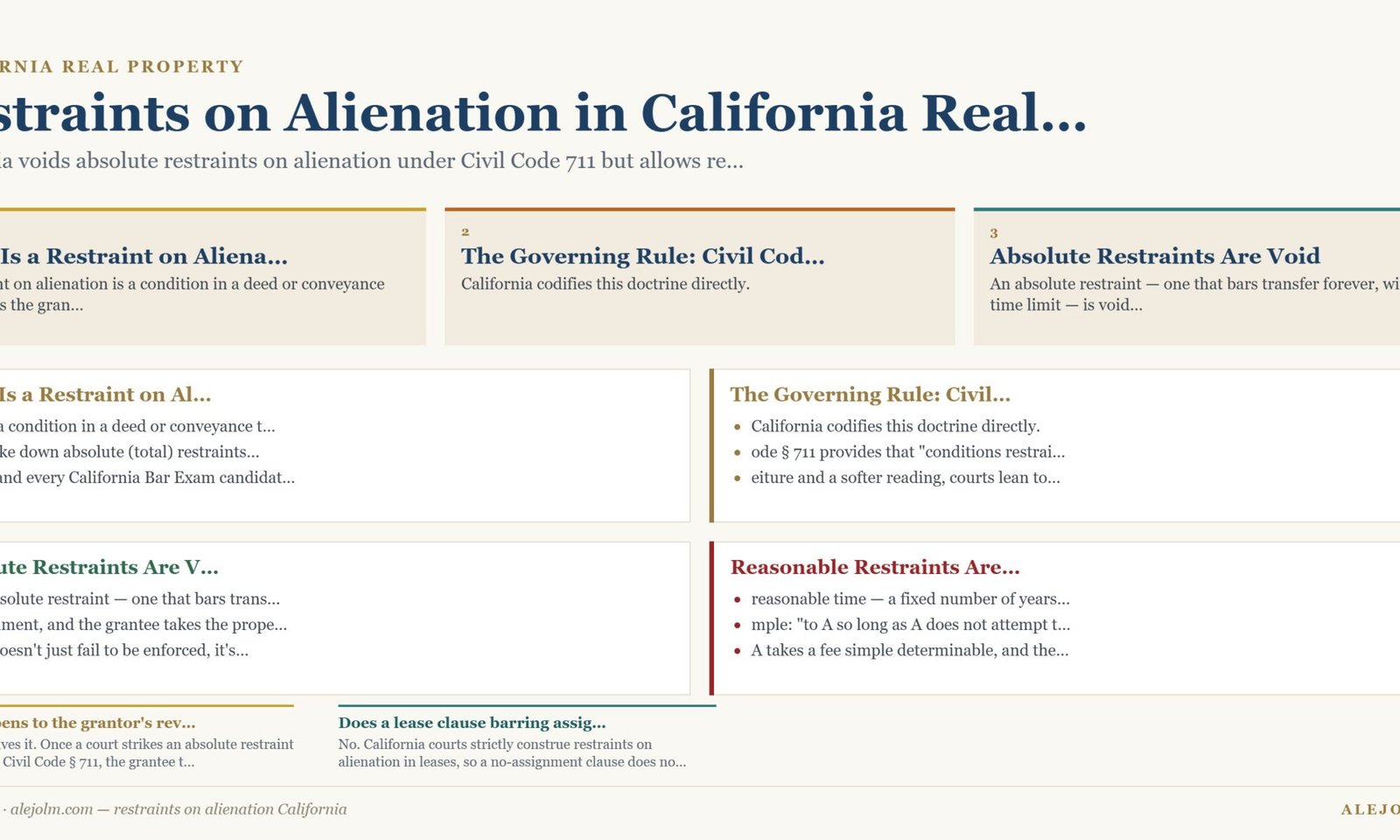
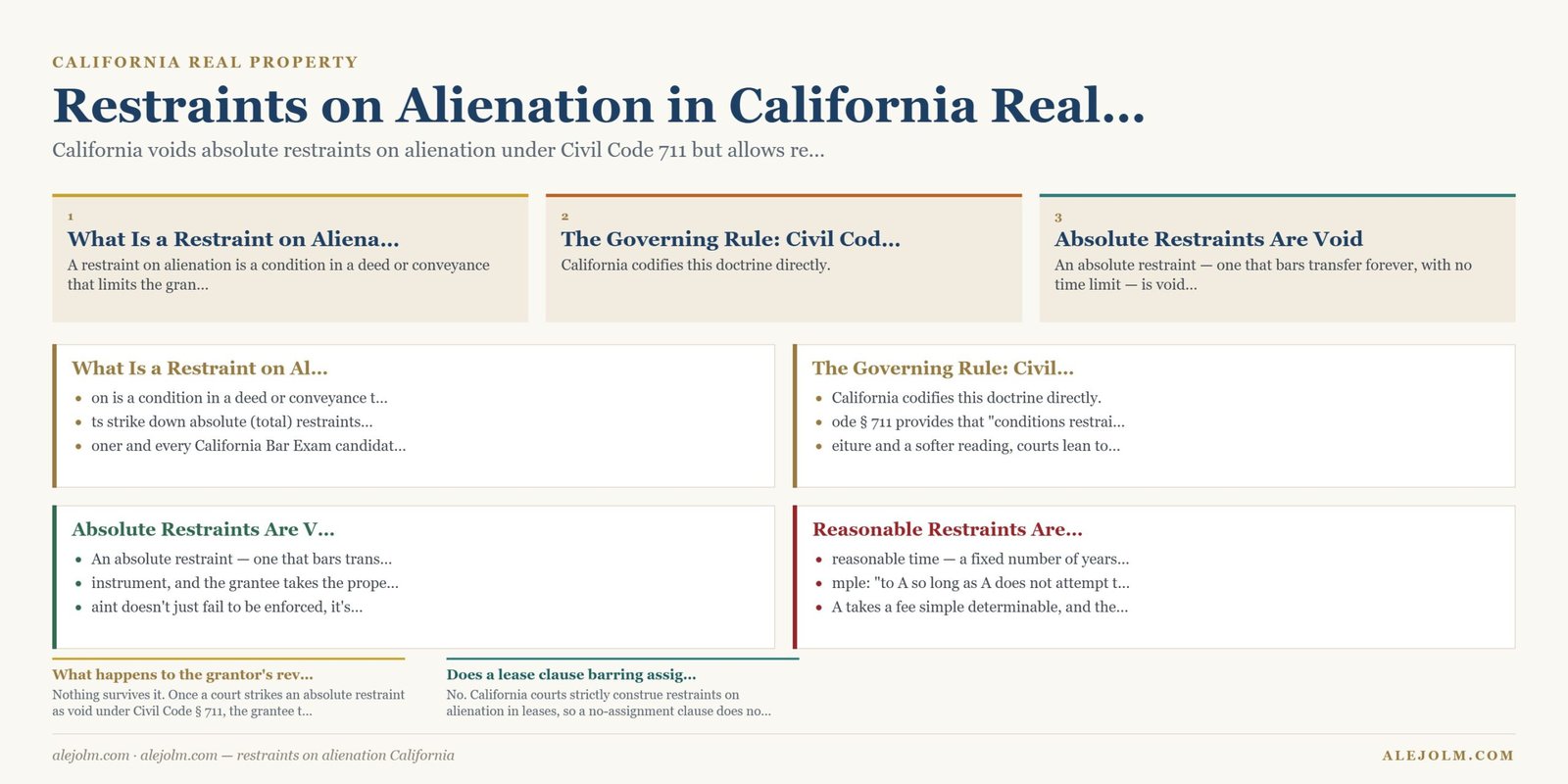
A restraint on alienation is a condition in a deed or conveyance that limits the grantee’s ability to sell or transfer the property. California, like most states, strongly favors keeping land freely transferable, so its courts strike down absolute (total) restraints as void while upholding reasonable, time-limited restraints. Every real estate practitioner and every California Bar Exam candidate needs to know which side of that line a given clause falls on.
The Governing Rule: Civil Code § 711
California codifies this doctrine directly. Civil Code § 711 provides that “conditions restraining alienation, when repugnant to the interest created, are void.” The rationale is twofold: first, the law encourages land to stay in the ordinary channels of commerce rather than being locked away from transfer indefinitely; second, courts generally abhor forfeitures — so where an instrument’s language is ambiguous between a hard forfeiture and a softer reading, courts lean toward the interpretation that avoids an automatic loss of the estate.
Absolute Restraints Are Void
An absolute restraint — one that bars transfer forever, with no time limit — is void outright. The offending condition is simply stricken from the instrument, and the grantee takes the property free of it, typically ending up with a fee simple absolute. Critically, the grantor keeps no possibility of reverter or right of entry tied to the void clause — the restraint doesn’t just fail to be enforced, it’s treated as though it were never validly created in the first place.
For example: “Blueacre to A so long as A never attempts to sell Blueacre” is an absolute restraint. It’s void; A takes a fee simple absolute, and the grantor retains nothing.
Reasonable Restraints Are Valid
A restraint limited to a reasonable time — a fixed number of years, or only during the grantor’s lifetime — is generally enforceable. For example: “to A so long as A does not attempt to sell Blueacre until 2035” creates a valid, time-limited restraint. A takes a fee simple determinable, and the grantor keeps a possibility of reverter during that window. Once 2035 arrives, A can sell freely, and the grantor’s reverter interest disappears if it hasn’t already been triggered.
Courts assess reasonableness by asking whether the restraint is genuinely necessary to protect a legitimate security interest, or serves some other substantial, legitimate purpose — the more heavily a restriction burdens the owner’s rights, the stronger that justification needs to be.
Words of Mere Hope Create No Restraint at All
Language expressing only hope, intention, or desire — “to A with the hope that A will keep the family farm” — creates no restraint and no defeasible fee whatsoever. A takes a fee simple absolute outright, unburdened by any condition, because the grantor never actually imposed an enforceable limitation.
Restraints in the Leasing Context
Restraints on alienation also appear in leases, most commonly as a landlord’s consent-to-transfer clause. Such clauses are enforceable, but because they restrain alienation, courts construe them strictly. A clause barring “assignment” does not, by its terms, bar a sublease, and a clause barring “sublease” does not bar an outright assignment — the two transfers are legally distinct, and a landlord who wants to block both must say so explicitly.
Worked Example: The Reyes Siblings
A grantor conveys land to two siblings, Marisol and Diego Reyes, “as joint tenants… for so long as neither makes any transfer; on transfer it reverts to grantor.” What’s the effect of this clause?
This is a total, indefinite restraint on alienation — there’s no time limit at all. Under Civil Code § 711, it’s stricken as void. Marisol and Diego take the property in fee simple absolute as joint tenants, and the grantor’s purported reverter is eliminated entirely. If Marisol later sells her interest to a third party, that transfer does not revert the land to the grantor — it simply severs the joint tenancy, converting the parties’ relationship into a tenancy in common as to Marisol’s share.
Absolute vs. Reasonable Restraints
| Restraint Type | Example Language | Validity | Grantor’s Retained Interest |
|---|---|---|---|
| Absolute (total, no time limit) | “so long as A never sells” | Void — stricken | None |
| Reasonable (time-limited) | “so long as A does not sell before 2035” | Valid | Possibility of reverter until 2035 |
| Mere hope/desire | “with the hope that A keeps the farm” | Creates no restraint at all | None |
| Lease consent clause (strictly construed) | “no assignment without landlord’s consent” | Valid, but doesn’t bar subleasing | N/A (lease context) |
FAQ
What happens to the grantor’s reverter when an absolute restraint is struck down?
Nothing survives it. Once a court strikes an absolute restraint as void under Civil Code § 711, the grantee takes a fee simple absolute, and the grantor keeps no possibility of reverter or right of re-entry tied to that void condition.
Does a lease clause barring assignment also bar subleasing?
No. California courts strictly construe restraints on alienation in leases, so a no-assignment clause does not, by itself, prohibit a sublease, and vice versa — the drafter must address both transfer types explicitly to restrict both.
Can a joint tenant sell despite a “no transfer” clause that has been struck down as void?
Yes. Once the void restraint is stricken, ordinary severance rules apply: a joint tenant’s transfer of their own interest severs the joint tenancy as to that share, converting it into a tenancy in common, rather than triggering any reversion to the original grantor.
Key Takeaways
- California Civil Code § 711 voids conditions restraining alienation that are repugnant to the interest created.
- Absolute (permanent) restraints are struck entirely, leaving the grantee with a fee simple absolute and the grantor with no reverter.
- Reasonable, time-limited restraints are valid and typically pair with a fee simple determinable and a possibility of reverter.
- Lease consent-to-transfer clauses are enforceable but strictly construed, so “no assignment” doesn’t automatically mean “no sublease.”
- A void restraint combined with a joint tenancy still allows ordinary severance rules to apply to any later transfer.
This article is educational and is not legal advice. Consult a licensed California attorney about your situation.
Related guides
- fee simple absolute
- fee simple determinable
- joint tenancy in California
- future interests in property
- lease assignment vs. sublease