
What Is Penn Central Balancing?
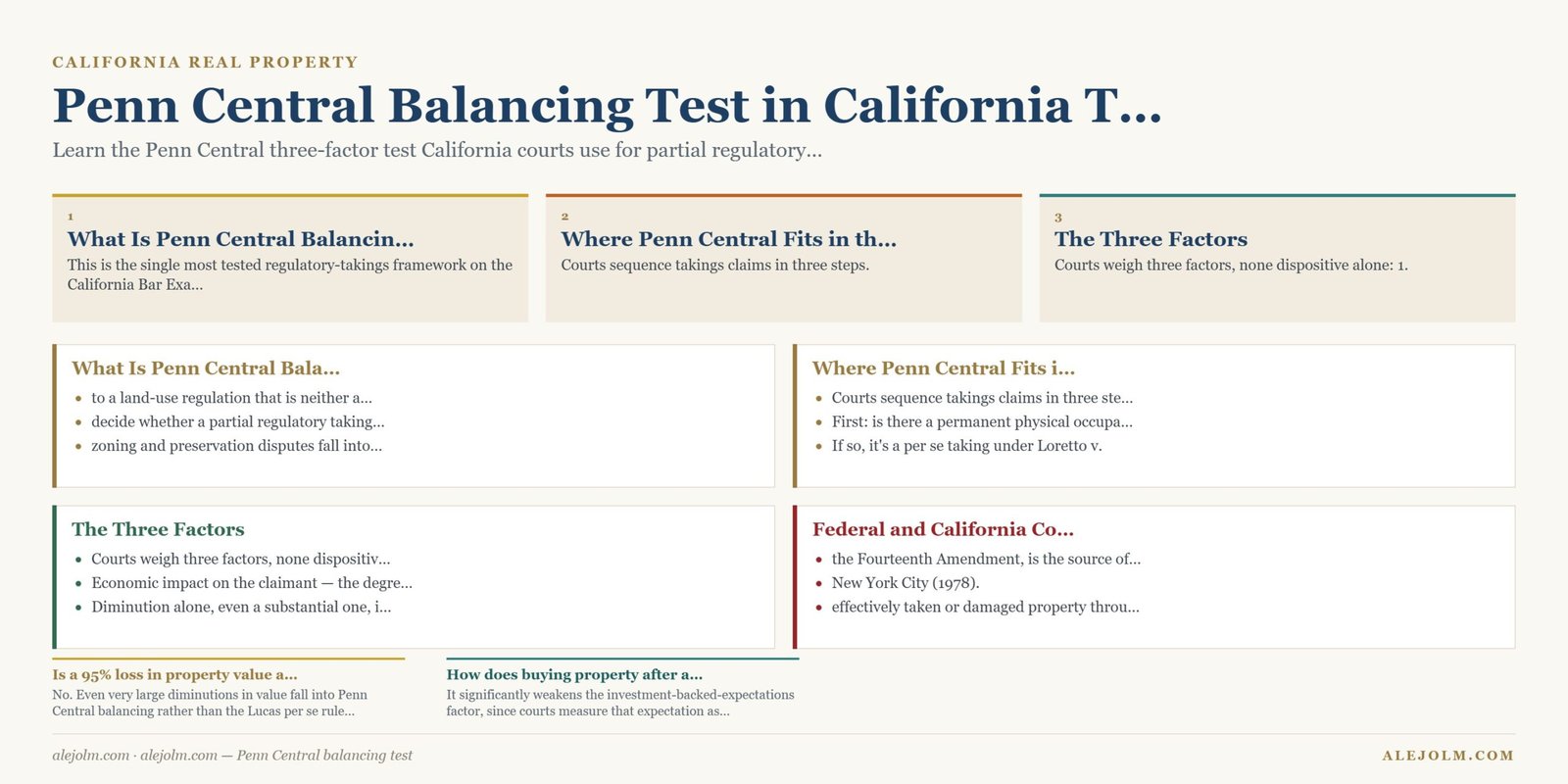
Penn Central balancing is the ad hoc, three-factor test courts apply to a land-use regulation that is neither a permanent physical occupation nor a total wipeout of economic value. There’s no rigid formula — the court weighs the factors holistically to decide whether a partial regulatory taking has occurred, requiring just compensation under the Takings Clause.
This is the single most tested regulatory-takings framework on the California Bar Exam, precisely because most real-world zoning and preservation disputes fall into this messy middle category rather than the two cleaner per se rules.
Where Penn Central Fits in the Takings Analysis
Courts sequence takings claims in three steps. First: is there a permanent physical occupation? If so, it’s a per se taking under Loretto v. Teleprompter Manhattan CATV Corp. regardless of size or public benefit. Second: does the regulation cause a complete, 100% wipeout of all economically viable use? If so, it’s a per se taking under Lucas v. South Carolina Coastal Council. Everything else — including regulations causing a 65% or even a 95% diminution in value — falls into Penn Central balancing, where the government usually wins. A temporary physical invasion (as opposed to a permanent one) is also analyzed under Penn Central rather than Loretto.
The Three Factors
Courts weigh three factors, none dispositive alone:
- Economic impact on the claimant — the degree of diminution in value. Diminution alone, even a substantial one, is almost never sufficient by itself.
- Interference with reasonable investment-backed expectations — whether the owner bought the property in reliance on an anticipated use the regulation now forecloses. Expectations are anchored to what the owner reasonably knew at the time of purchase; buying after a regulation already existed weakens the claim, because the owner effectively “bought in” with notice of the restriction.
- Character of the government action — a broad, general regulation applying to many property owners citywide is far less suspect than a targeted, idiosyncratic burden singling out one owner.
Federal and California Constitutional Grounding
The Takings Clause of the Fifth Amendment, applied to the states through the Fourteenth Amendment, is the source of the federal doctrine established in Penn Central Transportation Co. v. New York City (1978). California also has its own state constitutional takings and damages clause, and California courts apply the same Penn Central factors when evaluating inverse condemnation claims — lawsuits brought by property owners against a public entity that has effectively taken or damaged property through regulation without initiating formal eminent domain proceedings.
Diminution in Value Rarely Wins Alone
Courts strongly disfavor regulatory-takings claims under Penn Central. A 65% diminution in property value, without strong investment-backed expectations pointing the other way, is generally insufficient to establish a taking. The regulation need not even be newly enacted — a long-standing rule can still be challenged, though a long-standing rule that predates the current owner’s purchase makes the investment-backed-expectations factor weaker for that owner.
Worked Example: The Alameda Warehouse
Investor Dana Kessler buys a historic warehouse in Alameda for $2 million in 2024, three years after the city designated the building a protected landmark. The landmark ordinance bars Kessler from adding a fourth story she had hoped to build, cutting the property’s redevelopment value by roughly 65%. Kessler sues, alleging a regulatory taking.
Applying Penn Central: the economic impact (65% diminution) is significant but not a complete wipeout, since Kessler can still operate the existing warehouse profitably. Her investment-backed expectations are weak, because she bought after the landmark designation was already in place — she “bought in” with notice. And the regulation is a broad, generally applicable landmark-preservation ordinance covering many buildings citywide, not a rule targeting her alone. Under these facts, Kessler almost certainly loses; no compensable taking occurred.
Penn Central Factors at a Glance
| Factor | Weighs Toward Taking | Weighs Toward No Taking |
|---|---|---|
| Economic impact | Near-total loss of value, even short of 100% | Owner retains a reasonable economic return |
| Investment-backed expectations | Owner bought before the regulation existed | Owner bought after the regulation was already in place |
| Character of government action | Targeted, idiosyncratic burden on one owner | Broad, generally applicable regulation |
FAQ
Is a 95% loss in property value automatically a taking under Penn Central?
No. Even very large diminutions in value fall into Penn Central balancing rather than the Lucas per se rule, and the government typically prevails unless the owner also shows strong investment-backed expectations and a targeted, non-generalized regulation.
How does buying property after a regulation is already in place affect a takings claim?
It significantly weakens the investment-backed-expectations factor, since courts measure that expectation as of the time of purchase — an owner who buys with notice of an existing restriction cannot credibly claim reliance on a use the regulation already forecloses.
Is a temporary physical invasion analyzed under Loretto or Penn Central?
Under Penn Central, not Loretto. The per se physical-occupation rule under Loretto is reserved for permanent physical occupations; temporary invasions get the full three-factor balancing analysis instead.
Key Takeaways
- Penn Central balancing applies to regulations that are neither a permanent physical occupation nor a total economic wipeout.
- The three factors are economic impact, interference with investment-backed expectations, and the character of the government action.
- A 65% (or even larger) diminution in value, standing alone, is usually insufficient to establish a taking.
- Buying property after a regulation already exists weakens the investment-backed-expectations factor.
- California courts apply the same three-factor test in inverse condemnation actions under the state’s own takings framework.
This article is educational and is not legal advice. Consult a licensed California attorney about your situation.
Related guides
- Loretto per se physical taking rule
- California zoning law
- variances, conditional use permits, and spot zoning
- vested rights in California zoning
- nonconforming use and amortization