
What Is Non-Hearsay?
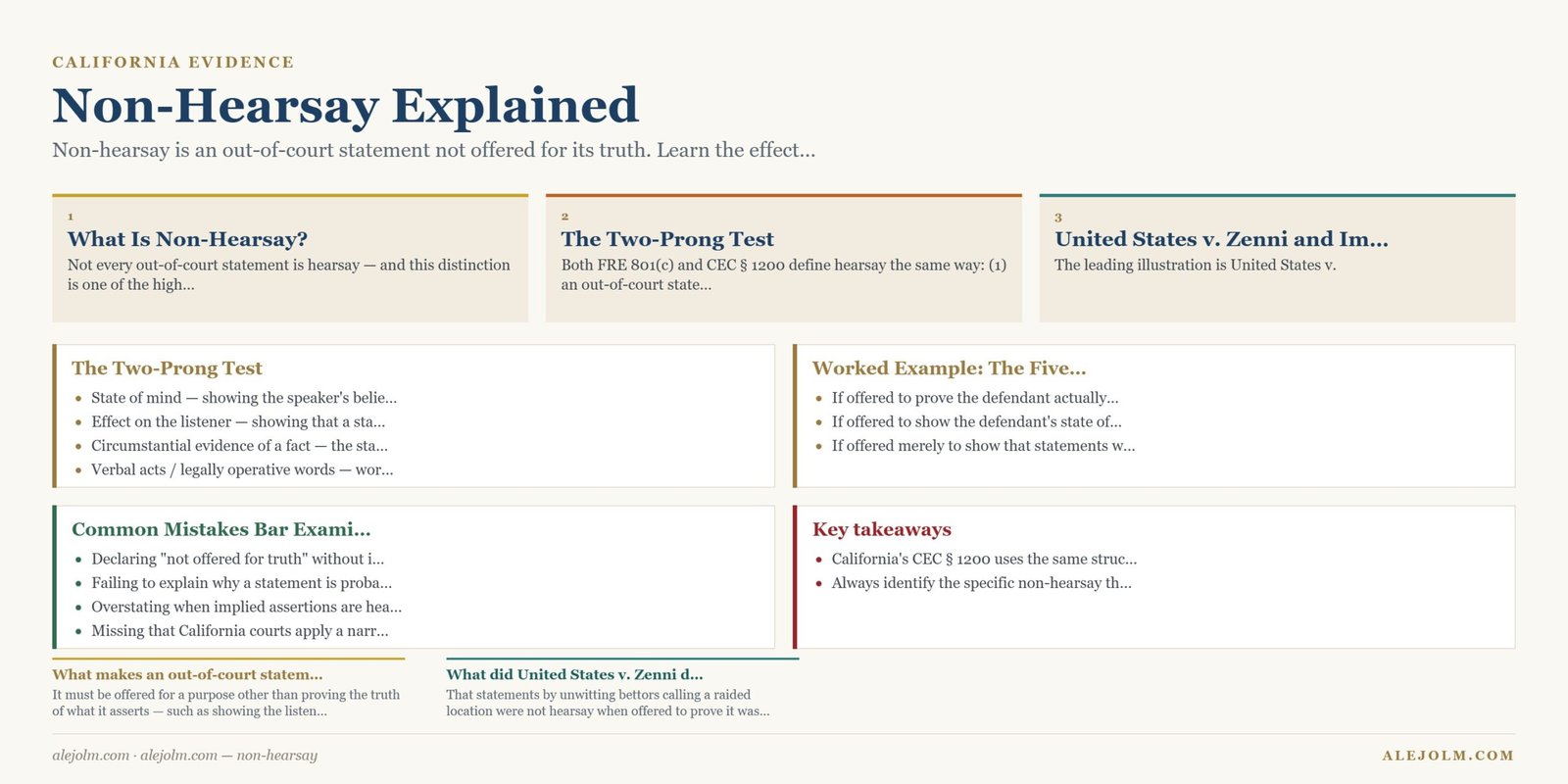
Not every out-of-court statement is hearsay — and this distinction is one of the highest-value, most misunderstood concepts on the California Bar Exam. Non-hearsay is an out-of-court statement offered for some purpose other than proving the truth of what it asserts. Kill the “offered for truth” element, and the hearsay objection disappears, no matter how clearly the statement was made outside the courtroom.
Non-hearsay, defined: an out-of-court statement introduced for a purpose other than proving the truth of the matter asserted — such as showing the listener’s state of mind, notice, or effect on the listener — and therefore outside the two-prong hearsay definition under FRE 801(c) and CEC § 1200.
The Two-Prong Test
Both FRE 801(c) and CEC § 1200 define hearsay the same way: (1) an out-of-court statement, (2) offered to prove the truth of the matter asserted. Eliminate either prong and there’s no hearsay problem. Non-hearsay analysis almost always attacks the second prong. Courts recognize several legitimate non-truth purposes:
- State of mind — showing the speaker’s belief, fear, or intent, not the truth of what was said.
- Effect on the listener — showing that a statement caused someone to act a certain way, regardless of whether the statement was accurate.
- Circumstantial evidence of a fact — the statement’s existence itself is probative, apart from its content being true.
- Verbal acts / legally operative words — words that themselves create legal consequences, like the terms of a contract.
United States v. Zenni and Implied Assertions
The leading illustration is United States v. Zenni (1980): federal agents raided a suspected bookmaking operation and answered the ringing phone; callers placed bets, unaware they were talking to police. The government offered this to prove the location was a bookmaking operation. The court held it was not hearsay — the callers weren’t asserting “this is a bookmaking operation,” they were just placing bets. The FRE rejected the older common-law “implied assertion” doctrine, which treated any statement or conduct as hearsay if a fact-finder could draw an inference from it. Under the modern approach, hearsay turns on the declarant’s intent to assert, not the logical implications a jury might draw.
Where California Diverges: A Narrower Reading
California’s CEC § 1200 uses the same “offered to prove the truth of the fact stated” language, but California courts — particularly influenced by Proposition 8’s tougher stance in criminal cases — have applied a narrower reading of what counts as a legitimate non-truth purpose. A reframing that might slide through in federal court can draw more scrutiny in a California courtroom.
| Issue | Federal Rule (FRE 801(c), Zenni) | California (CEC § 1200) |
|---|---|---|
| Basic definition | Statement + offered for truth | Same two-prong structure |
| Implied assertions | Generally non-hearsay (turns on declarant’s intent) | Same general framework, but courts apply it more cautiously |
| Non-truth purpose scrutiny | Recognized categories accepted readily | Narrower reading — reframings face closer scrutiny |
| Alternative pathways | FRE 801(d) exemptions (admissions, prior statements) | CEC § 1235 broadly admits prior inconsistent statements for truth, reducing the need to strain non-hearsay theories |
The practical effect: California’s broader hearsay exceptions (like CEC § 1235’s substantive admissibility of prior inconsistent statements) mean California lawyers often have less incentive to stretch a non-hearsay argument — there’s frequently an easier path in through an exception instead.
Worked Example: The Five Witnesses
After a car accident, the defendant testifies: “Five people at the scene told me I wasn’t at fault.” Plaintiff’s counsel objects: hearsay.
- If offered to prove the defendant actually wasn’t at fault, this is classic hearsay — the statements are offered for their truth, and no exception applies.
- If offered to show the defendant’s state of mind — that he genuinely believed he wasn’t at fault, undercutting any claim of consciousness of guilt — it’s non-hearsay, because the argument doesn’t depend on the bystanders being right.
- If offered merely to show that statements were made at the scene, without regard to their content’s accuracy, it may work as circumstantial evidence — but only if that framing is not a pretext for smuggling in the statements’ truth.
Courts, especially in California, look past labels. If the “non-hearsay purpose” doesn’t actually change the argument being made to the jury, the reframing fails.
Common Mistakes Bar Examiners Test
- Declaring “not offered for truth” without identifying an actual, legitimate non-truth purpose that makes the evidence probative.
- Failing to explain why a statement is probative under a state-of-mind or effect-on-listener theory.
- Overstating when implied assertions are hearsay — gestures and conduct intended as assertions are hearsay; purely circumstantial conduct usually is not.
- Missing that California courts apply a narrower, more skeptical lens to non-hearsay reframings than federal courts do.
Frequently Asked Questions
What makes an out-of-court statement non-hearsay?
It must be offered for a purpose other than proving the truth of what it asserts — such as showing the listener’s state of mind, notice, or effect, or serving as circumstantial evidence of a fact.
What did United States v. Zenni decide?
That statements by unwitting bettors calling a raided location were not hearsay when offered to prove it was a bookmaking operation, because the callers weren’t intending to assert that fact — they were just placing bets.
Is California’s non-hearsay analysis the same as the federal approach?
The core two-prong test (CEC § 1200) mirrors FRE 801(c), but California courts read the “not offered for truth” exception more narrowly, especially in criminal cases shaped by Proposition 8.
Key Takeaways
- Hearsay requires both an out-of-court statement AND that it be offered to prove the truth of what it asserts; remove either prong, and it’s non-hearsay.
- Recognized non-truth purposes include state of mind, effect on the listener, and circumstantial evidence of a fact.
- United States v. Zenni established that implied assertions are generally non-hearsay because hearsay turns on the declarant’s intent to assert, not logical inference.
- California’s CEC § 1200 uses the same structure as FRE 801(c) but courts apply it more narrowly than federal courts do.
- Always identify the specific non-hearsay theory and explain why the statement is probative under it — a bare assertion of “not for truth” won’t survive scrutiny.
This article is educational and is not legal advice. Consult a licensed California attorney about your situation.
Related guides
- hearsay rule basics
- hearsay exceptions under FRE 803
- hearsay exceptions for unavailable declarants under FRE 804
- witness impeachment methods